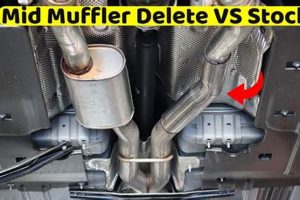
The modification in question involves removing the resonators located in the middle section of a specific high-performance vehicle’s exhaust system. This particular adaptation is typically executed on Dodge Challenger and Charger models bearing the “Hellcat” designation, primarily to alter the vehicle’s acoustic characteristics.
This alteration can offer benefits such as an increased exhaust volume, resulting in a more aggressive sound profile. Enthusiasts often pursue this modification to enhance the auditory feedback from the engine and to accentuate the car’s inherent performance capabilities. The practice has gained traction within the automotive community as a relatively straightforward method for achieving a noticeable change in the vehicle’s sound without requiring a complete exhaust system replacement.
The subsequent sections will delve into the potential impacts of such a modification on vehicle performance, regulatory compliance, and overall driving experience. These factors should be carefully considered before undertaking any exhaust system alterations.
Considerations Regarding Modification
The following points outline critical aspects to evaluate before undertaking the removal of the resonators from the specified exhaust system.
Tip 1: Acoustic Impact Assessment: The removal significantly amplifies exhaust noise. Prior to modification, evaluate whether the increased volume aligns with personal preference and complies with local noise ordinances. Understand the potential impact on residential areas and community standards.
Tip 2: Performance Evaluation: While some perceive an increase in horsepower, empirical evidence supporting significant gains is often lacking. Recognize that any performance alteration is likely minimal and may fall within the margin of error during dyno testing.
Tip 3: Legal Compliance Verification: Research and confirm adherence to all applicable state and local regulations pertaining to vehicle noise emissions. Non-compliance can result in fines or mandatory vehicle rectification.
Tip 4: Professional Installation Recommendation: While theoretically a straightforward process, proper welding and alignment are crucial. Engage a qualified exhaust technician to ensure correct installation, preventing leaks and potential damage to other vehicle components.
Tip 5: Resonator Retention Strategy: Consider retaining the removed resonators. This allows for potential reinstallation if the modified sound profile proves undesirable or if regulatory issues arise. Proper storage will preserve their condition for future use.
Tip 6: Drone Mitigation Measures: Resonator removal can introduce undesirable cabin drone at specific RPM ranges. Investigate potential drone mitigation strategies, such as aftermarket J-pipes or Helmholtz resonators, to address this issue if it arises.
Prudent consideration of these aspects will contribute to a more informed decision regarding the modification. A thorough understanding of the implications allows for a proactive approach to potential challenges.
The subsequent section will address the longer-term consequences and broader implications of this type of vehicle modification.
1. Acoustic Amplification
Acoustic amplification, in the context of removing the resonators from a Hellcat’s exhaust system, denotes the significant increase in the vehicle’s exhaust volume and the alteration of its sound characteristics. This modification directly affects the auditory experience, both for the driver and those in the surrounding environment. The extent and nature of this amplification are pivotal considerations for individuals contemplating this modification.
- Exhaust Note Modification
Removing the resonators results in a more aggressive and pronounced exhaust note. The vehicle emits a louder roar during acceleration and a deeper rumble at idle. This change in sound profile is the primary motivator for many individuals seeking this modification. The removal affects specific frequencies, typically enhancing the lower-end tones.
- Sound Pressure Level Increase
The decibel level emitted by the exhaust system rises substantially. This increase is measurable using sound level meters and is often the basis for determining compliance with local noise ordinances. The degree of increase varies depending on factors such as the presence of other exhaust components, including catalytic converters and mufflers.
- Cabin Resonance Enhancement
The absence of resonators can lead to increased resonance within the vehicle’s cabin, particularly at specific engine RPMs. This phenomenon, known as drone, can be perceived as an unpleasant and fatiguing auditory experience during prolonged driving. The intensity and frequency of the drone are influenced by vehicle design and exhaust system configuration.
- External Auditory Impact
The amplified sound carries further, potentially impacting residential areas and public spaces. This extended reach increases the likelihood of noise complaints and potential violations of noise regulations. The directionality and dispersion of the sound are affected by the exhaust system’s outlet configuration and the surrounding environment.
These facets of acoustic amplification highlight the complex interplay of sound characteristics resulting from the removal of resonators. While the modification can achieve a desired aggressive sound profile, it necessitates careful consideration of potential drawbacks, including regulatory compliance and cabin resonance. The magnitude and nature of the sound change should be thoroughly evaluated before proceeding with the alteration.
2. Perceived Performance
The notion of “perceived performance,” as it relates to resonator removal in the specified vehicle, centers on the subjective impression of enhanced vehicle capabilities following the modification. This perception often diverges from quantifiable performance metrics, influenced by auditory and psychological factors rather than objective data.
- Auditory Illusions
The increased exhaust volume contributes significantly to the perception of improved performance. The louder, more aggressive sound creates a psychological association with greater power and acceleration. This effect can overshadow actual, measured changes in horsepower or torque. The driver experiences a more visceral sensation, leading to the belief that the vehicle is performing at a higher level, irrespective of empirical validation.
- Placebo Effect
The inherent expectation of performance improvement, consciously or unconsciously, plays a role. The act of modifying the vehicle primes the driver to anticipate a change. This anticipation can alter their subjective assessment of the vehicle’s responsiveness and acceleration, even in the absence of substantial gains. The expectation itself becomes a contributing factor to the perceived improvement.
- Seat-of-the-Pants Feel
The change in exhaust note can alter the driver’s “seat-of-the-pants” feeling of acceleration. The louder sound provides more immediate auditory feedback, creating a stronger sensory connection to the engine. This heightened sensory input can be misinterpreted as an increase in power, even if the actual rate of acceleration remains largely unchanged. The immediacy of the sound enhances the perceived responsiveness of the vehicle.
- Dyno Test Discrepancies
While some may claim demonstrable performance gains based on dyno testing, such results should be scrutinized. Small variations in dyno readings can occur due to environmental conditions, testing procedures, and inherent dyno inaccuracies. The minimal gains often reported may fall within the margin of error and are unlikely to translate into a noticeable difference in real-world driving scenarios. Independent verification and controlled testing are necessary to validate any purported performance improvements.
In conclusion, the perceived performance enhancements associated with resonator removal are primarily driven by auditory illusions and psychological factors. While the modification may enhance the subjective driving experience, it is critical to distinguish between perceived gains and actual, measurable improvements in vehicle performance. Objectivity and critical evaluation are essential when assessing the true impact of this modification.
3. Legal Compliance
Legal compliance, in the context of resonator removal on high-performance vehicles, represents a critical intersection of vehicle modification and adherence to established noise regulations. The implications of non-compliance extend beyond potential fines, affecting vehicle operability and community standards.
- Federal Noise Standards
The Environmental Protection Agency (EPA) sets federal noise standards for newly manufactured vehicles. While these standards do not directly regulate modifications to existing vehicles, they establish a benchmark for acceptable noise levels. Modifications that significantly exceed these levels may attract scrutiny from regulatory bodies. Enforcement typically falls to state and local authorities, rendering federal guidelines indirectly relevant.
- State and Local Noise Ordinances
State and local jurisdictions enact noise ordinances that directly regulate vehicle noise emissions. These ordinances often specify maximum permissible decibel levels at prescribed distances from the vehicle. Enforcement mechanisms include roadside inspections, noise testing, and citations for violations. Regulations vary considerably across jurisdictions, necessitating thorough research prior to undertaking any exhaust modifications.
- Vehicle Inspection Requirements
Many states mandate periodic vehicle inspections, including assessments of exhaust system integrity and noise emissions. Modifications that result in excessive noise levels can lead to inspection failure, requiring rectification to achieve compliance. Inspection procedures may involve visual inspection of the exhaust system and measurement of sound levels using calibrated equipment.
- Community Noise Complaints
Even if a modification technically complies with legal limits, persistent noise complaints from community members can trigger investigations by local authorities. Authorities may conduct noise surveys and issue warnings or citations based on subjective assessments of noise nuisance. The threshold for what constitutes a noise nuisance can vary depending on the specific community and local ordinances.
The legal ramifications of resonator removal underscore the importance of informed decision-making. Prioritizing compliance with relevant noise regulations mitigates the risk of fines, vehicle impoundment, and community discord. Thorough research into applicable laws, coupled with responsible modification practices, ensures that vehicle enhancements do not infringe upon legal and social norms.
4. Installation Integrity
Installation integrity, in the context of resonator removal from a Hellcat’s exhaust system, refers to the soundness and correctness of the procedure by which the resonators are removed and the exhaust system is reconfigured. It is paramount to ensure the long-term reliability, safety, and performance of the vehicle post-modification.
- Weld Quality and Sealing
The integrity of the welds is critical. Improper welding can lead to exhaust leaks, which reduce engine performance, fuel efficiency, and can introduce harmful exhaust gases into the cabin. Example: Porous welds or incomplete weld penetration create weak points prone to failure under thermal stress and vibration. Implications include reduced power, increased fuel consumption, and potential health hazards.
- Pipe Alignment and Fitment
Precise alignment of exhaust pipes post-resonator removal is necessary to avoid stress on the exhaust system and its mounting points. Misalignment can cause premature wear, cracking, and potential damage to adjacent components. Example: Forcing misaligned pipes together can strain exhaust hangers and catalytic converters. Implications include exhaust leaks, reduced system lifespan, and potential damage to other vehicle components.
- Hanger Support and Vibration Control
Proper support through hangers is essential to mitigate vibrations and prevent excessive stress on the exhaust system. Inadequate support can result in fatigue failures of exhaust pipes and mounting points. Example: Failure to reinstall or reposition hangers after resonator removal can lead to increased vibration and potential breakage. Implications include exhaust leaks, increased noise, and eventual system failure.
- Clearance and Thermal Management
Adequate clearance between the modified exhaust system and other vehicle components is necessary to prevent heat transfer and potential damage. Insufficient clearance can lead to overheating of sensitive components, such as fuel lines or wiring harnesses. Example: Exhaust pipes positioned too close to fuel lines can cause fuel vaporization and potential fire hazards. Implications include fuel delivery problems, electrical malfunctions, and fire risk.
The discussed facets of installation integrity are vital to achieving a successful and safe resonator removal. Failure to adhere to proper installation techniques can negate any perceived benefits and introduce significant risks. A meticulous approach is required to ensure the modification does not compromise the vehicle’s long-term reliability or safety.
5. Reversibility
Reversibility, in the context of a mid-muffler deletion on a Hellcat exhaust system, denotes the ease and feasibility of restoring the vehicle’s exhaust configuration to its original, unmodified state. This consideration is paramount for owners who may later desire to undo the modification due to personal preferences, regulatory changes, or vehicle resale considerations.
- Component Preservation
Maintaining the integrity of the removed mid-muffler components is essential for reversibility. The original mufflers should be stored in a manner that prevents damage, corrosion, or distortion. Careful handling during removal and secure storage conditions ensure that the components remain viable for future reinstallation. Damage or loss of these components effectively eliminates the option for straightforward reversal.
- Welding Methodology
The method employed during the initial modification significantly impacts reversibility. A clean, precise cut and weld during the delete process allows for easier reinstallation. Conversely, sloppy or overly aggressive welding can damage the surrounding exhaust piping, complicating the restoration process. The use of flanges or slip-fit connectors, rather than direct welding, offers increased flexibility for future modifications and reversals.
- Availability of Original Hardware
Retaining all original clamps, gaskets, and mounting hardware is critical for a seamless reversal. These components are often specific to the vehicle and may be difficult or costly to replace. The absence of original hardware can necessitate the purchase of aftermarket replacements, potentially compromising the fit and seal of the restored exhaust system. Careful documentation of the removal process, including the location of all hardware, aids in the reinstallation process.
- Potential for Secondary Modifications
Additional modifications performed in conjunction with the mid-muffler delete can complicate reversibility. For example, altering the exhaust piping diameter or relocating exhaust hangers may require further modifications during the restoration process. A comprehensive understanding of all changes made to the exhaust system is essential for planning a successful reversal.
The ease with which a mid-muffler delete can be reversed directly impacts the long-term ownership experience of a Hellcat. By prioritizing component preservation, employing careful welding techniques, retaining original hardware, and minimizing secondary modifications, owners can ensure that the option to restore the vehicle to its original configuration remains viable.
6. Drone Potential
The removal of mid-mufflers on a Hellcat exhaust system introduces a heightened risk of undesirable cabin resonance, commonly termed “drone.” This phenomenon arises from the alteration of exhaust gas flow and the elimination of components specifically designed to dampen certain sound frequencies. The resonating frequencies generated by the engine and exhaust system are amplified, particularly within the cabin, at specific engine RPM ranges, creating an unpleasant and often fatiguing auditory experience for the vehicle occupants. This occurrence is not merely an aesthetic issue; prolonged exposure to low-frequency drone can induce driver distraction and discomfort.
Drone potential is inextricably linked to the design characteristics of both the exhaust system and the vehicle itself. The Hellcat, with its powerful engine and complex exhaust routing, is inherently susceptible to drone after mid-muffler deletion. For example, certain aftermarket exhaust systems designed for this vehicle incorporate Helmholtz resonators or J-pipes, which are tuned to counteract the specific frequencies that cause drone. In the absence of such mitigation measures, the unmodified exhaust system is more likely to produce significant cabin resonance. The practical significance of understanding drone potential lies in its impact on the overall driving experience and the need for informed decision-making prior to undertaking the modification. Owners must weigh the desired increase in exhaust volume against the potential for an increase in cabin drone.
In summary, the connection between mid-muffler deletion and drone potential is a critical consideration for Hellcat owners. The absence of resonators alters the exhaust sound profile, increasing the likelihood of undesirable cabin resonance. The implementation of drone mitigation strategies, such as the installation of tuned resonators or J-pipes, can significantly reduce this risk. A comprehensive understanding of the causes, effects, and potential remedies for drone is essential for achieving a satisfactory and comfortable driving experience post-modification.
Frequently Asked Questions
The following questions address common concerns and misconceptions regarding the removal of mid-mufflers on Dodge Challenger and Charger Hellcat models. The information provided is intended to offer a clear understanding of the potential implications of this modification.
Question 1: Does a mid-muffler delete increase horsepower on a Hellcat?
While some individuals report a perceived increase in power, empirical evidence supporting significant horsepower gains from a mid-muffler delete is often lacking. Dyno testing results may vary, and any gains are likely minimal and within the margin of error.
Question 2: Is a mid-muffler delete legal?
Legality depends on local and state noise ordinances. Many jurisdictions have regulations regarding vehicle noise emissions, and exceeding these limits can result in fines or citations. It is essential to research and comply with all applicable noise laws prior to undertaking this modification.
Question 3: Will a mid-muffler delete void the vehicle’s warranty?
Aftermarket modifications can potentially affect the vehicle’s warranty coverage. While a mid-muffler delete may not automatically void the entire warranty, it could void coverage for exhaust-related components or systems if the modification is deemed to have caused a failure. Consult the vehicle’s warranty documentation and a dealership representative for clarification.
Question 4: What is exhaust drone, and does a mid-muffler delete cause it?
Exhaust drone refers to an undesirable low-frequency resonance within the vehicle’s cabin, typically occurring at specific engine RPM ranges. Removing the mid-mufflers can increase the likelihood of drone, as these components are designed to dampen certain sound frequencies.
Question 5: Can a mid-muffler delete be reversed?
Reversing a mid-muffler delete is possible, provided the original mid-mufflers were preserved and the removal process was executed carefully. Reinstallation involves welding the mufflers back into the exhaust system, ensuring proper alignment and sealing.
Question 6: Is professional installation required for a mid-muffler delete?
While theoretically straightforward, proper welding and alignment are crucial for a successful and safe mid-muffler delete. Engaging a qualified exhaust technician is recommended to ensure correct installation, preventing leaks and potential damage to other vehicle components.
In summary, a mid-muffler delete on a Hellcat offers a louder exhaust note but carries potential implications for performance, legality, warranty coverage, and cabin resonance. Thorough research and careful consideration are essential before undertaking this modification.
The subsequent sections will further explore potential alternatives to this modification, offering different methods for achieving a desired exhaust sound profile.
Conclusion
The preceding analysis has meticulously examined the multifaceted aspects of a Hellcat mid muffler delete. It has clarified the potential acoustic enhancements, the subjective nature of perceived performance gains, and the critical importance of adhering to legal noise regulations. Furthermore, the exploration extended to the practical considerations of installation integrity, the feasibility of reversing the modification, and the likelihood of increased cabin drone. Each of these elements contributes to a comprehensive understanding of the ramifications associated with this specific alteration to the vehicle’s exhaust system.
The decision to proceed with a Hellcat mid muffler delete should be predicated upon a thorough assessment of individual priorities and a clear understanding of the potential consequences. Responsible modification practices demand a commitment to both personal enjoyment and societal well-being. Prioritizing compliance with applicable laws and minimizing potential disturbances to the community represent essential considerations for any vehicle enthusiast.