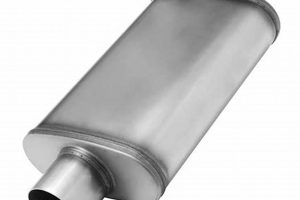
This particular type of exhaust component features a single, undivided resonating cavity. The design prioritizes simplicity, resulting in a relatively compact and lightweight unit. A typical application involves vehicles where minimal backpressure and cost-effectiveness are primary concerns. The device functions by allowing exhaust gases to expand within the chamber, altering their flow and reducing sound levels through destructive interference.
Its appeal lies in its ability to offer a noticeable change in exhaust note without significant expense. Historically, it has been a popular choice for performance enthusiasts seeking an aggressive sound profile. While offering sound dampening, it often prioritizes auditory enhancement over maximum noise reduction, leading to a louder exhaust note compared to multi-chamber alternatives. This characteristic makes it suitable for applications where a distinct engine sound is desirable.
The subsequent discussion will delve deeper into the acoustic principles governing the operation of this component, explore its practical applications in diverse automotive scenarios, and compare its performance characteristics with alternative exhaust system designs. Factors influencing the component’s efficiency, durability, and suitability for specific vehicle types will also be examined.
Optimizing Performance and Longevity
The following recommendations aim to maximize the operational effectiveness and lifespan of a single-chamber exhaust resonator. Adherence to these guidelines contributes to improved vehicle performance and reduces the likelihood of premature component failure.
Tip 1: Material Selection: When replacing an existing unit, prioritize stainless steel construction. This material provides superior resistance to corrosion, extending the lifespan of the component, particularly in environments exposed to road salt or extreme temperatures.
Tip 2: Proper Installation: Ensure correct alignment during installation. Misalignment can induce stress fractures and premature wear, leading to exhaust leaks and reduced performance. Utilize appropriate mounting hardware and torque specifications.
Tip 3: Regular Inspection: Conduct routine inspections for signs of corrosion, damage, or leaks. Early detection of these issues allows for timely repairs, preventing more significant problems and maintaining optimal sound characteristics.
Tip 4: Minimize Backpressure: Although this design inherently minimizes backpressure, ensure the entire exhaust system is free from obstructions. Excessive backpressure can negatively impact engine performance and potentially damage other engine components.
Tip 5: Sound Level Considerations: Be aware of local noise ordinances. While these components offer a distinct exhaust note, excessive noise can result in legal penalties. Consider supplementary resonators or sound-dampening materials if necessary.
Tip 6: Weld Integrity: For modified or custom exhaust systems, ensure all welds are performed by a qualified professional. Poor welding quality can result in leaks, vibration, and premature failure of the unit.
Following these guidelines can contribute significantly to the performance and longevity. Proactive maintenance and informed component selection are crucial for optimal results.
In conclusion, careful attention to these details ensures the component continues to deliver its intended performance characteristics while mitigating potential issues.
1. Simple Construction

The defining characteristic of a single-chamber exhaust resonator is its uncomplicated internal configuration, a feature directly responsible for several performance and cost-related outcomes. The absence of complex baffles or multiple resonating chambers translates to reduced manufacturing costs and a lighter overall unit weight. This simplicity influences sound attenuation, resulting in a more pronounced and aggressive exhaust note compared to multi-chamber designs. The directness of the exhaust path also contributes to minimized backpressure, potentially enhancing engine efficiency and horsepower output. Examples of this are frequently found in aftermarket performance exhaust systems for vehicles prioritizing auditory feedback and throttle response over maximum noise reduction. In race applications, the streamlined design offers a tangible weight advantage and minimizes potential flow restrictions.
The simplicity of construction also impacts installation and maintenance procedures. The fewer components involved simplify the welding and mounting processes, reducing labor time and the potential for fabrication errors. Furthermore, troubleshooting and repair are generally more straightforward due to the absence of intricate internal structures. However, this simplified design trades off some sound-dampening capabilities, necessitating careful consideration of noise regulations and personal preferences. Custom-built exhaust systems often benefit from the ease of integration afforded by the basic structure, allowing fabricators to tailor the system’s performance characteristics through modifications to pipe diameter and resonator placement.
In conclusion, the simple construction of a single-chamber exhaust resonator is a fundamental element influencing its cost, weight, sound characteristics, and installation requirements. While this simplicity offers advantages in terms of performance and ease of use, it also presents limitations in terms of noise control. Understanding these trade-offs is critical for selecting the appropriate exhaust component for a given application. Despite potential noise concerns, the straightforward design allows effective implementation in a variety of applications.
2. Aggressive Sound

The auditory characteristic often described as “aggressive sound” is a direct consequence of the design principles inherent in a single-chamber exhaust resonator. This exhaust component, characterized by its undivided internal chamber, offers minimal resistance to the flow of exhaust gases. The resulting effect is a less-muted, more pronounced emission of engine noise, amplifying specific frequencies and creating a distinct auditory profile. This louder and often deeper tone is achieved by reducing the internal baffling that is otherwise present in multi-chamber resonators designed for greater sound attenuation. A practical example is observed when comparing the sound of a vehicle equipped with a factory-installed multi-chamber resonator versus one fitted with a single-chamber alternative. The latter typically produces a significantly louder and more readily identifiable exhaust note. Thus, the aggressive sound is not merely an incidental byproduct but a defining attribute resulting from the components simplified internal structure.
The importance of this “aggressive sound” extends beyond mere auditory aesthetics. For some vehicle owners, it serves as an indicator of enhanced performance or a specific tuning profile. In motorsports, the characteristic sound assists drivers and spectators in identifying gear changes and engine load. However, the increased sound level necessitates careful consideration of local noise regulations. Applications in urban areas may require additional sound dampening measures to avoid legal infringements. Moreover, the aggressive sound profile can be perceived differently depending on the vehicle type and the intended application, demonstrating the contextual aspect of acoustic tuning. This distinctive feature is a key consideration when opting for this particular component.
Ultimately, the connection between the single-chamber exhaust resonator and the “aggressive sound” is one of deliberate design and consequence. While the simplified construction provides benefits in terms of cost and performance, it also results in a specific auditory signature that may be desirable or undesirable depending on individual preferences and regulatory constraints. Managing the aggressive sound requires awareness and implementation of suitable sound mitigation strategies if deemed necessary. The understanding of this component’s sonic output is crucial to ensure compliance with the legal requirements.
3. Minimal Backpressure

The design of a single-chamber exhaust resonator inherently facilitates minimal backpressure within the exhaust system. The undivided resonating cavity allows exhaust gases to flow with reduced obstruction compared to multi-chamber or baffled designs. This reduction in backpressure is a primary consideration for performance-oriented applications. The simplified internal structure diminishes the restrictions on exhaust flow, enabling more efficient evacuation of combustion byproducts from the engine cylinders. This improved scavenging can lead to enhanced volumetric efficiency, resulting in increased horsepower and torque output. A real-world example can be observed in high-performance vehicles where single-chamber resonators are often implemented to maximize engine output. The enhanced exhaust flow allows the engine to breathe more freely, translating into improved acceleration and responsiveness. The practical significance lies in the ability to realize performance gains without requiring extensive modifications to other engine components.
The relationship between a single-chamber resonator and minimal backpressure also impacts fuel efficiency, albeit to a lesser extent than performance. Reduced backpressure can contribute to slightly improved fuel economy by decreasing the engine’s workload during the exhaust stroke. The engine requires less energy to expel exhaust gases, freeing up power to be used for propulsion. This effect is most noticeable at higher engine speeds where the exhaust system is operating at its maximum capacity. Moreover, the decreased backpressure reduces the likelihood of exhaust gas recirculation (EGR) issues, preventing performance degradation and potential damage to emission control components. For instance, in forced-induction engines, reduced backpressure is particularly crucial as it minimizes the strain on the turbocharger or supercharger, improving their efficiency and prolonging their lifespan. The implementation benefits a vast array of vehicles and engine types.
In conclusion, the association between the single-chamber exhaust resonator and minimal backpressure is a deliberate design choice with significant implications for engine performance and, to a lesser degree, fuel efficiency. While the simplified design offers advantages in terms of exhaust flow, it is essential to consider potential trade-offs, such as increased noise levels. Understanding the practical consequences of minimal backpressure is crucial for selecting the appropriate exhaust system components and optimizing engine performance for specific applications. The challenges lie in balancing performance gains with noise considerations and adhering to emission regulations, thereby making informed design and configuration choices.
4. Cost-Effectiveness

The single-chamber exhaust resonator offers inherent cost-effectiveness stemming from its simplified design and reduced material requirements. The absence of complex internal baffling translates directly into lower manufacturing costs, impacting both the initial purchase price and potential replacement expenses. The reduced part count streamlines the production process, minimizing labor input and material wastage. This cost advantage makes it a particularly attractive option for budget-conscious consumers seeking aftermarket performance modifications or cost-effective replacements for original equipment components. A typical example involves budget restorations of classic cars, where affordability often outweighs the need for sophisticated sound dampening. The component provides a functional exhaust solution at a fraction of the price compared to more complex multi-chamber alternatives. The cost savings also extend to installation, as the simplified design reduces labor costs and facilitates easier integration into existing exhaust systems.
The cost-effectiveness of a single-chamber resonator impacts several downstream decisions. For instance, vehicle owners might opt for a complete exhaust system upgrade involving this component due to the overall budget-friendliness of the system. The savings can be reinvested in other performance enhancements or maintenance items. Furthermore, the reduced replacement cost encourages proactive maintenance, as replacing a worn-out single-chamber unit poses less of a financial burden than replacing a more expensive and complex alternative. Budget-minded racing teams often use this component as a means of reducing operational costs. However, the consideration of sound levels remains crucial despite the cost benefits. Certain noise-sensitive environments or regulations may require the addition of supplementary sound-dampening devices, thereby potentially offsetting some of the initial cost savings.
In summary, the cost-effectiveness of a single-chamber exhaust resonator is a substantial factor driving its popularity, particularly in scenarios where budget constraints are a primary concern. While other designs may offer superior sound attenuation or performance characteristics, the affordability of the single-chamber resonator provides a compelling value proposition. This value, however, must be balanced against potential compromises in sound control. Challenges lie in optimizing the design to achieve a desirable balance between cost, performance, and noise levels, ensuring that the component meets both economic and functional requirements. The affordability contributes to its accessibility for wider consumer bases.
5. Compact Size
The dimensional attribute of “Compact Size” holds considerable significance in the context of a single-chamber exhaust resonator. Its relevance stems from the spatial constraints often encountered during vehicle design and modification, impacting installation feasibility and overall vehicle configuration. This aspect influences not only the ease of integration but also the potential for weight reduction and optimized vehicle packaging.
- Vehicle Integration
A smaller footprint facilitates easier integration into vehicles with limited undercarriage space. Examples include sports cars, compact vehicles, and motorcycles, where available room for exhaust components is often restricted. The streamlined dimensions of the resonator allows for greater flexibility in exhaust system routing, accommodating various chassis designs and avoiding interference with other critical vehicle components. The implications include simplified installation procedures and increased compatibility across a wider range of vehicles.
- Weight Reduction
Reduced dimensions often correlate with a lighter overall weight. This weight reduction contributes to improved vehicle performance, enhancing acceleration, braking, and handling characteristics. In motorsport applications, even minor weight savings can yield a competitive advantage. For example, a lightweight resonator can contribute to a more favorable power-to-weight ratio, resulting in quicker lap times and improved overall vehicle agility. The implications encompass improved fuel efficiency and enhanced driving dynamics.
- Design Flexibility
The smaller form factor enables greater flexibility in exhaust system design. This allows engineers and custom fabricators to optimize exhaust flow and sound characteristics without being unduly constrained by physical size limitations. For instance, a compact resonator can be positioned closer to the engine or rear axle, influencing the overall exhaust note and scavenging effects. The improved design allows for increased customization options and enhanced performance tuning capabilities.
- Material Efficiency
A smaller size generally necessitates less material in construction, translating to reduced manufacturing costs and resource consumption. This aligns with principles of sustainable design and promotes cost-effective production practices. For example, a smaller resonator requires less stainless steel or other construction materials, minimizing waste and reducing the environmental impact of the manufacturing process. The implications are environmentally responsible production and reduced overall cost.
In conclusion, the “Compact Size” of a single-chamber exhaust resonator is a multifaceted attribute impacting vehicle integration, weight reduction, design flexibility, and material efficiency. This characteristic enhances installation, reduces weight, provides more design options, and reduces waste while providing performance benefits. The interplay between these facets underscores the importance of considering dimensional constraints when selecting exhaust components for specific applications.
6. Lightweight Design

The reduced mass of a single-chamber exhaust resonator directly correlates with its simplified internal structure. The absence of multiple chambers, baffles, and intricate sound-dampening elements contributes significantly to a lower overall weight compared to multi-chamber alternatives. This lightweight design influences vehicle dynamics, enhancing acceleration, braking performance, and handling characteristics. Examples include applications in motorsports, where even small weight reductions can translate to measurable improvements in lap times. A lighter exhaust system reduces the vehicle’s inertia, allowing for quicker changes in direction and improved responsiveness to driver inputs. Furthermore, reduced weight contributes to enhanced fuel efficiency by decreasing the overall energy required to propel the vehicle. The significance lies in its potential to improve driving performance.
The implementation of lightweight materials further augments the weight-saving benefits. Utilizing materials such as titanium or thin-gauge stainless steel in the construction of the single-chamber resonator can yield even more substantial weight reductions. These advanced materials offer high strength-to-weight ratios, enabling the creation of durable and lightweight components. In the aftermarket performance industry, these lightweight resonators are often marketed as a means of improving vehicle performance and handling. The benefits extend beyond performance; reduced weight also contributes to decreased stress on suspension components, potentially prolonging their lifespan. Practical applications are widespread in the automotive and motorcycle industries, where weight optimization is a constant pursuit.
In summary, the lightweight design inherent in a single-chamber exhaust resonator provides tangible benefits in terms of vehicle performance, fuel efficiency, and handling. By minimizing mass through simplified construction and the use of lightweight materials, this type of exhaust component offers a cost-effective means of improving overall vehicle dynamics. Balancing the benefits of lightweight design with durability requirements and noise attenuation remains a key challenge. Understanding these trade-offs enables informed decision-making in the selection and implementation of exhaust system components, and provides for enhanced vehicle control and fuel usage.
7. Performance Enhancement
The single-chamber exhaust resonator, through its design characteristics, directly influences aspects of engine performance. The connection between this component and potential performance gains is primarily attributed to the reduction in exhaust backpressure. The simplified, undivided chamber offers minimal restriction to the flow of exhaust gases, enabling more efficient expulsion of combustion byproducts from the engine cylinders. This improved exhaust flow can lead to enhanced volumetric efficiency, resulting in increased horsepower and torque output. A clear example is found in naturally aspirated engines where minimizing backpressure is crucial for maximizing power output across the RPM range. By facilitating a more efficient scavenging process, the single-chamber resonator allows the engine to breathe more freely, thereby improving overall performance. Its role in the exhaust stream directly effects combustion dynamics within the engine itself, creating noticeable change in power delivery.
This performance enhancement is further amplified when the single-chamber resonator is incorporated into a well-designed exhaust system. The effectiveness is optimized when paired with appropriately sized exhaust piping and a free-flowing catalytic converter, further reducing restrictions in the exhaust pathway. Conversely, using the resonator in conjunction with undersized exhaust piping can negate many of its benefits. In turbocharged engines, a single-chamber resonator is often preferred to minimize backpressure on the turbine, allowing for quicker spool-up and improved boost response. However, this potential for performance enhancement must be balanced against the corresponding increase in exhaust noise, ensuring compliance with legal regulations. Applications in vehicles used on public roads necessitate careful consideration of noise levels and potential mitigation strategies.
In conclusion, the link between the single-chamber exhaust resonator and performance enhancement is predicated on its ability to minimize exhaust backpressure and facilitate efficient scavenging. While this design offers potential power gains, it is essential to consider the interplay between the resonator and other exhaust system components, as well as the impact on noise levels. The practical application lies in its strategic use for improving engine responsiveness. Balancing performance gains with noise reduction is a significant challenge and the focus in the practical implementation of a system with optimized overall engine functionality.
Frequently Asked Questions Regarding Single-Chamber Exhaust Resonators
The following section addresses common inquiries and clarifies misconceptions surrounding the implementation and performance characteristics of a single-chamber exhaust resonator. The information provided aims to offer a comprehensive understanding of this exhaust component.
Question 1: Does a single-chamber exhaust resonator guarantee a power increase?
No. While the reduced backpressure associated with a single-chamber design can potentially improve engine performance, the actual power increase depends on several factors, including the engine’s inherent characteristics, the design of the entire exhaust system, and the effectiveness of the engine management system.
Question 2: Are single-chamber exhaust resonators excessively loud?
Single-chamber exhaust resonators tend to produce a more aggressive exhaust note compared to multi-chamber designs. The loudness level is subjective and depends on the specific unit and vehicle. Compliance with local noise regulations must be verified and maintained.
Question 3: Can a single-chamber exhaust resonator be used on any vehicle?
The suitability of a single-chamber exhaust resonator depends on the vehicle’s intended use, noise level restrictions, and space constraints. While it can be physically installed on many vehicles, careful consideration of these factors is crucial to ensure optimal performance and compliance.
Question 4: Is the material of construction important for a single-chamber exhaust resonator?
Yes. The material significantly impacts durability and longevity. Stainless steel is preferred due to its superior resistance to corrosion, particularly in environments exposed to road salt or extreme temperatures.
Question 5: How does a single-chamber exhaust resonator affect fuel economy?
While the reduced backpressure can potentially improve fuel economy slightly, the effect is often minimal. Any gains are most noticeable at higher engine speeds and under load, but it is also worth noting that driving style often plays a larger role.
Question 6: What maintenance is required for a single-chamber exhaust resonator?
Regular inspections for corrosion, damage, and leaks are essential. Prompt repairs prevent more significant issues. The integrity of the mounting hardware and welds should also be periodically checked.
In summary, the effective utilization of a single-chamber exhaust resonator necessitates a comprehensive understanding of its performance characteristics, material considerations, and maintenance requirements. Adherence to best practices ensures optimal results.
The following section will explore alternative exhaust system designs and their respective advantages and disadvantages relative to the single-chamber configuration.
Conclusion
The preceding analysis has comprehensively explored the characteristics, benefits, and limitations of the one chamber muffler. Its simplified design offers advantages in cost-effectiveness, weight reduction, and minimal backpressure, rendering it a suitable option for applications prioritizing these factors. The resulting aggressive sound profile, however, necessitates careful consideration of noise regulations and individual preferences. The components suitability is highly context-dependent, requiring informed evaluation of specific vehicle requirements and performance objectives.
Ultimately, the efficacy of the one chamber muffler lies in its judicious application. Further research into advanced materials and acoustic dampening technologies may mitigate current limitations, expanding its utility across a broader range of vehicles and performance scenarios. Understanding the inherent trade-offs remains paramount for optimizing exhaust system design and achieving desired performance characteristics. The future success hinges on innovation.