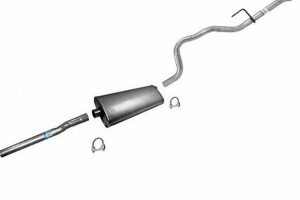
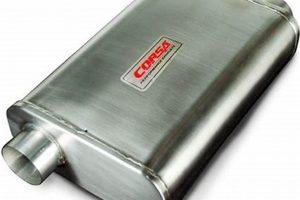
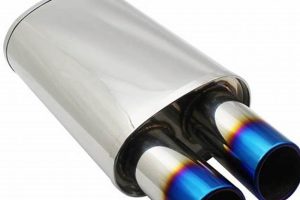
A component utilized in automotive exhaust systems secures the muffler to the vehicle’s undercarriage. It typically consists of a band or strap, often made of metal, that encircles the muffler. A tightening mechanism, such as a bolt or clamp, is integrated to fasten the strap, holding the muffler in place. An example would be its use after a vehicle’s exhaust system repair where original fasteners are damaged or missing.
Proper functioning of this component is important for preventing excessive vibration and noise from the exhaust system. It also helps maintain the exhaust system’s structural integrity, preventing premature wear and potential damage to other vehicle components. Historically, these components were simple metal bands; modern iterations often incorporate rubber or other materials to dampen vibrations and resist corrosion, improving longevity and performance.
The following sections will detail types of these components, installation procedures, common problems encountered, and maintenance practices that help ensure optimal exhaust system operation.
Guidance on Securing Exhaust Systems
This section provides crucial guidance for ensuring a secure and properly functioning exhaust system attachment. Proper installation and maintenance are essential for vehicle safety and performance.
Tip 1: Select the Appropriate Component. Verify the component’s size and material compatibility with the specific muffler and vehicle model. Using the wrong size or material can lead to premature failure and exhaust leaks.
Tip 2: Inspect for Corrosion. Before installation, thoroughly inspect the component for any signs of rust or corrosion. Replace any part exhibiting damage to ensure a secure and lasting hold.
Tip 3: Proper Positioning is Crucial. Position the component correctly around the muffler, ensuring it aligns with the designated mounting points on the vehicle. Misalignment can cause stress on the exhaust system and lead to premature wear.
Tip 4: Use Appropriate Torque. When tightening the fastener, adhere to the manufacturer’s recommended torque specifications. Over-tightening can damage the component or the muffler, while under-tightening can lead to loosening and failure.
Tip 5: Vibration Dampening. Consider using components with integrated vibration dampening materials or adding separate dampening pads to minimize noise and prevent wear due to vibration.
Tip 6: Regular Inspection. Periodically inspect the component for signs of loosening, corrosion, or damage. Early detection allows for timely replacement and prevents more significant exhaust system problems.
Tip 7: Professional Installation. For complex installations or if unsure about the process, seek professional assistance from a qualified mechanic. Improper installation can compromise safety and performance.
Adhering to these guidelines ensures that the exhaust system is securely attached, contributing to vehicle safety, performance, and reduced noise pollution.
The subsequent sections will address common issues, troubleshooting techniques, and preventative measures for maintaining optimal exhaust system health.
1. Material Durability

Material durability is a primary factor determining the service life and reliability of components securing exhaust systems. The harsh operating environment subjects these parts to extreme temperatures, corrosive road salts, and constant vibration, necessitating robust material selection.
- Corrosion Resistance
The selection of materials inherently resistant to corrosion is paramount. Stainless steel and specialized alloys are frequently employed to combat the effects of road salt and moisture, preventing degradation that can lead to premature failure. The use of inferior materials accelerates corrosion, compromising the component’s structural integrity and the security of the exhaust system.
- Tensile Strength
Sufficient tensile strength is necessary to withstand the forces exerted by the exhaust system’s weight and vibrations. High-strength steel alloys provide the required resistance to deformation and fracture under stress. Components with inadequate tensile strength may stretch or break, leading to exhaust leaks or detachment of the muffler.
- Thermal Stability
Exhaust systems operate at elevated temperatures, requiring materials that maintain their mechanical properties under thermal stress. Components made from materials with poor thermal stability may weaken or distort, reducing their effectiveness. The use of high-temperature alloys ensures consistent performance across the exhaust system’s operating temperature range.
- Fatigue Resistance
Constant vibration and cyclical temperature changes can induce fatigue in the component’s material. High-quality materials with excellent fatigue resistance can withstand these repetitive stresses without cracking or failing. Poor fatigue resistance leads to stress fractures and premature component failure, potentially causing damage to other vehicle systems.
These considerations underscore the significance of material durability in ensuring the secure and reliable operation of exhaust systems. The selection of appropriate materials directly impacts the lifespan of the securing components, reducing the risk of costly repairs and potential safety hazards.
2. Size Compatibility

The dimensional conformity between an exhaust securing component and the muffler it is intended to support is crucial for proper function and system longevity. Mismatched dimensions can lead to compromised performance, accelerated wear, and potential system failure.
- Diameter Matching
The strap or band portion must correspond precisely to the outer diameter of the muffler. Oversized components provide inadequate clamping force, allowing movement and promoting leaks. Undersized components may be forced into place, causing stress and potential damage to the muffler casing. Precise diameter matching ensures uniform pressure distribution and secure retention.
- Length Accommodation
If the design incorporates a band, its length needs to accommodate the mounting points on the vehicle’s chassis. An insufficient length prevents proper attachment, while an excessive length can interfere with other vehicle components or create opportunities for snagging. Appropriate length facilitates a secure and unobtrusive installation.
- Fastener Capacity
The tightening mechanism, such as a bolt or clamping device, must possess sufficient adjustability to accommodate slight variations in muffler diameter or vehicle mounting point tolerances. Limited adjustability can hinder proper tensioning, resulting in a loose or improperly secured connection. Adequate fastener capacity provides a secure and adaptable attachment.
- Material Thickness Consideration
The material thickness influences its ability to conform to the muffler’s surface. Excessively thick material may not adequately conform to curved surfaces, reducing contact area and clamping force. Insufficient thickness may result in deformation under pressure, compromising the connection’s integrity. Optimal material thickness balances conformity and structural strength.
These dimensional considerations highlight the integral role of size compatibility in the proper application of these components. Accurate sizing facilitates secure, vibration-resistant exhaust system attachment, contributing to vehicle safety and regulatory compliance regarding noise emissions.
3. Clamping Force
Clamping force, in the context of a muffler strap clamp, represents the compressive force exerted by the clamp onto the muffler’s outer surface. This force is pivotal in maintaining a secure connection between the muffler and the vehicle’s exhaust system, preventing unwanted movement and potential dislodgement. Insufficient clamping force allows for slippage and vibration, which can lead to exhaust leaks, increased noise, and eventual damage to the exhaust system components. Conversely, excessive clamping force can deform or crush the muffler casing, creating stress points and shortening its lifespan. A common example is observed when replacing a rusted-out clamp; the new clamp must apply sufficient pressure to hold the muffler securely without damaging it.
The magnitude of the applied force is influenced by several factors, including the clamp’s design, the material properties of both the clamp and the muffler, and the torque applied during installation. The design dictates how force is distributed. Materials with high coefficients of friction contribute to a stronger hold with less applied torque. Overtightening, even with a properly sized clamp, can damage the muffler or distort the clamp itself, reducing its effectiveness over time. In contrast, under-tightening fails to create adequate friction, leaving the system prone to loosening due to vibration.
Therefore, understanding and controlling the clamping force is paramount for effective and long-lasting exhaust system repairs. Proper installation techniques, torque specifications, and regular inspections are crucial to ensure that the system functions as intended. Failure to address this critical aspect can compromise the vehicle’s performance, increase noise pollution, and lead to costly maintenance issues. Prioritizing controlled clamping force during installation and maintenance is essential to a successful exhaust system implementation.
4. Vibration Resistance
Vibration resistance is a critical performance characteristic influencing the longevity and reliability of exhaust system securing mechanisms. The ability to withstand vibrational forces directly impacts the operational effectiveness of components designed to maintain the exhaust system’s integrity.
- Material Damping Properties
The inherent ability of a material to absorb and dissipate vibrational energy is fundamental to vibration resistance. Components made from materials with high damping coefficients reduce the transmission of vibrational forces throughout the exhaust system. For example, incorporating rubber or polymer insulators can significantly reduce the impact of engine vibrations on the clamping mechanism, preventing fatigue and loosening over time. This material selection directly affects the clamp’s long-term performance.
- Joint Design and Integrity
The design of the joints and connections within the securing component significantly affects its ability to withstand vibration. Secure and properly tightened joints minimize play and movement, reducing the amplification of vibrational forces. A well-designed component will distribute stress evenly, preventing localized stress concentrations that can lead to failure. Loose or poorly designed joints exacerbate vibration-induced wear.
- Clamping Force Stability
The ability to maintain consistent clamping force under vibrational conditions is crucial for preventing loosening and subsequent component failure. Vibrations can cause fasteners to loosen over time, reducing the effectiveness. Designs incorporating locking mechanisms or self-tightening features help maintain the necessary clamping force, ensuring secure retention of the muffler. Loss of clamping force results in increased vibration and accelerated wear.
- Resonance Frequency Avoidance
Exhaust systems exhibit natural resonant frequencies, and if the component’s design coincides with these frequencies, it can amplify vibrations. Effective designs avoid these resonance frequencies through material selection, shape optimization, or the incorporation of damping elements. By minimizing resonance effects, the component’s vibration resistance is enhanced, prolonging its service life.
These interconnected factors underscore the complex relationship between vibration resistance and securing devices. Prioritizing these design and material considerations ensures enhanced component reliability, reduced noise, and extended exhaust system lifespan.
5. Corrosion Protection

Corrosion protection is a paramount consideration in the design and material selection of muffler strap clamps. These components are exposed to harsh environmental conditions, including moisture, road salt, and extreme temperatures, all of which accelerate corrosive processes. The long-term integrity and functionality of these devices directly depend on their ability to resist degradation caused by corrosion.
- Material Selection
The choice of materials is the first line of defense against corrosion. Stainless steel alloys, known for their inherent resistance to oxidation, are frequently employed in the manufacture of muffler strap clamps. Alternative materials may include coated steel, where a protective layer such as zinc or aluminum is applied to prevent direct contact between the steel and corrosive elements. The effectiveness of the chosen material dictates the lifespan of the component.
- Protective Coatings
In addition to base material selection, supplemental protective coatings can enhance corrosion resistance. These coatings, often applied through electroplating, galvanizing, or powder coating processes, create a barrier that shields the underlying material from corrosive agents. The integrity of the coating, including its thickness and adhesion, is critical to its effectiveness. Damage to the coating, such as scratches or chips, can compromise the protection and initiate localized corrosion.
- Design Considerations
Design features can also play a role in mitigating corrosion. Designs that minimize crevices and sharp edges reduce the accumulation of moisture and debris, which can promote corrosion. Drainage holes can facilitate the removal of water and contaminants, preventing prolonged exposure to corrosive environments. Attention to design details can significantly extend the service life of the clamp.
- Regular Maintenance
Even with robust corrosion protection measures, regular inspection and maintenance are essential. Periodic cleaning to remove accumulated salt and debris can prevent the onset of corrosion. The application of protective sprays or coatings can further enhance corrosion resistance, particularly in regions with severe winter weather. Proactive maintenance practices complement the inherent corrosion resistance of the component.
The multifaceted approach to corrosion protection, encompassing material selection, protective coatings, design considerations, and regular maintenance, is essential for ensuring the long-term reliability of muffler strap clamps. Neglecting corrosion protection can lead to premature failure of the clamps, resulting in exhaust system leaks, increased noise, and potential safety hazards. Prioritizing corrosion resistance is crucial for maintaining vehicle performance and regulatory compliance.
6. Installation Integrity

The effectiveness and longevity of a muffler strap clamp are inextricably linked to the integrity of its installation. A properly installed component ensures secure attachment, optimal exhaust system performance, and minimized risk of premature failure. Conversely, substandard installation practices can negate the benefits of even the highest-quality clamps.
- Correct Positioning and Alignment
Precise positioning and alignment of the clamp are critical for uniform pressure distribution. Misalignment can create stress concentrations, leading to deformation or cracking of the muffler casing. For example, failing to center the clamp over the designated mounting points can result in uneven clamping force, causing exhaust leaks or premature wear. Proper alignment ensures the clamp functions as intended, distributing force evenly across the muffler’s surface.
- Torque Specification Adherence
Applying the correct torque to the clamp’s fastener is essential for achieving the appropriate clamping force. Under-tightening allows for movement and vibration, leading to loosening and potential detachment. Over-tightening can damage the clamp or the muffler, compromising the connection’s integrity. Adhering to manufacturer-specified torque values ensures optimal clamping force without risking damage to the components. This often involves using a calibrated torque wrench.
- Hardware Compatibility and Condition
Using compatible and undamaged hardware is crucial for a secure and reliable installation. Substituting incorrect bolts or nuts can result in improper clamping force or thread failure. Similarly, using corroded or damaged hardware compromises the connection’s strength and longevity. Replacing worn or damaged hardware ensures a secure and durable installation, preventing premature failure of the clamp.
- Surface Preparation and Cleanliness
Ensuring the contact surfaces between the clamp and the muffler are clean and free from debris is important for achieving a secure connection. Dirt, rust, or other contaminants can reduce friction and prevent the clamp from achieving optimal clamping force. Cleaning the surfaces with a wire brush or solvent removes contaminants, allowing for direct contact between the clamp and the muffler, enhancing the connection’s security.
These interconnected elements highlight the critical role of installation integrity in maximizing the performance and lifespan of a muffler strap clamp. Even the most robust component will fail prematurely if installed improperly. Conversely, meticulous installation practices can enhance the performance and longevity of a clamp, ensuring a secure and reliable exhaust system attachment. Therefore, attention to detail during installation is paramount.
Frequently Asked Questions
The following questions address common concerns and provide information regarding muffler strap clamps, essential components for exhaust system security.
Question 1: What is the primary function of a muffler strap clamp?
The primary function is to secure the muffler to the vehicle’s exhaust system, preventing excessive movement, vibration, and potential detachment. It maintains the structural integrity of the exhaust system.
Question 2: What materials are commonly used in manufacturing muffler strap clamps?
Common materials include stainless steel, coated steel (e.g., zinc-plated), and aluminized steel. Stainless steel offers superior corrosion resistance, while coated steels provide a cost-effective alternative.
Question 3: How do I determine the correct size of the clamp for my vehicle?
The correct size is determined by the outer diameter of the muffler and the mounting point configuration on the vehicle’s chassis. Consult the vehicle’s service manual or a parts catalog for specific size requirements.
Question 4: What happens if the clamp is over-tightened during installation?
Over-tightening can deform the muffler casing, damage the clamp itself, or strip the threads of the fastener. This weakens the connection and can lead to premature failure and exhaust leaks.
Question 5: How often should muffler strap clamps be inspected and/or replaced?
Inspections should be conducted during routine vehicle maintenance, typically every 12 months or 12,000 miles. Replacement is recommended if signs of corrosion, damage, or loosening are observed.
Question 6: Can I use a generic clamp instead of a model-specific clamp?
While generic clamps may appear compatible, model-specific clamps are engineered to match the exact dimensions and mounting requirements of the vehicle. Using a generic clamp can compromise the security and longevity of the exhaust system.
Properly functioning muffler strap clamps are critical for vehicle safety and noise reduction. Regular inspection and timely replacement are essential for maintaining exhaust system integrity.
The next section will address common issues encountered with these components and provide troubleshooting guidance.
Concluding Remarks on Muffler Strap Clamps
This examination has elucidated the critical role a properly functioning securing device plays in exhaust system integrity. Material durability, precise sizing, adequate clamping force, vibration resistance, corrosion protection, and meticulous installation are paramount. Any compromise in these elements directly affects vehicle performance, safety, and regulatory compliance regarding noise emissions.
Given the significant consequences of component failure, diligent inspection, adherence to manufacturer specifications, and prompt corrective action are not merely recommended but essential. The continued development of advanced materials and innovative designs promises further improvements in component reliability and longevity, thereby enhancing vehicle safety and minimizing environmental impact.