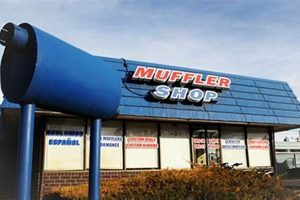
An establishment focused on the repair, replacement, and maintenance of vehicle exhaust systems. These businesses specialize in components such as mufflers, exhaust pipes, catalytic converters, and related hardware. For example, many automobiles experiencing increased engine noise or reduced fuel efficiency may benefit from a visit to this type of service provider.
These shops play a crucial role in ensuring vehicles operate within legal noise emission standards and contribute to improved air quality through proper functioning of exhaust control devices. Historically, they emerged alongside the growth of the automotive industry and have adapted to changing emission regulations and vehicle technologies. The services offered are essential for maintaining vehicle performance, safety, and environmental compliance.
The following discussion will delve into various aspects of vehicle exhaust systems, common issues addressed by these specialized businesses, and considerations for selecting a suitable service provider. This exploration aims to provide a comprehensive understanding of the services and expertise involved in maintaining this vital aspect of vehicle operation.
Essential Vehicle Exhaust System Maintenance
Maintaining a vehicle’s exhaust system is crucial for optimal performance, fuel efficiency, and environmental responsibility. The following guidelines offer practical advice for preserving the integrity of this essential component.
Tip 1: Regular Visual Inspections: Conduct periodic visual checks of the exhaust system for signs of rust, leaks, or physical damage. Early detection of these issues can prevent more extensive and costly repairs.
Tip 2: Listen for Unusual Noises: Pay attention to changes in exhaust sounds. Excessive roaring, hissing, or rattling noises may indicate problems such as a hole in the muffler or a loose connection.
Tip 3: Monitor Fuel Efficiency: A decrease in fuel economy can be an indicator of exhaust system issues, particularly a malfunctioning catalytic converter. Investigate any significant drop in mileage.
Tip 4: Promptly Address Rust: Rust is a primary enemy of exhaust systems. Treat any surface rust as soon as it is detected to prevent it from spreading and weakening the components.
Tip 5: Ensure Proper Mounting: Check the exhaust system’s mounting points to ensure all hangers and brackets are secure. Loose or broken mounts can lead to excessive vibration and premature wear.
Tip 6: Consider Catalytic Converter Health: Catalytic converters are critical for emissions control. If a vehicle fails an emissions test or displays symptoms of converter failure (e.g., poor performance, engine misfires), seek professional diagnosis.
Regular maintenance of the exhaust system contributes significantly to a vehicle’s overall health and lifespan, while also ensuring compliance with environmental regulations. Proactive care can prevent costly repairs and maintain optimal performance.
With these practices established, the subsequent section will review common vehicle exhaust repairs.
1. Exhaust System Repair

Exhaust system repair constitutes a foundational service offering within the operational framework of establishments specializing in vehicle exhaust systems. The degradation or failure of exhaust components, such as mufflers, pipes, or catalytic converters, directly precipitates the need for repair services at such facilities. The cause-and-effect relationship is evident: damage to these components results in noise pollution, reduced engine efficiency, and potential violations of emission regulations, thereby necessitating professional intervention. As a core function, repair services directly sustain the primary purpose of these establishments.
Consider a scenario where a vehicle’s muffler develops a significant rust perforation. The increased noise level prompts the vehicle owner to seek assistance. The repair typically involves either patching the affected area or, more commonly, replacing the entire muffler. Another example includes a catalytic converter that has become clogged or damaged, leading to reduced engine performance and potential failure to meet emissions standards. Specialized shops diagnose the issue and perform the necessary replacement to restore proper functionality and regulatory compliance. The availability of expertise in welding, cutting, and component replacement is central to performing these repairs effectively.
In summary, exhaust system repair is inextricably linked to the existence and operational mandate of these specialized businesses. The ability to diagnose and rectify exhaust-related issues ensures vehicles operate within legal and environmental parameters, maintaining performance and minimizing pollution. Challenges lie in adapting to increasingly complex vehicle designs and evolving emission control technologies. As such, ongoing training and investment in specialized equipment are crucial for shops to continue effectively addressing the repair needs of the modern vehicle fleet.
2. Muffler Replacement

Muffler replacement is intrinsically linked to the fundamental purpose of establishments specializing in vehicle exhaust systems. A malfunctioning or deteriorated muffler directly necessitates replacement, creating a core demand fulfilled by such businesses. The connection is a clear cause-and-effect: as mufflers age or sustain damage (e.g., rust, impact), their noise reduction capabilities diminish, leading to increased sound pollution and potential legal ramifications. This creates a need for specialized services. These businesses provide the expertise and components necessary to restore a vehicle’s exhaust system to proper functioning.
Consider a scenario where an automobile’s muffler has corroded internally due to prolonged exposure to moisture and exhaust gases. The resulting increase in exhaust noise prompts the vehicle owner to seek a remedy. A shop specializing in exhaust systems offers a direct solution through muffler replacement, involving the removal of the damaged component and the installation of a new, compatible muffler. Another instance involves a muffler damaged by road debris. The resulting structural compromise leads to both increased noise and potentially hazardous exhaust leaks. The ability to correctly identify and address these specific issues is central to the service provided.
In summary, muffler replacement constitutes a critical function within establishments dedicated to vehicle exhaust systems. The effective diagnosis and execution of muffler replacements are essential for maintaining vehicle compliance with noise regulations and ensuring a quieter operational environment. Future challenges may involve adapting to new vehicle designs and materials, requiring continued investment in training and specialized equipment to effectively address the evolving needs of muffler replacements.
3. Custom Exhaust Fabrication
Custom exhaust fabrication represents a specialized service often offered by establishments such as Road Runner Muffler Shop. It involves designing and constructing exhaust systems tailored to meet specific performance, aesthetic, or functional requirements beyond the capabilities of standard, off-the-shelf components. This service caters to vehicle owners seeking to optimize engine performance, alter exhaust sound characteristics, or accommodate unique vehicle modifications.
- Performance Enhancement
Custom fabrication allows for optimization of exhaust flow dynamics, potentially increasing horsepower and torque. This is achieved through careful selection of pipe diameter, bend radius, and muffler design. For example, a performance enthusiast might request a custom system with larger diameter pipes and a high-flow muffler to reduce backpressure and improve engine breathing. The result is often increased acceleration and improved throttle response. These performance enhancement often lead to higher engine efficiency too.
- Sound Modification
Vehicle owners may desire a specific exhaust note that differs from the factory sound. Custom fabrication provides the ability to create exhaust systems that produce a deeper, more aggressive tone or a quieter, more refined sound. This involves selecting mufflers and resonators with specific acoustic properties. A client might request a system that minimizes drone at highway speeds while providing an aggressive sound during acceleration.
- Unique Vehicle Fitment
Custom fabrication is essential when dealing with heavily modified vehicles or those with custom chassis configurations. Standard exhaust systems may not be compatible with such vehicles, necessitating a bespoke solution. For instance, a classic car undergoing a modern engine swap might require a completely custom exhaust system to accommodate the new engine and fit within the constraints of the original chassis.
- Aesthetic Customization
Some vehicle owners seek to enhance the visual appeal of their vehicle through a custom exhaust system. This can involve selecting specific exhaust tip styles, pipe finishes, and overall system routing to create a visually striking appearance. For example, a client might request a polished stainless steel exhaust system with quad exhaust tips to complement the overall design of their vehicle.
The ability to provide custom exhaust fabrication distinguishes Road Runner Muffler Shop from establishments that only offer standard replacement parts and services. It requires specialized equipment, skilled technicians, and a thorough understanding of exhaust system design principles, making it a valuable offering for vehicle owners with specific needs and preferences.
4. Catalytic Converter Service
Catalytic converter service is a critical component of operations within establishments such as Road Runner Muffler Shop. It addresses the essential function of emission control in vehicles, directly influencing environmental compliance and vehicle performance. The following explores key facets of this service within the context of such a shop.
- Functionality and Role
Catalytic converters serve to reduce harmful pollutants emitted from a vehicle’s exhaust system, converting them into less harmful substances. The proper functioning of this component is essential for vehicles to meet emission standards mandated by environmental regulations. For instance, a vehicle failing an emissions test may require catalytic converter service to rectify the issue and ensure compliance.
- Diagnosis and Testing
Effective catalytic converter service begins with accurate diagnosis. Technicians employ diagnostic tools to assess the converter’s efficiency and identify potential problems, such as clogging, damage, or failure. Example scenarios include assessing backpressure in the exhaust system or analyzing the composition of exhaust gases to determine if the converter is functioning within acceptable parameters. A faulty oxygen sensor, for example, can cause a catalytic converter to fail.
- Replacement Procedures
When a catalytic converter is deemed non-functional or severely degraded, replacement is necessary. This process involves removing the old converter and installing a new, compliant unit. The replacement must adhere to legal standards and match the vehicle’s specifications. An example of this is when a vehicle owner fails an emissions test and then the catalytic converter is replaced with a California Air Resources Board (CARB) compliant converter to pass the emissions test.
- Related System Maintenance
Catalytic converter service often extends beyond simple replacement to include inspection and maintenance of related components, such as oxygen sensors and exhaust manifolds. Malfunctions in these systems can contribute to converter failure or reduced efficiency. For instance, a leaking exhaust manifold can cause a catalytic converter to overheat and fail prematurely. Oxygen sensors are monitored and replaced as needed to maximize emissions compliance.
In conclusion, catalytic converter service is an indispensable aspect of operations at Road Runner Muffler Shop, contributing directly to environmental protection and vehicle regulatory compliance. Proper diagnosis, competent replacement procedures, and attention to related systems are essential for ensuring optimal performance and long-term reliability.
5. Welding and Fabrication
Welding and fabrication are intrinsically linked to the operational capabilities of an establishment providing exhaust system services. The ability to perform welding is essential for repairing damaged exhaust components, such as mufflers, pipes, and catalytic converters. Fabrication skills are crucial for creating custom exhaust solutions or modifying existing systems to meet specific vehicle requirements. A vehicle experiencing a cracked exhaust manifold, for instance, may require welding to seal the fracture, preventing exhaust leaks and maintaining engine performance. Without in-house welding capabilities, such a repair would necessitate outsourcing, increasing repair time and cost for the customer. The presence of welding and fabrication skills directly enhances the service provider’s ability to address a wider range of exhaust-related issues efficiently and effectively.
Fabrication is particularly vital for addressing unique vehicle modifications or performance enhancements. A vehicle owner seeking to install a custom exhaust system on a classic car or modify an existing system for improved engine airflow requires the fabrication expertise to create and integrate the necessary components. This could involve bending and welding pipes to achieve specific angles and lengths, fabricating custom brackets for mounting, or modifying existing components to accommodate the new system. The ability to fabricate custom solutions allows the shop to cater to a wider range of customer needs, including those with specialized vehicles or performance goals.
In summary, welding and fabrication are not merely ancillary skills but integral components of a comprehensive exhaust service provider. The presence of these capabilities allows for efficient repairs, custom modifications, and the ability to address unique vehicle requirements. While challenges exist in maintaining skilled welders and investing in appropriate equipment, the benefits of offering welding and fabrication services are significant in terms of service breadth, customer satisfaction, and overall operational effectiveness.
6. Emissions Compliance

Emissions compliance is inextricably linked to the operations of any establishment specializing in vehicle exhaust systems. Regulations mandate that vehicles meet specific emissions standards to minimize environmental impact. Road Runner Muffler Shop, therefore, is directly responsible for ensuring that its services contribute to, rather than detract from, a vehicle’s ability to meet these standards. A malfunctioning exhaust system, including components serviced or replaced by such a shop, can lead to increased emissions of pollutants such as hydrocarbons, carbon monoxide, and nitrogen oxides. Consequently, the shop’s actions directly impact a vehicle’s compliance status.
The specific services provided by Road Runner Muffler Shop, such as catalytic converter replacement or exhaust leak repair, are critical for maintaining emissions compliance. For example, a damaged catalytic converter may fail to adequately convert harmful pollutants, leading to a vehicle failing an emissions test. Properly diagnosing and replacing the converter is a direct means of restoring compliance. Similarly, exhaust leaks can disrupt the delicate balance of the engine’s air-fuel mixture, resulting in incomplete combustion and increased emissions. Repairing these leaks is therefore essential for adhering to environmental regulations. Further, many areas require visual inspections for tampering with emissions control equipment, making expertise in this area of paramount importance.
In conclusion, emissions compliance is not merely an external requirement but an intrinsic aspect of Road Runner Muffler Shop’s core business. Failure to prioritize compliance can result in legal repercussions for both the shop and its customers, as well as contribute to environmental degradation. Ongoing training, adherence to best practices, and a thorough understanding of relevant regulations are essential for ensuring that services provided support, rather than undermine, a vehicle’s emissions compliance status. Future challenges lie in adapting to increasingly stringent emission standards and evolving vehicle technologies.
Frequently Asked Questions About Vehicle Exhaust Systems
This section addresses common inquiries regarding vehicle exhaust systems, providing informative responses to assist in understanding their function and maintenance requirements.
Question 1: What are the primary functions of a vehicle’s exhaust system?
The primary functions include channeling exhaust gases away from the engine, reducing engine noise, and converting harmful pollutants into less harmful substances through the catalytic converter. It also contributes to engine efficiency by managing backpressure.
Question 2: What are some common signs of a failing muffler?
Common signs include increased exhaust noise, rattling sounds emanating from under the vehicle, visible rust or damage to the muffler body, and potentially reduced fuel efficiency.
Question 3: How often should a catalytic converter be replaced?
Catalytic converters typically last for the lifespan of the vehicle, but they can fail prematurely due to engine issues, physical damage, or contamination. Regular vehicle maintenance can extend the life of the converter.
Question 4: Can a custom exhaust system improve vehicle performance?
A properly designed custom exhaust system can improve performance by reducing backpressure and optimizing exhaust flow, potentially leading to increased horsepower and torque. However, improper design can negatively impact performance.
Question 5: What is the significance of emissions testing for vehicle exhaust systems?
Emissions testing verifies that a vehicle’s exhaust system is functioning correctly and that pollutant emissions are within legal limits, ensuring compliance with environmental regulations.
Question 6: Is it possible to repair a damaged exhaust pipe, or does it always require replacement?
Minor damage, such as small holes or cracks, may be repairable through welding. However, extensive damage, significant rust, or structural compromise typically necessitates replacement of the affected section.
Understanding the function and maintenance of vehicle exhaust systems is crucial for ensuring optimal performance, environmental responsibility, and compliance with regulations.
The following section will explore practical considerations for selecting a reputable service provider for exhaust system maintenance and repairs.
Conclusion
This exploration of Road Runner Muffler Shop has illuminated the critical role such establishments play in vehicle maintenance and regulatory compliance. The discussed services, encompassing exhaust system repair, muffler replacement, custom fabrication, catalytic converter service, welding, and emissions adherence, are fundamental to ensuring vehicle performance, safety, and environmental responsibility. The information provides a foundation for understanding the intricacies of vehicle exhaust systems and the expertise required to maintain them effectively.
Maintaining a vehicle’s exhaust system is not merely a matter of addressing noise or performance issues; it is an integral aspect of responsible vehicle ownership and environmental stewardship. Recognizing the significance of these services empowers vehicle owners to make informed decisions regarding their vehicle’s maintenance, contributing to a safer and more sustainable transportation ecosystem. Prioritizing exhaust system integrity ultimately benefits both the vehicle and the broader community.


![Piqua Ohio Muffler Shop: [Car Model] Exhaust Pros | Best Mufflers for Cars & Trucks | Performance, Sound & Durability Upgrades](https://dnamufflers.com/wp-content/uploads/2026/06/th-68-300x200.jpg "Piqua Ohio Muffler Shop: [Car Model] Exhaust Pros Best Mufflers for Cars & Trucks | Performance, Sound & Durability Upgrades")