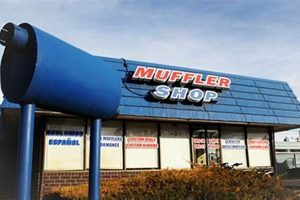
This establishment provides automotive exhaust system services, specializing in the repair and replacement of components designed to reduce engine noise and emissions. A typical function includes diagnosing issues such as leaks, corrosion, or damage, followed by offering appropriate solutions ranging from welding patches to complete system overhauls. Skilled technicians utilize specialized tools and diagnostic equipment to ensure vehicles meet performance and regulatory standards.
Properly functioning exhaust systems are crucial for maintaining vehicle efficiency, reducing harmful pollutants, and ensuring a comfortable driving experience. These services contribute to environmental responsibility by minimizing emissions and improve fuel economy by optimizing engine performance. Historically, such businesses evolved alongside the automotive industry, adapting to increasingly complex emission control technologies.
The following sections will delve into specific aspects of muffler repair, exhaust system maintenance best practices, and the factors to consider when selecting a qualified auto repair service provider.
Maintenance Advice
The following represents best practices for exhaust system care, designed to prolong component life and ensure optimal vehicle performance.
Tip 1: Regular Visual Inspections: Periodically examine the exhaust system for signs of corrosion, leaks, or physical damage. Early detection can prevent costly repairs down the line.
Tip 2: Prompt Leak Repair: Address exhaust leaks immediately. Leaks can compromise fuel efficiency, increase emissions, and pose safety hazards due to carbon monoxide exposure.
Tip 3: Monitor Unusual Noises: Be alert for rattling, hissing, or roaring sounds emanating from the exhaust system. These sounds often indicate loose components, cracks, or internal damage.
Tip 4: Preventative Maintenance: Schedule regular exhaust system checkups with a qualified technician. Preventative maintenance can identify potential problems before they escalate.
Tip 5: Avoid Short Trips: Frequent short trips can lead to moisture buildup in the exhaust system, accelerating corrosion. Ensure the engine reaches operating temperature during each drive to evaporate moisture.
Tip 6: Mind the Road Hazards: Exercise caution when navigating rough roads or encountering speed bumps. Impact damage can severely compromise the exhaust system’s structural integrity.
Adherence to these guidelines will contribute significantly to the longevity and efficiency of a vehicle’s exhaust system, resulting in reduced repair costs and a minimized environmental impact.
The subsequent section will address selecting a qualified professional for exhaust system repair and maintenance needs.
1. Exhaust System Repair

Exhaust system repair constitutes a core service offering within automotive maintenance businesses, particularly those, like this one, specializing in exhaust systems. Understanding the multifaceted nature of exhaust system repair provides insight into the expertise and services available at such establishments.
- Leak Detection and Repair
Exhaust leaks can occur at various points within the system due to corrosion, damage, or loose connections. These leaks reduce engine efficiency, increase emissions, and can introduce harmful gases into the passenger compartment. Services often employ diagnostic tools to pinpoint the source of leaks, followed by welding, patching, or component replacement to restore system integrity.
- Muffler and Resonator Replacement
Mufflers and resonators are critical components for noise reduction. Over time, these components can deteriorate due to rust and internal wear, leading to increased noise levels. Replacement services involve selecting appropriate mufflers and resonators based on vehicle specifications and customer preferences, ensuring optimal noise reduction and exhaust flow.
- Pipe and Connector Repair/Replacement
Exhaust pipes and connectors are subject to corrosion and physical damage from road debris. Repair or replacement services involve assessing the extent of damage and either repairing damaged sections through welding or replacing entire pipe sections to maintain proper exhaust flow and prevent leaks. Precise cutting and welding techniques are essential for a secure and leak-free repair.
- Catalytic Converter Service
While not always a direct repair, assessment of catalytic converter health is often performed during exhaust system inspection. Catalytic converters reduce harmful emissions. Failures can trigger warning lights and require replacement to comply with emissions regulations. Service often includes diagnosis to ensure a malfunctioning catalytic converter is the root cause, rather than a symptom of another engine problem.
The comprehensive approach to exhaust system repair underscores the importance of specialized knowledge and equipment. Addressing each facet ensures vehicles operate efficiently, meet emissions standards, and maintain acceptable noise levels, thereby contributing to vehicle safety and environmental responsibility.
2. Muffler Replacement Services

Muffler replacement services represent a core offering, acting as a foundational component of establishments focused on exhaust system maintenance. The presence of a functioning muffler is essential for reducing engine noise to acceptable levels, meeting legal requirements, and ensuring driver and community well-being. Establishments specializing in such services, dedicate a significant portion of their operations to the diagnosis, removal, and installation of mufflers. A real-world scenario includes a vehicle failing a noise emissions test, necessitating a muffler replacement to achieve compliance and legal operation. The proficiency in accurately assessing muffler condition, identifying compatible replacements, and performing installations directly impacts the business’s reputation and customer satisfaction.
Further elaborating, these businesses understand the correlation between muffler condition and engine performance. A damaged or deteriorated muffler can create backpressure, affecting engine efficiency and fuel economy. Therefore, a proper replacement not only reduces noise but can also restore optimal engine function. Specific examples include technicians inspecting mufflers for rust, cracks, or internal damage, then recommending replacements that match the vehicle’s make, model, and engine specifications. Moreover, they handle various muffler types, from standard designs to performance-enhancing models, demonstrating a spectrum of options to cater to different customer needs and preferences.
In conclusion, muffler replacement services are intrinsically linked to the core function and value proposition. Its expertise in this area is pivotal for delivering comprehensive exhaust system care. Addressing noise reduction, engine performance, and regulatory compliance, these establishments provide essential services for vehicle owners. The challenges lie in staying updated with evolving vehicle technologies and ensuring precise installation for sustained performance and customer trust.
3. Welding and Fabrication

Welding and fabrication are integral skills extending capabilities beyond standard replacement services. Expertise in these areas allows for customized solutions, addressing unique exhaust system challenges and catering to specific customer needs.
- Custom Exhaust System Design and Modification
Fabrication capabilities enable the modification of existing exhaust systems or the creation of entirely custom systems. This includes adapting systems to fit unique vehicle configurations, optimizing exhaust flow for performance enhancements, and creating specialized exhaust setups for classic or modified vehicles. Examples include designing a high-flow exhaust system for a performance car or fabricating a custom exhaust for a vehicle with non-standard dimensions. Skill ensures proper fitment and optimal performance characteristics.
- Exhaust Manifold Repair and Reinforcement
Exhaust manifolds are subject to extreme temperatures and vibrations, leading to cracks and failures. Welding skills allow for the repair of cracked manifolds, extending their lifespan and preventing costly replacements. Reinforcement techniques, such as adding support braces, can further enhance manifold durability. Successfully repairing exhaust manifolds is more economical than replacing them.
- Specialized Component Fabrication
Welding is essential for fabricating specialized components such as custom flanges, hangers, and adapters. These components are necessary when installing aftermarket exhaust systems or modifying existing systems to accommodate different parts. Precision welding ensures a secure and leak-free connection between components, maintaining exhaust system integrity.
- Corrosion Repair and Prevention
Welding can address corrosion damage by patching corroded sections of exhaust pipes or reinforcing weakened areas. Applying protective coatings or using corrosion-resistant materials during welding can further prevent future corrosion. This extends the lifespan of exhaust components, reducing the need for frequent replacements.
Proficiency in welding and fabrication differentiates providing comprehensive solutions for a wide range of exhaust system needs. The ability to customize, repair, and reinforce exhaust components enhances service offerings, catering to both standard repairs and specialized modifications, thus increasing its value proposition to customers.
4. Emission System Diagnostics

Emission system diagnostics represent a crucial function within automotive repair facilities, especially those specializing in exhaust systems. The ability to accurately diagnose and address emission-related issues is essential for vehicle compliance, environmental responsibility, and overall engine performance. For an exhaust system-focused establishment, expertise in this area is paramount.
- Diagnostic Code Interpretation
Modern vehicles utilize sophisticated onboard diagnostic (OBD) systems that generate diagnostic trouble codes (DTCs) when emission-related malfunctions occur. Skilled technicians interpret these codes to identify the source of the problem. For instance, a P0420 code indicates a catalytic converter inefficiency, prompting further investigation of the converter’s functionality and upstream components. Accurate interpretation prevents unnecessary repairs and ensures the correct problem is addressed. It’s important in proper diagnosing the root cause of emissions trouble.
- Sensor Testing and Calibration
Emission systems rely on various sensors, such as oxygen sensors, mass airflow sensors, and manifold absolute pressure sensors, to monitor engine performance and emissions output. These sensors must function accurately to ensure proper fuel mixture and catalyst efficiency. Diagnostics include testing sensor output using specialized tools to verify proper operation and calibrating or replacing sensors as needed. A faulty oxygen sensor, for example, can lead to increased fuel consumption and elevated emissions.
- Catalytic Converter Efficiency Evaluation
The catalytic converter is a key component in reducing harmful emissions. Diagnostics include evaluating converter efficiency using exhaust gas analyzers and monitoring oxygen sensor readings to determine if the converter is functioning within acceptable parameters. A failing catalytic converter can lead to increased emissions of hydrocarbons, carbon monoxide, and nitrogen oxides, resulting in failed emissions tests and environmental damage. A full understanding of diagnostic trouble codes and sensors makes the catalytic converter efficiency evaluation to be a breeze.
- Exhaust Leak Detection
Exhaust leaks, while often associated with noise and performance issues, can also impact emission system performance. Leaks can introduce ambient air into the exhaust stream, affecting oxygen sensor readings and catalytic converter efficiency. Diagnostic procedures include visual inspections, smoke tests, and pressure tests to locate and repair exhaust leaks, ensuring the integrity of the emission system. Exhaust leak detection is important in order to assure safety protocols as well in vehicles.
The ability to perform comprehensive emission system diagnostics is critical for maintaining vehicle compliance, reducing environmental impact, and ensuring optimal engine performance. The services provided contribute to a cleaner environment and reliable vehicle operation by identifying and addressing emission-related issues promptly and accurately.
5. Catalytic Converter Service

Catalytic converter service is a fundamental aspect of automotive exhaust system maintenance, directly influencing both vehicle emissions and regulatory compliance. As a provider of exhaust system services, a repair business must possess the capability to accurately diagnose catalytic converter malfunctions and provide appropriate solutions.
- Diagnosis of Converter Inefficiency
Catalytic converters degrade over time, losing their ability to efficiently convert harmful pollutants into less harmful substances. Diagnosis involves analyzing diagnostic trouble codes (DTCs) related to catalytic converter performance, such as P0420 (Catalyst System Efficiency Below Threshold). Further verification may involve exhaust gas analysis to measure the levels of hydrocarbons, carbon monoxide, and nitrogen oxides exiting the converter, comparing them to acceptable limits. For instance, elevated levels of hydrocarbons downstream of the converter indicate a failure to properly oxidize these pollutants.
- Converter Replacement Procedures
When a catalytic converter is deemed to have failed, replacement becomes necessary to restore proper emission control. The procedure involves selecting a replacement converter that meets or exceeds original equipment manufacturer (OEM) specifications, ensuring compatibility with the vehicle’s make, model, and engine configuration. Proper installation is crucial, requiring secure connections to the exhaust system and adherence to any specific torque requirements. Failure to properly install the converter can lead to leaks, reduced efficiency, and potential damage to the vehicle.
- Verification of Post-Replacement Performance
Following converter replacement, it is essential to verify that the new converter is functioning correctly and that the vehicle is meeting emission standards. This involves clearing any stored DTCs and performing a test drive to monitor the vehicle’s performance. Additionally, a subsequent exhaust gas analysis can confirm that the converter is effectively reducing emissions. Successful verification ensures that the vehicle complies with environmental regulations and avoids future emission-related issues.
- Addressing Underlying Causes of Converter Failure
Catalytic converter failure is often a symptom of underlying engine problems, such as excessive oil consumption, improper air-fuel mixture, or coolant leaks. Addressing these underlying issues is crucial to prevent premature failure of the replacement converter. Diagnostic procedures should include evaluating engine performance, inspecting for leaks, and ensuring proper sensor operation. Neglecting these underlying causes can lead to repeated converter failures and increased repair costs.
The expertise in providing catalytic converter service ensures that vehicles meet regulatory emission standards, reduces environmental impact, and maintains optimal engine performance. A comprehensive approach, encompassing accurate diagnosis, proper replacement procedures, and addressing underlying causes, is essential for delivering reliable and effective service.
Frequently Asked Questions
The following addresses common inquiries concerning exhaust system maintenance and services, providing clarity on procedures, potential issues, and best practices.
Question 1: What constitutes a muffler?
A muffler is a component within a vehicle’s exhaust system designed to reduce the noise produced by the engine. It typically consists of a series of chambers and baffles that attenuate sound waves before they exit the exhaust pipe.
Question 2: What are the indicators suggesting a muffler requires replacement?
Indications of muffler failure include excessive exhaust noise, rattling sounds emanating from beneath the vehicle, visible rust or corrosion on the muffler body, and exhaust leaks.
Question 3: Does a faulty exhaust system negatively affect fuel efficiency?
Yes, an exhaust leak or blockage can create backpressure, hindering engine performance and reducing fuel economy. Correcting exhaust system issues can restore optimal fuel efficiency.
Question 4: How frequently should the exhaust system be inspected?
It is advisable to have the exhaust system inspected at least once a year or during routine maintenance intervals. More frequent inspections may be necessary in areas with harsh weather conditions or exposure to road salts.
Question 5: Is it possible to repair a cracked exhaust pipe via welding?
Small cracks or holes in exhaust pipes can often be repaired through welding, provided the surrounding metal is structurally sound. However, extensive corrosion or damage may necessitate pipe replacement.
Question 6: How does the catalytic converter contribute to environmental protection?
The catalytic converter reduces harmful emissions by converting pollutants such as hydrocarbons, carbon monoxide, and nitrogen oxides into less harmful substances, such as carbon dioxide, water, and nitrogen.
Maintaining a functional exhaust system is essential for vehicle performance, fuel efficiency, and environmental responsibility. Regular inspections and prompt repairs can prevent costly issues and ensure regulatory compliance.
The subsequent section will explore customer testimonials and reviews, providing insights into service quality and customer satisfaction.
Summary
This document has comprehensively explored the operational facets of businesses providing exhaust system services. The discussion encompassed essential maintenance practices, specific repair procedures such as muffler replacement and welding, diagnostic techniques related to emission systems, and the critical role of catalytic converters. The necessity of these establishments in maintaining vehicle performance, ensuring regulatory compliance, and mitigating environmental impact was underscored.
Given the critical role of properly functioning exhaust systems, continuous adherence to recommended maintenance schedules and prompt attention to identified issues are paramount. Neglecting these aspects can lead to diminished vehicle performance, increased environmental pollution, and potential regulatory penalties. Therefore, informed decision-making regarding exhaust system care remains vital for responsible vehicle ownership.



![Piqua Ohio Muffler Shop: [Car Model] Exhaust Pros | Best Mufflers for Cars & Trucks | Performance, Sound & Durability Upgrades](https://dnamufflers.com/wp-content/uploads/2026/06/th-68-300x200.jpg "Piqua Ohio Muffler Shop: [Car Model] Exhaust Pros Best Mufflers for Cars & Trucks | Performance, Sound & Durability Upgrades")