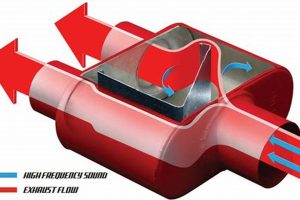
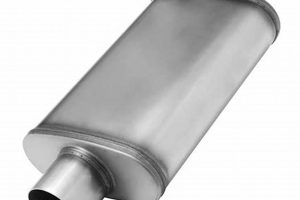
An exhaust component designed to offer a variable level of sound attenuation is under consideration. This type of device often incorporates a mechanism, such as an adjustable baffle or valve, that allows the operator to modify the exhaust flow path. By altering this path, the user can select between a quieter, more restrictive mode of operation and a louder, less restrictive one. As an example, consider a situation where a vehicle owner desires reduced noise levels for residential driving but a more aggressive sound profile for performance applications.
The appeal of this adjustable system stems from its ability to provide drivers with a degree of control over their vehicle’s auditory signature. This control can be particularly valuable in environments with noise ordinances or where a balance between performance and sound level is desired. Historically, such systems have evolved from simple cutouts to more sophisticated electronically controlled valves, reflecting advancements in materials and actuator technology. This evolution has led to more precise and reliable sound management.
The following sections will delve deeper into the specific design features, performance characteristics, and considerations for installation and maintenance relevant to this type of variable exhaust technology.
Essential Considerations
Proper utilization of variable exhaust technology demands careful consideration of several factors to ensure optimal performance and compliance.
Tip 1: Understand Local Noise Regulations: Prior to installation, research and comprehend local noise ordinances. Operating a vehicle in an unrestricted mode within a restricted zone may result in fines or legal action.
Tip 2: Regular Inspection of Actuator Mechanisms: The adjustable valve or baffle is a critical component. Periodic inspection for corrosion, damage, or malfunction is essential to maintain proper operation. Lubrication may be required according to the manufacturer’s recommendations.
Tip 3: Proper Installation is Paramount: Incorrect installation can lead to leaks, reduced performance, or even damage to the exhaust system. Professional installation is advisable, particularly for complex electronically controlled systems.
Tip 4: Consider the Impact on Engine Performance: Altering the exhaust flow can influence engine backpressure, potentially impacting horsepower and torque. It is prudent to understand the manufacturer’s specifications regarding performance changes in different modes.
Tip 5: Material Compatibility Matters: Ensure the selected system is constructed from materials compatible with the vehicle’s intended use and operating environment. Stainless steel is generally preferred for its corrosion resistance, particularly in regions with road salt.
Tip 6: Familiarize Yourself with the Control System: If the system incorporates electronic controls, thoroughly understand their operation. This includes knowing how to switch between modes and interpreting any diagnostic indicators.
Adhering to these guidelines will contribute to a safer and more enjoyable experience with variable exhaust technology. Careful planning and execution are crucial for realizing the benefits while mitigating potential drawbacks.
The following concluding remarks will summarize the core concepts and offer final thoughts on the responsible implementation of variable exhaust systems.
1. Sound Level Adjustment

Sound Level Adjustment, in the context of variable exhaust systems, represents the primary functional advantage. The system permits the operator to selectively attenuate or amplify exhaust noise. This functionality arises from an internal mechanism typically a valve or baffle that redirects exhaust gases through different pathways within the muffler. A more restrictive pathway generally yields a quieter sound profile, while a less restrictive pathway allows for increased noise output. The ability to alter sound levels caters to diverse operational requirements, such as conforming to noise restrictions in residential areas or achieving a more aggressive exhaust note for performance driving scenarios. Consider, for instance, a performance car owner who values reduced noise during daily commutes but desires a louder, sportier sound during track events. Sound Level Adjustment allows this adaptability within a single exhaust system.
The mechanical or electronic control of the adjustable valve directly mediates Sound Level Adjustment. Mechanical systems often employ a cable-actuated lever or knob, whereas electronic systems utilize a solenoid or servo motor, controlled via a switch or a programmed setting. These electronic systems can offer more precise and automated control, potentially integrating with engine management systems to modulate sound output based on engine load or speed. A practical example is the integration of variable exhaust systems into modern luxury vehicles, where sound level adjustment is dynamically linked to selectable driving modes, such as “Comfort” or “Sport,” automatically adjusting the exhaust note to match the desired driving experience.
In summary, Sound Level Adjustment is a critical feature, enabling dynamic control over exhaust acoustics. This adjustability presents both practical advantages in noise-sensitive environments and enhanced driver experiences, demonstrating that the feature offers considerable value. Further development in material science and control systems continues to refine the precision and reliability with which this function is delivered, enhancing its practical adoption across diverse vehicle applications.
2. Exhaust Flow Control

Exhaust Flow Control is a fundamental aspect of variable exhaust technology. It refers to the manipulation of exhaust gas passage through the system. This control is integral to the operation and performance characteristics, allowing adjustment between different operating modes.
- Valve Modulation and its Impact on Backpressure
The valve, a primary component of exhaust flow control, alters the exhaust gas path. A partially closed valve increases backpressure, reducing noise but potentially limiting engine power. Conversely, a fully opened valve minimizes backpressure, allowing for increased exhaust flow and enhanced performance, but at the cost of higher noise levels. This modulation allows users to optimize between performance and sound levels as required.
- Baffle System Design and Its Influence
The baffle system, another component employed in exhaust flow control, strategically redirects exhaust gases to attenuate sound. Baffle design directly influences the degree of sound reduction and the resulting backpressure. Different configurations can offer varied levels of noise suppression, each with a corresponding impact on exhaust flow. A complex baffle system can offer fine-tuned sound control.
- Electronic Control Integration and Automation
Electronic control enhances exhaust flow control by providing automated adjustments. Sensors monitor engine parameters, such as RPM or throttle position, and dynamically adjust the valve position for optimal performance. This system allows for real-time adaptation of exhaust flow to changing driving conditions, achieving a balance between power, fuel efficiency, and sound.
- Impact on Catalytic Converter Efficiency
The control of exhaust flow can indirectly impact the efficiency of the catalytic converter. Restricting exhaust flow may increase exhaust gas temperatures, potentially enhancing catalytic converter performance, especially during cold starts. However, excessive backpressure could also negatively affect engine performance and longevity, requiring careful calibration of the exhaust flow control system.
These components of exhaust flow control collectively define the overall functionality. The ability to finely tune these variables allows for customization tailored to specific driving needs and preferences, highlighting the system’s versatility and responsiveness.
3. Backpressure Management

Backpressure management is a critical element in the design and functionality of a variable exhaust system. Exhaust backpressure, the resistance to exhaust gas flow within the exhaust system, directly influences engine performance. An engine requires a specific amount of backpressure for optimal operation. Too little backpressure can reduce low-end torque, while excessive backpressure can restrict horsepower and increase fuel consumption. A variable exhaust system addresses this challenge by offering adjustable levels of backpressure. By manipulating the internal baffles or valves, the system allows for tuning the backpressure to suit different driving conditions and performance requirements. For example, when greater power is desired, such as during acceleration, the system can reduce backpressure to maximize exhaust flow. Conversely, when noise reduction is a priority, the system can increase backpressure, thereby dampening sound levels.
The impact of inadequate backpressure management can be observed in real-world scenarios. Consider a vehicle modified with a straight-pipe exhaust, which significantly reduces backpressure. While this may increase peak horsepower at high RPMs, it often results in a noticeable loss of torque at lower engine speeds, making the vehicle less responsive in everyday driving situations. In contrast, a variable exhaust system, with its ability to modulate backpressure, can mitigate this trade-off. Electronic control systems integrated into these systems can automatically adjust backpressure based on factors such as engine speed, load, and throttle position, ensuring optimal performance across a wide range of driving conditions. Furthermore, precise backpressure management also contributes to improved fuel efficiency and reduced emissions, aligning with increasingly stringent environmental regulations.
In summary, backpressure management represents a significant capability of a variable exhaust system. The ability to adjust backpressure not only contributes to optimized engine performance but also provides enhanced control over the vehicle’s sound profile. The challenge lies in achieving a balanced design that maximizes performance benefits while minimizing any adverse effects on fuel efficiency or emissions. Ongoing advancements in materials, valve technology, and electronic control systems continue to refine the precision and effectiveness of backpressure management in variable exhaust applications.
4. Performance Impact

The performance impact of a variable exhaust system is a multifaceted consideration, directly influenced by the design and operational characteristics. Altering the exhaust flow path, inherent in these systems, can significantly modify engine behavior. The degree to which performance is affected hinges on several factors, including the specific engine configuration, the valve or baffle design, and the control system logic. An unrestricted exhaust flow, achieved by opening the valve or adjusting the baffle, generally reduces backpressure, potentially increasing horsepower at higher engine speeds. However, this reduction in backpressure can also diminish low-end torque, resulting in a less responsive feel at lower RPMs. Conversely, a more restricted exhaust flow, achieved by closing the valve or redirecting exhaust through a more complex baffle arrangement, increases backpressure, which can improve low-end torque but may limit peak horsepower. Therefore, the performance impact is not unidirectional; it represents a balance between power delivery characteristics across the engine’s operating range. Real-world examples demonstrate this trade-off. A sports car equipped with such a system might exhibit enhanced acceleration on a racetrack with the valve open but feel less responsive during city driving, where lower RPMs are more prevalent.
The practical significance of understanding the performance impact lies in the ability to optimize the system’s settings for specific driving scenarios. For instance, an electronically controlled system could be programmed to automatically adjust the valve position based on engine load, throttle position, and vehicle speed, ensuring optimal performance under varying conditions. Furthermore, proper installation and calibration of the system are essential to avoid negative consequences, such as reduced fuel efficiency or increased emissions. Aftermarket variable exhaust systems, if not correctly tuned to the engine’s specifications, can actually reduce overall performance rather than enhance it. Therefore, a thorough understanding of the engine’s characteristics and the exhaust system’s design is crucial for achieving the desired performance gains. Data logging and dyno testing can be valuable tools for evaluating the performance impact of different system settings and ensuring that the system is properly optimized.
In summary, the performance impact is a key consideration in variable exhaust technology. While the potential exists for enhanced power and improved sound, realizing these benefits requires careful attention to design, installation, and calibration. The challenge lies in striking a balance between high-end horsepower and low-end torque, ensuring optimal performance across a range of driving conditions. Future developments in materials, control systems, and engine management integration hold the promise of further refining and optimizing the performance impact of these systems.
5. Regulation Compliance

Regulation Compliance represents a crucial consideration when evaluating variable exhaust systems. The operation of these systems must adhere to noise regulations and emission standards established by local, state, and federal authorities. Failure to comply can result in fines, vehicle impoundment, or legal action.
- Noise Level Restrictions
Many jurisdictions impose limits on vehicle noise levels. Variable exhaust systems must be designed and operated in a manner that adheres to these restrictions. This often involves incorporating a quiet mode that reduces exhaust noise to acceptable levels. Exceeding these noise limits can result in citations and penalties. Real-world examples include urban areas with strict noise ordinances designed to minimize noise pollution, particularly during nighttime hours.
- Emission Standards Adherence
Variable exhaust systems must not compromise vehicle emission control systems. Altering the exhaust flow path can affect the efficiency of catalytic converters and other emission control devices. These systems must be designed to meet established emission standards, such as those set by the Environmental Protection Agency (EPA). Non-compliance can lead to vehicle failing emissions tests, preventing registration or legal operation. Modifications that disable or bypass emission control devices are strictly prohibited.
- Type Approval and Certification
Some regions require exhaust systems to undergo type approval or certification processes to ensure compliance with applicable regulations. This may involve testing the system for noise levels, emissions performance, and durability. Variable exhaust systems that have obtained type approval or certification demonstrate that they meet the required standards. For instance, the European Union requires exhaust systems to meet specific noise and emission standards before they can be sold or installed on vehicles within member states.
- Tampering Prevention Measures
Regulations often prohibit the tampering with or removal of emission control devices. Variable exhaust systems must be designed to prevent unauthorized modifications that could bypass or disable emission controls. This may involve incorporating tamper-resistant hardware or software safeguards. Systems must also be installed correctly to prevent any adverse effects on emission control components. Manufacturers must demonstrate reasonable efforts to prevent tampering to comply with legal requirements.
Regulation Compliance forms an essential part of responsible implementation. Variable exhaust systems must be carefully designed, installed, and operated to ensure that they meet all applicable standards and regulations. Failure to do so can have significant legal and environmental consequences, thereby undermining the system’s benefits.
6. Durability & Longevity
The operational lifespan and resistance to degradation of an adjustable muffler are paramount considerations, impacting the long-term value and reliability of the component. Several factors contribute to the overall durability and longevity, determining how well the system withstands operational stresses and environmental conditions over time.
- Material Selection and Corrosion Resistance
The materials used in the construction of an adjustable muffler significantly influence its durability. Stainless steel, particularly grades 304 and 316, are favored for their superior corrosion resistance compared to aluminized steel. This resistance is critical in preventing rust and structural weakening caused by exposure to moisture, road salt, and exhaust gases. For instance, a stainless steel system is likely to outlast an aluminized steel system in regions with harsh winter climates where road salt is heavily used.
- Weld Quality and Structural Integrity
The quality of the welds that join the various components of the adjustable muffler plays a vital role in its structural integrity. Poorly executed welds can be prone to cracking and failure under the stresses of thermal expansion and vibration. Robotic welding techniques often produce more consistent and reliable welds than manual processes. A system with robust welding is less likely to develop leaks or structural failures over time, ensuring consistent performance.
- Actuator Mechanism Design and Reliability
The actuator mechanism, responsible for adjusting the exhaust flow path, is a critical component that can impact the longevity of the system. A well-designed actuator, utilizing durable materials and robust construction, is essential for reliable operation over extended periods. Factors such as the type of motor used (e.g., stepper motor vs. servo motor), the quality of the linkages, and the effectiveness of the sealing against contaminants influence the actuator’s lifespan. A poorly designed or manufactured actuator can fail prematurely, rendering the adjustable muffler ineffective.
- Environmental Protection and Sealing
Effective sealing against the ingress of moisture, dirt, and debris is crucial for maintaining the durability of the internal components. Properly sealed valves and actuators are less susceptible to corrosion and malfunction. Protective coatings applied to external surfaces can further enhance resistance to environmental degradation. A system with effective sealing is more likely to maintain consistent performance and structural integrity over its service life.
In conclusion, the long-term durability and lifespan of an adjustable muffler are determined by a combination of material selection, construction quality, actuator design, and environmental protection measures. These factors must be carefully considered to ensure that the system provides reliable performance and withstands the rigors of daily use over an extended period.
Frequently Asked Questions
The following questions address common concerns and misconceptions regarding an adjustable muffler.
Question 1: How does an adjustable muffler affect a vehicle’s warranty?
Modifying a vehicle’s exhaust system may impact the manufacturer’s warranty. It is crucial to consult the warranty documentation and understand its specific terms. Some modifications may void the warranty if they directly cause a failure of a covered component. However, the Magnuson-Moss Warranty Act protects consumers by preventing manufacturers from voiding warranties simply because aftermarket parts were installed. The manufacturer must demonstrate that the aftermarket part caused the failure.
Question 2: Is professional installation required for an adjustable muffler?
Professional installation is highly recommended, particularly for systems that involve electronic controls or complex modifications to the exhaust system. Improper installation can lead to leaks, reduced performance, or damage to the vehicle. Certified technicians possess the expertise and tools necessary to ensure proper installation and calibration. While some mechanically inclined individuals may attempt self-installation, it is essential to have a thorough understanding of exhaust systems and vehicle mechanics.
Question 3: How often should an adjustable muffler be inspected and maintained?
Regular inspection and maintenance are crucial for ensuring the longevity and proper functioning of an adjustable muffler. The system should be inspected at least annually, or more frequently under severe operating conditions. Inspection should include checking for corrosion, leaks, and damage to the valve or baffle mechanism. Lubrication of moving parts may be required according to the manufacturer’s recommendations. Addressing any issues promptly can prevent further damage and maintain optimal performance.
Question 4: Can an adjustable muffler improve fuel efficiency?
The impact on fuel efficiency varies depending on the system’s design and the driving conditions. In some cases, reducing backpressure can improve fuel efficiency at higher engine speeds. However, it can also reduce low-end torque, which may negatively impact fuel economy in city driving. Electronically controlled systems that dynamically adjust exhaust flow can potentially optimize fuel efficiency across a wider range of driving conditions.
Question 5: What is the typical lifespan of an adjustable muffler?
The lifespan is influenced by factors such as material quality, environmental conditions, and maintenance practices. Stainless steel systems generally last longer than aluminized steel systems due to their superior corrosion resistance. Regular inspection and maintenance can help to extend the lifespan of the system. Actuator mechanisms, being more complex, may require replacement sooner than the muffler body itself.
Question 6: Are all adjustable mufflers compatible with all vehicles?
Compatibility depends on the specific design of the adjustable muffler and the vehicle’s exhaust system configuration. It is essential to verify compatibility before purchasing a system. Factors such as exhaust pipe diameter, mounting points, and the presence of catalytic converters must be considered. Some systems may require modifications to the vehicle’s exhaust system for proper installation. Consulting with a qualified technician can ensure compatibility and prevent installation issues.
These FAQs highlight key considerations for an adjustable muffler. Careful planning and understanding can ensure satisfactory performance.
The following section summarizes essential information.
Conclusion
The preceding analysis has examined various facets of exhaust modification systems, encompassing their operational principles, performance implications, regulatory compliance, and durability considerations. Key elements include sound level adjustment, exhaust flow management, and the resulting influence on engine backpressure and overall performance. The importance of adhering to noise and emissions standards has also been underscored, alongside the factors contributing to system longevity.
A comprehensive understanding of these systems is essential for informed decision-making. Further research and consultation with qualified professionals are encouraged before implementation. The responsible application of this technology ensures both enhanced vehicle performance and adherence to societal regulations, reflecting a commitment to both individual needs and collective well-being. Continued advancements in materials and control systems promise further refinements in exhaust management technology.