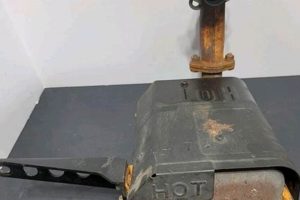
This component joins sections of an exhaust system, specifically linking the sound-dampening device to adjacent pipes. Its purpose is to create a secure and often gas-tight connection, facilitating the passage of exhaust gases. For example, a vehicle repair might necessitate its replacement if corrosion or damage compromise the seal between the exhaust pipe and the noise-reduction unit.
A functioning joint is critical for maintaining optimal engine performance, reducing noise pollution, and preventing harmful emissions from leaking into the environment. Historically, these connections were simple clamps; modern iterations often incorporate advanced materials and designs to enhance durability and sealing capabilities, extending the lifespan of the overall exhaust system and improving vehicle efficiency.
The ensuing article will delve into the selection criteria, installation procedures, common issues, and maintenance techniques associated with these crucial exhaust system components. Understanding these aspects is essential for both automotive professionals and vehicle owners seeking to ensure the continued proper operation of their vehicles.
Essential Guidelines for Exhaust System Joints
The following recommendations address best practices related to the selection, installation, and maintenance of the components responsible for uniting sections of an exhaust system, particularly those connecting the noise-reduction unit.
Tip 1: Material Selection: Prioritize components fabricated from corrosion-resistant materials, such as stainless steel or aluminized steel. These materials extend the lifespan of the joint, particularly in regions with harsh weather conditions or road salts.
Tip 2: Proper Sizing: Ensure dimensional compatibility with the connecting exhaust pipes. An incorrectly sized component will lead to leaks, reduced exhaust system efficiency, and potential damage.
Tip 3: Secure Fastening: Utilize appropriate clamping hardware, such as U-bolts or band clamps, tightened to the manufacturer’s specified torque. Over-tightening can damage the pipes, while under-tightening will result in leaks.
Tip 4: Leak Inspection: After installation, meticulously inspect the joint for exhaust leaks using a soapy water solution. Bubbles indicate a compromised seal requiring immediate attention.
Tip 5: Regular Maintenance: Periodically inspect the component for signs of corrosion, damage, or loosening. Addressing minor issues promptly prevents more significant and costly repairs.
Tip 6: Heat Shield Compatibility: When replacing the component, verify compatibility with existing heat shields. Properly positioned heat shields mitigate the risk of heat damage to nearby components.
Tip 7: Professional Installation: For complex exhaust systems or when encountering installation difficulties, seek assistance from a qualified automotive technician. Incorrect installation can negatively impact vehicle performance and safety.
Adhering to these guidelines promotes optimal exhaust system performance, minimizes noise pollution, and ensures compliance with emissions regulations. Properly maintained joints contribute to the overall longevity and reliability of the vehicle.
The subsequent sections of this article will cover troubleshooting common issues, diagnosing failures, and further extending the life of these critical exhaust system elements.
1. Material Corrosion Resistance

The operational environment of an exhaust system creates considerable demands regarding component longevity. Elevated temperatures, exposure to corrosive combustion byproducts, and the potential for road salt exposure collectively contribute to a highly corrosive setting. The material selection for an exhaust joint, particularly those that connect the sound-dampening device, directly dictates its resistance to degradation. Inferior materials rapidly corrode, compromising structural integrity and creating exhaust leaks. This, in turn, diminishes engine efficiency, increases noise levels, and elevates harmful emissions. A practical example involves the premature failure of a mild steel exhaust joint in regions where road salt is liberally applied during winter, leading to rust-through and the need for costly repairs.
The implementation of corrosion-resistant alloys, such as stainless steel or aluminized steel, significantly extends the service life of these joints. Stainless steel, with its inherent resistance to oxidation and chemical attack, offers superior long-term performance. Aluminized steel provides a cost-effective alternative, employing an aluminum coating to create a protective barrier against corrosion. The selection of the appropriate material grade depends on factors such as budget constraints, vehicle usage patterns, and the prevailing environmental conditions. Choosing a joint constructed from a material demonstrably suited to the operating environment is a proactive measure against future system failures.
In summary, material corrosion resistance stands as a paramount factor in the selection and performance of an exhaust joint. Investing in components fabricated from high-quality, corrosion-resistant materials mitigates the risk of premature failure, ensures long-term reliability, and contributes to overall vehicle efficiency and environmental responsibility. Overcoming the challenge of exhaust system corrosion hinges on understanding the materials science principles involved and applying appropriate preventative measures during the selection and maintenance processes.
2. Precise dimensional matching

Precise dimensional matching is paramount for any component used to connect the noise-reduction unit to the exhaust system. Deviations from specified dimensions can lead to compromised performance, increased emissions, and potential system failures.
- Gas-Tight Seal Integrity
Mismatched dimensions inevitably result in imperfect seals, leading to exhaust gas leaks. These leaks not only degrade engine performance but also pose safety risks due to the potential for carbon monoxide intrusion into the vehicle cabin. A properly sized component ensures a secure, gas-tight connection, preventing the escape of harmful exhaust fumes. An example is the selection of a replacement component with a slightly smaller inner diameter than the exhaust pipe, causing incomplete sealing and subsequent leakage.
- Structural Integrity of the Exhaust System
An improperly sized joint places undue stress on adjacent exhaust components. This stress accelerates wear and tear, potentially leading to cracks or failures in pipes or the noise-reduction unit itself. For instance, attempting to force a larger-than-specified component onto a pipe can create stress points and weaken the entire assembly, necessitating premature replacements.
- Optimized Flow Dynamics
Dimensional inaccuracies can disrupt the smooth flow of exhaust gases, creating turbulence and backpressure. Increased backpressure reduces engine efficiency and can negatively impact fuel economy. Selecting a component with the correct internal diameter and alignment ensures unobstructed flow, maximizing engine performance and minimizing fuel consumption. A real-world scenario involves the use of a reducer joint with an abrupt diameter change, generating significant turbulence and hindering exhaust flow.
- Ease of Installation and Maintenance
Components that conform precisely to specified dimensions facilitate straightforward installation and removal. Mismatched parts require excessive force to install, potentially damaging the joint or adjacent exhaust pipes. This also complicates future maintenance or repair work. A typical example is struggling to install a new component that is slightly too small, requiring modification or potentially compromising the integrity of the connection during forced installation.
The importance of adhering to precise dimensional specifications when selecting and installing components intended for exhaust system connections cannot be overstated. Failure to do so compromises gas-tightness, system integrity, flow dynamics, and ease of maintenance, ultimately affecting vehicle performance, emissions, and overall reliability. Selecting the correct size and type of component is a preventative measure that contributes to the long-term health and efficiency of the vehicle’s exhaust system.
3. Secure Fastening Technique

Secure fastening techniques are integral to the reliable performance of exhaust system joints. The integrity of the connection directly affects emissions control, noise reduction, and overall system longevity. Insufficient or incorrect fastening methods can lead to premature failure and associated operational issues.
- Clamping Force Distribution
Effective fastening ensures uniform clamping force distribution around the circumference of the connected pipes. Uneven force can deform the components, leading to leaks or stress fractures. For example, using a worn or improperly sized clamp concentrates pressure at specific points, compromising the seal. The selection of clamps with appropriate width and material strength is crucial for distributing force evenly.
- Torque Specification Adherence
Manufacturers provide specific torque specifications for fastening hardware. Deviating from these specifications, either by over-tightening or under-tightening, can be detrimental. Over-tightening can strip threads or distort the pipes, while under-tightening allows for movement and eventual loosening. Utilizing a calibrated torque wrench and adhering to the recommended torque values ensures a secure and reliable connection.
- Material Compatibility of Fasteners
The materials used in fastening hardware must be compatible with the materials of the connected pipes and the joint itself. Dissimilar metals can lead to galvanic corrosion, weakening the connection over time. For instance, using steel clamps on stainless steel pipes can accelerate corrosion of the steel. Employing stainless steel clamps for stainless steel systems mitigates this risk.
- Vibration Resistance
Exhaust systems are subjected to constant vibration, which can loosen fasteners over time. Fastening methods that incorporate locking mechanisms, such as lock washers or self-locking nuts, help to prevent loosening due to vibration. Regularly inspecting and re-tightening fasteners, as needed, is a preventative measure that maintains connection integrity. An example is the use of Nyloc nuts, which incorporate a nylon insert to resist loosening.
The application of correct fastening techniques is essential for the proper function of exhaust system joints. By ensuring uniform clamping force, adhering to torque specifications, selecting compatible materials, and addressing vibration concerns, a secure and reliable connection is established. These practices contribute directly to the overall performance, longevity, and safety of the exhaust system.
4. Exhaust Gas Tightness and Muffler Couplers

Exhaust gas tightness represents a critical performance parameter for any joint within an exhaust system, particularly at the interface where the sound-dampening device connects. The integrity of this seal directly impacts vehicle emissions, engine efficiency, and passenger safety.
- Environmental Compliance
A compromised seal allows the escape of untreated exhaust gases, including harmful pollutants such as carbon monoxide, nitrogen oxides, and hydrocarbons. This directly contravenes environmental regulations designed to minimize air pollution. For example, a faulty connection can lead to increased emissions during vehicle inspections, resulting in failure and the need for repairs. Proper design and installation ensure compliance with stringent environmental standards.
- Engine Performance and Fuel Economy
Exhaust leaks disrupt the carefully engineered backpressure within the exhaust system. Altered backpressure can negatively impact engine combustion efficiency, leading to reduced power output and diminished fuel economy. As an example, a leak near the muffler can cause the engine control unit to compensate for altered readings from oxygen sensors, resulting in inefficient fuel consumption. Maintaining a tight seal preserves optimal engine operating conditions.
- Passenger Safety
Carbon monoxide, an odorless and colorless gas present in exhaust fumes, poses a significant health risk. Leaks at the joint can allow carbon monoxide to enter the vehicle cabin, endangering the occupants. For instance, a poorly sealed connection coupled with a compromised vehicle body can create a pathway for carbon monoxide intrusion. A robust seal is vital for preventing carbon monoxide exposure and ensuring passenger well-being.
- Noise Reduction Effectiveness
The sound-dampening device’s performance relies on a sealed system to properly attenuate exhaust noise. Leaks diminish the effectiveness of the noise-reduction unit, resulting in increased vehicle noise levels. As an example, a visible gap around the joint allows exhaust gases to bypass the sound-dampening chambers, increasing the vehicle’s acoustic signature. A properly sealed joint optimizes the noise reduction capabilities of the system.
The relationship between a sound-dampening device’s joint and exhaust gas tightness is fundamental to vehicle operation. Proper design, material selection, installation, and maintenance are paramount for ensuring a leak-free connection, which directly contributes to environmental protection, engine performance, passenger safety, and noise reduction. The absence of a secure, gas-tight seal compromises the entire exhaust system’s functionality and poses potential hazards.
5. Vibration dampening properties
Exhaust systems, particularly the joints connecting the sound-dampening device, are continuously subjected to mechanical vibrations originating from the engine and road conditions. The presence of effective vibration dampening properties in these joints is crucial for maintaining structural integrity and preventing premature failure.
- Stress Reduction
Vibration induces stress on the metallic components of the exhaust system. A joint with adequate dampening capabilities absorbs and dissipates vibrational energy, reducing the stress concentration at weld points and pipe connections. For example, a flexible joint incorporating a braided section allows for movement and absorbs vibration, preventing the transmission of these forces to the sound-dampening device’s shell and mounting points.
- Noise Attenuation
Vibration can contribute to audible noise emanating from the exhaust system. Dampening properties within the joint can minimize the transmission of vibrational energy to surrounding structures, reducing rattling and other unwanted sounds. A joint with rubber isolators, for instance, effectively decouples the exhaust system from the vehicle chassis, preventing structure-borne noise transmission.
- Longevity Enhancement
The cumulative effect of vibration-induced stress leads to fatigue and eventual component failure. By mitigating these stresses, joints with effective dampening characteristics extend the service life of the exhaust system. The implementation of spring-loaded joints, which allow for controlled movement and vibration absorption, can significantly delay the onset of fatigue-related failures.
- Seal Integrity Preservation
Vibration can cause fasteners to loosen and sealing surfaces to separate, leading to exhaust leaks. Joints with vibration dampening features maintain consistent clamping force and prevent movement between the connected pipes, preserving the integrity of the exhaust seal. The use of specialized clamps with vibration-resistant locking mechanisms, such as serrated flanges or Belleville washers, minimizes the risk of loosening.
Incorporating vibration dampening properties into the design and selection of joints used in exhaust systems, particularly those connecting the sound-dampening device, represents a proactive measure against premature failure and noise generation. Implementing these features enhances the overall durability, performance, and acoustic characteristics of the vehicle.
Frequently Asked Questions
The following questions address common inquiries and misconceptions regarding components used to connect the sound-dampening device to the exhaust system.
Question 1: What constitutes a typical lifespan for exhaust joints?
The service life varies considerably depending on material composition, environmental conditions, and vehicle usage patterns. Joints constructed from stainless steel in regions with minimal road salt exposure can last upwards of ten years. Conversely, mild steel components in harsh climates may require replacement every two to three years.
Question 2: Is it permissible to weld an exhaust joint instead of using clamps?
Welding offers a permanent connection, but it complicates future repairs or replacements. Clamps provide a more flexible solution, allowing for easier disassembly and reassembly. Welding should be reserved for situations where a gas-tight seal is paramount and future maintenance is unlikely.
Question 3: How can exhaust leaks at the joint be detected?
Exhaust leaks can often be identified by a hissing sound emanating from the exhaust system, particularly during cold starts. A visual inspection may reveal soot deposits around the joint. A soapy water solution applied to the connection can reveal leaks through the formation of bubbles.
Question 4: What are the implications of neglecting exhaust leaks at the joint?
Unaddressed exhaust leaks diminish engine performance, increase harmful emissions, and can lead to carbon monoxide intrusion into the vehicle cabin. Continued operation with a leak can also damage other exhaust system components and necessitate more extensive repairs.
Question 5: Are all exhaust joints universally compatible?
No, exhaust joints are not universally compatible. Dimensional specifications, pipe diameters, and connection types vary significantly between vehicle models and exhaust system designs. Careful measurement and selection are crucial for ensuring a proper fit.
Question 6: Can aftermarket performance joints improve exhaust system efficiency?
Aftermarket performance joints, typically constructed from higher-grade materials and featuring optimized flow designs, can enhance exhaust system efficiency. However, these benefits are often marginal and may not be noticeable in everyday driving conditions. The primary advantage lies in increased durability and longevity.
In summary, selecting the appropriate component, employing proper installation techniques, and addressing leaks promptly are essential for maintaining the integrity and performance of exhaust system joints.
The next section of this article will address advanced troubleshooting techniques and diagnostic procedures related to exhaust system failures.
Conclusion
This exploration has underscored the critical role of the muffler coupler in ensuring exhaust system integrity. From material selection and precise dimensional matching to secure fastening techniques and vibration dampening properties, each aspect contributes to the overall performance and longevity of this connection. Exhaust gas tightness, environmental compliance, engine efficiency, and passenger safety are all directly affected by the functionality of the muffler coupler.
The ongoing maintenance and informed selection of this component remain paramount for both automotive professionals and vehicle owners. By understanding the principles discussed herein, it becomes possible to optimize exhaust system performance, minimize environmental impact, and guarantee the safe operation of motor vehicles. Continuous advancements in materials science and engineering promise to further enhance the reliability and efficiency of future muffler coupler designs.

![Unleash Sound: Hooker Blackheart Muffler Upgrade [Review] | Best Mufflers for Cars & Trucks | Performance, Sound & Durability Upgrades](https://dnamufflers.com/wp-content/uploads/2026/09/th-44-300x200.jpg "Unleash Sound: Hooker Blackheart Muffler Upgrade [Review] Best Mufflers for Cars & Trucks | Performance, Sound & Durability Upgrades")