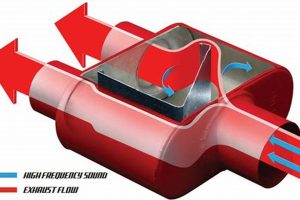
A component designed to attenuate sound produced by an internal combustion engine by facilitating the passage of exhaust gases. This device typically employs a straight-through design, minimizing backpressure while maximizing the volume of gases it can process. For example, in high-performance vehicles, a less restrictive exhaust system is often desired to improve engine efficiency.
The utilization of such a design is advantageous in applications where maximizing engine power output is paramount. Benefits include enhanced scavenging of exhaust gases from the engine cylinders, leading to increased horsepower and torque. Historically, these designs have been favored in motorsports and aftermarket performance upgrades due to their ability to reduce restriction in the exhaust system.
Understanding the principles of exhaust system design and the trade-offs between noise reduction and performance is crucial when selecting or modifying this component. Further exploration of specific configurations, materials used, and their impact on both acoustic properties and engine output will provide a more comprehensive understanding. This article will delve into these topics, offering a detailed analysis of their characteristics and applications.
Optimizing Exhaust System Performance
Maximizing the effectiveness of performance-oriented exhaust components requires careful consideration of several factors. The following tips outline key aspects to consider when selecting, installing, or maintaining exhaust systems utilizing a straight-through design.
Tip 1: Material Selection is Critical: Consider the material used in construction. Stainless steel offers superior corrosion resistance and longevity compared to aluminized steel, particularly in environments exposed to road salt or moisture. Titanium, while lightweight and strong, presents a higher cost.
Tip 2: Diameter Optimization: Choose the appropriate diameter for the intended application. An excessively large diameter can reduce exhaust gas velocity, negatively impacting engine scavenging and low-end torque. Conversely, an undersized diameter restricts flow, limiting high-RPM power.
Tip 3: Welding Quality Matters: Ensure the quality of welds is high. Poor welds can introduce leaks, reducing efficiency and potentially causing exhaust noise. TIG welding is generally preferred for its precision and strength.
Tip 4: Sound Level Considerations: Understand that a less restrictive design typically results in a louder exhaust note. Assess local noise regulations and personal preferences when choosing a specific model. Additional resonators can be integrated to mitigate excessive noise without significantly impacting performance.
Tip 5: Heat Management: Implement proper heat management strategies. Exhaust wrap or ceramic coatings can reduce radiant heat, preventing damage to nearby components and improving engine bay temperatures.
Tip 6: Proper Installation is Essential: Follow all manufacturer installation guidelines precisely. Incorrect installation can lead to leaks, vibrations, and reduced performance. Ensure proper alignment and secure all connections.
Tip 7: Regular Inspection and Maintenance: Conduct regular inspections to identify potential issues early. Check for leaks, corrosion, and damage. Replace worn or damaged components promptly to maintain optimal performance and prevent costly repairs.
By implementing these tips, users can ensure that performance-oriented exhaust systems function optimally, delivering the intended performance gains while minimizing potential drawbacks. Prioritizing quality materials, precise installation, and diligent maintenance is crucial for long-term performance and reliability.
The information provided offers a practical guide to maximizing the benefits of performance-enhanced exhaust designs. The subsequent sections will explore specific applications and advanced considerations in greater detail.
1. Reduced backpressure

Reduced backpressure is a defining characteristic and a primary functional goal in the design of such mufflers. The straight-through configuration, devoid of significant internal obstructions or restrictive baffles, directly contributes to minimizing resistance to exhaust gas flow. This minimization of resistance allows the engine to expel exhaust gases more efficiently. The resulting effect is a decrease in the pressure exerted against the pistons during the exhaust stroke. For instance, a vehicle equipped with a turbocharger benefits significantly from reduced backpressure, as the turbocharger’s performance is directly impacted by the ease with which exhaust gases can exit the engine.
The importance of reduced backpressure is particularly evident in high-performance engine applications. An engine operating with excessive backpressure experiences increased internal stresses, reduced volumetric efficiency, and ultimately, diminished power output. This pressure build-up impedes the complete evacuation of exhaust gases from the cylinders, leaving residual gases that dilute the incoming air-fuel mixture. Real-world examples demonstrate this: dyno tests frequently show a marked increase in horsepower and torque when replacing a restrictive factory muffler with a performance-oriented unit designed for low backpressure. Similarly, in racing environments, the pursuit of minimal backpressure is crucial for achieving optimal engine performance.
In summary, reduced backpressure is not merely a desirable feature, but a foundational element. It directly impacts engine efficiency, power output, and overall performance. The understanding of this relationship is vital for selecting and implementing exhaust systems that effectively balance noise reduction with the demand for unrestricted exhaust gas flow. The challenge lies in achieving the optimal balance between acoustics and performance, given that a more open design generally results in a louder exhaust note. Further investigation into the specific design attributes that contribute to reduced backpressure will yield a deeper understanding of the overall system effectiveness.
2. Straight-through design
The term “straight-through design” is intrinsically linked to the functional characteristic of a particular type of muffler. The straight-through configuration is the defining element that enables the unimpeded passage of exhaust gases, a key attribute sought after for performance enhancement. In essence, it describes an internal construction within the muffler where exhaust gases traverse in a relatively linear path, minimizing turbulence and backpressure. Without this design element, a muffler cannot truly be categorized as being capable of efficiently processing high-volume exhaust flow.
The correlation manifests practically in the performance benefits observed in vehicles equipped with such systems. For example, in turbocharged engines, the presence of a straight-through designed muffler significantly reduces the load on the turbine, allowing it to spin more freely and generate boost more quickly. This is in stark contrast to baffled muffler designs, where gases are forced to navigate a tortuous path through chambers and deflectors, significantly impeding flow. Similarly, in naturally aspirated engines, the straight-through design can improve cylinder scavenging, resulting in a more complete expulsion of exhaust gases and a more efficient intake of fresh air and fuel.
In conclusion, understanding the straight-through design is essential for comprehending the overall functionality. The design directly enables the desired performance characteristics. The selection of such a muffler necessitates a thorough understanding of the trade-offs involved, particularly in balancing performance gains with potential increases in noise levels. Future advancements in muffler technology will likely focus on refining the design to further minimize backpressure while simultaneously addressing noise mitigation concerns, solidifying the straight-through design as a fundamental principle.
3. Enhanced exhaust scavenging
Enhanced exhaust scavenging, the process of efficiently removing exhaust gases from the engine cylinders, is intrinsically linked to the design and implementation of flow-through mufflers. The principle underlying this connection is rooted in the minimization of backpressure. A less restrictive muffler allows exhaust gases to exit the combustion chamber with greater ease, creating a pressure differential that facilitates a more complete evacuation of spent gases. This improved scavenging effect contributes directly to enhanced engine performance. The more efficient removal of exhaust gases allows for a greater volume of fresh air and fuel to enter the cylinder during the intake stroke, leading to a more powerful combustion event. In essence, the design of the muffler becomes a critical element in optimizing the overall engine cycle.
The impact of enhanced exhaust scavenging is observable in various engine applications. For instance, in racing engines, where maximizing power output is paramount, flow-through muffler designs are frequently employed to minimize backpressure and promote efficient scavenging. The resulting increase in engine responsiveness and horsepower is a direct consequence of this improved exhaust gas evacuation. Similarly, in aftermarket performance upgrades, the installation of a flow-through muffler is often cited as a key component in unlocking additional engine performance. These systems are calibrated to work with the engine’s overall design to enhance scavenging and improve the combustion process. For example, removing the restrictive original exhaust and fitting a flow through exhaust results in better sound and better engine power.
In conclusion, enhanced exhaust scavenging is a crucial consequence of utilizing flow-through mufflers. The efficiency of this process is directly proportional to the muffler’s ability to minimize backpressure and facilitate the unobstructed passage of exhaust gases. This understanding is of practical significance for both engine designers and performance enthusiasts, guiding the selection and implementation of exhaust systems that optimize engine performance. While increased noise levels may pose a challenge, the benefits of enhanced scavenging, including improved engine responsiveness and increased power output, often outweigh this consideration in performance-oriented applications. Therefore, the selection and application of these mufflers are a trade-off between performance and noise reduction.
4. Performance optimization
Performance optimization, in the context of exhaust systems, refers to the strategic enhancement of engine output and efficiency through modifications to the exhaust flow dynamics. Flow-through mufflers are a key component in achieving this, offering a pathway to improved engine performance.
- Minimizing Backpressure for Power Gains
A primary objective of performance optimization is the reduction of backpressure within the exhaust system. Flow-through mufflers achieve this by offering a less restrictive pathway for exhaust gases compared to traditional baffled designs. The reduced backpressure allows the engine to expel exhaust gases more efficiently, resulting in increased horsepower and torque. In turbocharged applications, this reduction in backpressure can also improve turbocharger spool-up time, leading to enhanced throttle response.
- Enhancing Volumetric Efficiency
Improved exhaust flow directly impacts the engine’s volumetric efficiency, which is a measure of how effectively the engine fills its cylinders with air and fuel. By facilitating the rapid evacuation of exhaust gases, flow-through mufflers allow for a more complete intake of fresh air and fuel, leading to a more powerful combustion event. This is particularly noticeable at higher engine speeds, where the demand for efficient exhaust gas removal is greatest. This helps the vehicles run better and faster.
- Optimizing Exhaust Scavenging
Exhaust scavenging, the process of drawing exhaust gases out of the cylinders, is also enhanced by the use of flow-through mufflers. A less restrictive exhaust system creates a pressure wave that aids in the removal of exhaust gases from the cylinder during the overlap period, when both the intake and exhaust valves are open. This improved scavenging contributes to a cleaner burn, reduced emissions, and increased engine efficiency. Optimized Exhaust Scavenging ensures the vehicle runs smoothly and efficiently.
- Balancing Performance and Sound
While performance optimization is the primary goal, the resulting sound characteristics must also be considered. Flow-through mufflers often produce a more aggressive exhaust note compared to stock mufflers. Achieving the optimal balance between performance gains and acceptable sound levels requires careful selection of muffler design and materials. The better sound can result in better performance.
The strategic implementation of flow-through mufflers is a critical step in achieving performance optimization within the exhaust system. By minimizing backpressure, enhancing volumetric efficiency, optimizing exhaust scavenging, and carefully managing sound output, these components contribute significantly to improved engine output and overall vehicle performance. These benefits are relevant in both naturally aspirated and turbocharged engine applications, across different vehicles.
5. Sound level control

The ability to regulate acoustic output is a critical consideration in the design and application of flow-through mufflers. While the primary objective of these components is to enhance engine performance by minimizing exhaust backpressure, the trade-off often involves an increase in sound levels. Therefore, effective sound level control mechanisms are essential for compliance with noise regulations and for mitigating undesirable auditory effects.
- Acoustic Absorption Materials
The strategic use of sound-absorbing materials, such as fiberglass packing or woven metal mesh, within the muffler body plays a significant role in attenuating exhaust noise. These materials work by converting sound energy into heat through friction as sound waves pass through them. The effectiveness of these materials is dependent on their density, thickness, and placement within the muffler. For example, a thicker layer of fiberglass packing can provide greater sound reduction, but may also slightly increase backpressure. The correct balance ensures that the driver and passengers can enjoy their drive with minimum noise.
- Resonator Integration
Resonators are auxiliary chambers designed to cancel out specific frequencies of sound waves through destructive interference. These devices can be incorporated into the exhaust system, either as part of the muffler or as separate components, to target and eliminate drone, a low-frequency humming sound that can be particularly irritating. The effectiveness of a resonator is determined by its size, shape, and placement relative to the muffler. Precise tuning is required to ensure that the resonator effectively cancels out the targeted frequencies without negatively impacting exhaust flow.
- Muffler Chamber Design
While flow-through mufflers are characterized by their relatively unrestricted internal pathway, subtle variations in chamber design can influence sound characteristics. For example, the introduction of small internal diffusers or strategically placed perforations can disrupt the propagation of sound waves without significantly impeding exhaust flow. These design elements can help to attenuate higher-frequency sounds, resulting in a smoother and more controlled exhaust note. Optimizing muffler chamber design balances acoustic absorption without increasing backpressure.
- Exhaust Valve Systems
In some high-performance applications, exhaust valve systems are employed to provide dynamic sound level control. These systems utilize electronically controlled valves to alter the exhaust flow path, allowing for a quieter operation during normal driving conditions and a more aggressive exhaust note during performance driving. This offers a driver more control over their vehicles sound, whether they need to adhere to noise regulations or desire a more exciting driving experience.
In conclusion, effective sound level control in flow-through mufflers involves a multifaceted approach, incorporating acoustic absorption materials, resonator integration, subtle chamber design modifications, and, in some cases, electronically controlled exhaust valve systems. The optimal combination of these elements depends on the specific application, desired performance characteristics, and prevailing noise regulations. Understanding these mechanisms is crucial for selecting and implementing exhaust systems that effectively balance performance gains with acceptable sound levels.
6. Material durability

Material durability is a paramount consideration in the design and longevity of flow-through mufflers. The harsh environment in which these components operatecharacterized by high temperatures, corrosive exhaust gases, and exposure to road debrisnecessitates the selection of robust materials capable of withstanding degradation over extended periods. The material composition directly affects the muffler’s resistance to corrosion, thermal stress, and mechanical damage, influencing its lifespan and performance.
- Corrosion Resistance
Exhaust gases contain corrosive compounds, such as sulfur oxides and water vapor, which can attack and weaken the metal structure of the muffler. Materials like stainless steel (particularly 304 and 316 grades) offer superior corrosion resistance compared to aluminized steel. For example, a flow-through muffler constructed from 304 stainless steel is less susceptible to rust and pitting, maintaining its structural integrity and aesthetic appearance longer than a comparable muffler made from aluminized steel. The implementation of enhanced corrosion resistance extends the functional lifespan.
- Thermal Stress Resistance
The extreme temperature fluctuations experienced by a muffler during engine operation induce thermal stress, which can lead to fatigue and cracking of the material. Materials with high thermal conductivity and low thermal expansion coefficients, such as titanium and certain grades of stainless steel, exhibit better resistance to thermal stress. In high-performance applications where exhaust temperatures are exceptionally high, a titanium flow-through muffler is often preferred for its ability to withstand these stresses without deformation or failure. The result is consistent performance during operation.
- Mechanical Strength and Impact Resistance
Flow-through mufflers are vulnerable to mechanical damage from road debris, such as rocks and salt, which can impact the muffler body and compromise its structural integrity. Materials with high tensile strength and impact resistance, such as thick-gauge stainless steel or reinforced alloys, are better suited for withstanding these impacts. For example, an off-road vehicle equipped with a heavy-gauge stainless steel flow-through muffler is more likely to survive harsh terrain without sustaining damage that could impair its performance or lead to premature failure. The enhanced mechanical strength improves its longevity.
- Weld Integrity
The quality and durability of welds are crucial for maintaining the structural integrity of a flow-through muffler. Welds are often the weakest points in the structure, and poor welding techniques or the use of incompatible filler materials can lead to weld failure under stress. Stainless steel mufflers typically require TIG welding with compatible filler metals to ensure strong, corrosion-resistant welds. An example of the need for high integrity welds is seen when poor weld quality can result in leaks, vibrations, and ultimately, muffler failure, requiring costly repairs or replacement.
In conclusion, the material selection significantly impacts the durability and performance of flow-through mufflers. By considering corrosion resistance, thermal stress resistance, mechanical strength, and weld integrity, manufacturers can produce mufflers that withstand the rigors of the exhaust environment, ensuring long-term reliability and sustained performance. The proper consideration and implementation of appropriate materials ultimately extend its useful lifespan, while maximizing performance.
Frequently Asked Questions
This section addresses common inquiries regarding the functionality, application, and maintenance of flow-through mufflers. The following questions and answers aim to provide clarity and dispel misconceptions surrounding these performance-oriented exhaust components.
Question 1: What distinguishes a flow-through muffler from a traditional baffled muffler?
A flow-through muffler is characterized by its internal design, which allows exhaust gases to pass through with minimal obstruction. This contrasts with baffled mufflers, which utilize a series of chambers and deflectors to attenuate sound, resulting in increased backpressure.
Question 2: Does the installation of a flow-through muffler always guarantee increased horsepower?
While a flow-through muffler can contribute to increased horsepower by reducing backpressure, the actual gains are dependent on several factors, including the engine’s overall design, existing exhaust system configuration, and any other modifications performed. The expected performance gains are dependent on the engine’s design.
Question 3: Are flow-through mufflers excessively loud, and are there methods to mitigate the noise?
Flow-through mufflers typically produce a louder exhaust note compared to stock mufflers. However, the noise level can be managed through the use of resonators, acoustic absorption materials, or electronically controlled exhaust valves. The desired sound levels may require further adjustment through the exhaust system.
Question 4: What materials are commonly used in the construction of flow-through mufflers, and which offers the best durability?
Common materials include aluminized steel, stainless steel, and titanium. Stainless steel, particularly 304 and 316 grades, generally offers the best balance of corrosion resistance, thermal stability, and cost-effectiveness, making it a durable choice.
Question 5: How does one properly maintain a flow-through muffler to ensure its longevity?
Regular inspections for leaks, corrosion, and damage are crucial. Promptly addressing any issues, such as weld failures or material degradation, will extend the lifespan of the muffler. Also, cleaning it periodically can help maintain performance and appearance. Periodic maintenance helps ensure proper function.
Question 6: Can flow-through mufflers be installed on any vehicle, or are they restricted to certain applications?
While flow-through mufflers can be installed on a wide range of vehicles, compatibility depends on factors such as exhaust system dimensions, mounting configurations, and intended use. Consulting with a qualified mechanic or exhaust specialist is recommended to ensure proper fitment and optimal performance.
In summary, flow-through mufflers represent a performance-enhancing exhaust component that requires careful consideration of various factors, including intended application, sound level preferences, and material durability. Proper selection, installation, and maintenance are crucial for realizing the benefits of reduced backpressure and improved engine performance.
The subsequent sections will explore specific applications and advanced considerations in greater detail.
Conclusion
This article has provided a comprehensive overview of the component in the exhaust system. Key points have been highlighted, including its performance advantages and implications. A deep understanding of “flow through muffler” design, application, and maintenance is paramount for vehicle enhancement and optimal performance levels. These components play a crucial role in optimizing exhaust gas flow, but it is important to have a clear grasp of the overall system and specific parameters.
Selecting the correct muffler will impact overall performance. It is critical to approach this topic with a measured understanding of both its possibilities and constraints. Continued research and technological advancement will only further reveal and refine their integration, ensuring both an optimization of output and sound and also providing a better understanding of “flow through muffler”.

![Avondale Muffler Masters: Exhaust Repair Pros, [Year] | Best Mufflers for Cars & Trucks | Performance, Sound & Durability Upgrades](https://dnamufflers.com/wp-content/uploads/2026/09/th-5-300x200.jpg "Avondale Muffler Masters: Exhaust Repair Pros, [Year] Best Mufflers for Cars & Trucks | Performance, Sound & Durability Upgrades")