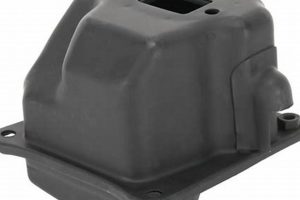
An automotive component designed to reduce the acoustic intensity of exhaust gases expelled from an internal combustion engine. This device utilizes a series of chambers and tubes strategically arranged to attenuate sound waves through reflection and absorption, minimizing noise pollution. A common example is the metal casing found in most vehicles’ exhaust systems.
The effective operation of these components is critical for maintaining acceptable noise levels in urban environments and residential areas. Their development has been driven by both regulatory requirements and consumer demand for quieter vehicles. Historically, advancements in materials science and acoustic engineering have led to progressively more efficient and durable designs.
The subsequent sections of this analysis will explore specific design features, material considerations, performance characteristics, and environmental impact of these noise reduction devices in detail.
Maximizing Performance and Longevity
This section provides guidance to ensure optimal functionality and extended service life of exhaust noise reduction systems.
Tip 1: Regular Inspection is Essential. Conduct routine visual checks for signs of corrosion, physical damage, or leaks. Early detection of these issues can prevent more extensive and costly repairs.
Tip 2: Address Rust Promptly. Surface rust should be treated immediately to prevent it from compromising the structural integrity of the component. Use appropriate rust converters and protective coatings.
Tip 3: Ensure Proper Mounting. Verify that all mounting brackets and hangers are securely attached and in good condition. Vibration and movement can accelerate wear and tear if the system is not properly supported.
Tip 4: Avoid Short Trips. Frequent short trips can lead to condensation buildup within the device, accelerating internal corrosion. Ensure the engine reaches operating temperature to allow for moisture evaporation.
Tip 5: Select Quality Replacements. When replacement is necessary, opt for components manufactured to original equipment specifications or higher. Inferior products may offer reduced performance and durability.
Tip 6: Professional Installation is Recommended. While some maintenance tasks can be performed by vehicle owners, complex repairs or replacements should be entrusted to qualified technicians to ensure proper fitment and functionality.
Following these guidelines contributes to the continued efficient operation and prolonged lifespan of exhaust noise reduction systems, resulting in reduced noise pollution and minimized repair expenses.
The subsequent conclusion will summarize the key findings and reinforce the importance of these components.
1. Noise Reduction Efficiency

Noise reduction efficiency, in the context of exhaust noise reduction devices, quantifies the device’s capacity to attenuate sound pressure levels generated by an internal combustion engine. This metric is a primary indicator of the device’s performance and is a critical factor in meeting regulatory noise standards and consumer expectations for vehicle quietness.
- Acoustic Attenuation Mechanisms
The device achieves noise reduction through various acoustic principles, including absorption, reflection, and interference. Absorption involves converting sound energy into heat within porous materials like fiberglass packing. Reflection utilizes strategically placed baffles and chambers to redirect sound waves, causing them to cancel each other out. Interference employs destructive interference patterns to diminish the amplitude of sound waves. The effectiveness of these mechanisms directly impacts the overall noise reduction efficiency.
- Frequency-Specific Attenuation
Exhaust noise comprises a spectrum of frequencies, and the efficiency often varies across this spectrum. Some designs are optimized for low-frequency attenuation, while others prioritize high-frequency reduction. The specific design choices, such as chamber size and baffle configuration, determine the frequency response of the component. An efficient device provides balanced attenuation across the relevant frequency range.
- Backpressure Considerations
While maximizing noise reduction is a primary goal, it must be balanced against the need to minimize backpressure. Excessive backpressure can negatively impact engine performance, reducing power and fuel efficiency. Efficient designs strive to achieve high noise reduction without unduly restricting exhaust flow. This often involves carefully optimizing the internal geometry of the device to minimize flow resistance.
- Material Properties and Construction
The materials used in construction, and the methods employed, significantly influence noise reduction efficiency. Durable, high-temperature-resistant materials are essential for long-term performance. The precision of the component is critical for ensuring optimal acoustic performance. Variations in chamber dimensions or baffle placement can degrade efficiency. The use of advanced manufacturing techniques, such as computer-aided design and precision welding, is crucial for achieving consistent and reliable performance.
The cumulative effect of these factors determines the overall noise reduction efficiency of an exhaust noise reduction device. Evaluating these parameters is essential for selecting or designing components that meet both noise reduction targets and engine performance requirements. Furthermore, continual advancement in material science and acoustic engineering will further refine the designs and functionality of these devices to mitigate unwanted vehicular noise emissions.
2. Material Durability
Material durability is a paramount consideration in the design and performance of any exhaust noise reduction system. These components are subjected to a uniquely harsh operational environment, enduring extreme temperature fluctuations, corrosive exhaust gases, and mechanical vibrations. Premature failure due to material degradation leads to increased noise pollution, compromised vehicle performance, and elevated maintenance costs. Therefore, the selection of appropriate materials with robust durability characteristics is crucial for ensuring the long-term effectiveness of these systems. Stainless steel, for instance, is frequently employed due to its high resistance to corrosion, as opposed to aluminized steel which, while more economical, exhibits a shorter lifespan in similar conditions. The material selected can dictate the period between replacement.
The corrosive nature of exhaust gases, containing compounds such as sulfur dioxide and nitrogen oxides, poses a significant threat to material integrity. Elevated temperatures, often exceeding several hundred degrees Celsius, accelerate the rate of corrosion and thermal fatigue. Furthermore, mechanical vibrations induced by engine operation contribute to material stress and potential failure points, especially at welded joints or mounting points. A real-world example demonstrating this point is the tendency for less durable systems made of mild steel to corrode extensively in regions with high road salt usage during winter, resulting in premature failure and necessitating costly replacements. The ability to tolerate these factors is what differentiates a longer lasting exhaust component.
In summary, material durability directly impacts the lifespan and overall effectiveness of exhaust noise reduction components. Choosing materials that can withstand the demanding operating conditions is vital for mitigating noise pollution, maintaining vehicle performance, and reducing the life-cycle costs associated with exhaust system maintenance. The ongoing development of advanced materials with enhanced durability characteristics will contribute significantly to the advancement of quieter, more reliable, and environmentally responsible vehicles.
3. Backpressure Optimization

Backpressure optimization within exhaust systems represents a critical engineering balance, directly impacting engine performance and the effectiveness of exhaust noise reduction devices. Excessive backpressure compromises engine efficiency, while insufficient backpressure can detrimentally affect low-end torque. The design of a muffler silencer must therefore carefully consider these opposing forces.
- Core Design
The internal design of the muffler silencer directly dictates the amount of backpressure generated. Straight-through designs, while minimizing backpressure, may offer reduced noise attenuation. Chambered designs, conversely, provide enhanced noise reduction but typically increase backpressure. Engineers must carefully modulate chamber size, baffle placement, and internal tubing diameter to achieve an optimal balance.
- Material Choice and Its Impact
Material selection also influences backpressure characteristics. Rough internal surfaces increase frictional resistance to exhaust flow, thus elevating backpressure. Smooth-walled materials, like polished stainless steel, reduce this resistance. However, material cost and durability must be considered alongside backpressure minimization.
- Engine-Specific Tuning
Optimal backpressure is engine-specific, depending on factors such as displacement, cylinder configuration, and intended application. A muffler silencer designed for a high-performance engine may be unsuitable for a fuel-efficient commuter vehicle due to mismatched backpressure characteristics. Consequently, manufacturers often offer a range of muffler designs tailored to specific engine types.
- The Role of Exhaust System Diameter
The exhaust piping diameter upstream and downstream of the device plays a critical role. Undersized piping can negate the benefits of a low-backpressure muffler silencer, while oversized piping can diminish exhaust scavenging effects. Proper sizing of the entire exhaust system is essential for achieving optimal engine performance and sound reduction.
In conclusion, backpressure optimization is an essential consideration in the design and selection of a muffler silencer. A well-designed component minimizes the negative effects of backpressure on engine performance while effectively attenuating exhaust noise, contributing to both vehicle efficiency and environmental responsibility. Achieving this delicate balance requires careful attention to internal design, material selection, and engine-specific tuning, ultimately improving the overall vehicle performance and reducing noise pollution.
4. Thermal Resistance

Thermal resistance, in the context of exhaust noise reduction devices, represents a component’s ability to withstand high temperatures and thermal cycling without undergoing significant material degradation or structural failure. This characteristic is critical due to the extreme operating conditions within exhaust systems, where temperatures can fluctuate rapidly and routinely exceed several hundred degrees Celsius. Insufficient thermal resistance leads to premature component failure, increased noise output, and potential safety hazards.
The primary cause of concern stems from the direct exposure to hot exhaust gases, coupled with external environmental factors. For example, consider a vehicle operating in a cold climate, where the external surface of the muffler silencer is exposed to sub-zero temperatures while the internal components are subjected to searing heat. This extreme thermal gradient induces significant stress within the material, leading to fatigue and eventual cracking. Similarly, the cyclical heating and cooling during normal vehicle operation causes expansion and contraction, further exacerbating material stress. The selection of materials with high thermal resistance, such as certain grades of stainless steel or specialized alloys, is therefore essential to ensure long-term structural integrity. Examples of thermal barrier coatings applied to exhaust components represent a direct effort to improve resistance by reflecting radiant heat and reducing surface temperature.
In conclusion, thermal resistance is a foundational characteristic for exhaust noise reduction systems. Its importance extends beyond simple longevity, impacting safety, performance, and environmental compliance. Understanding the interplay between operating conditions, material properties, and design considerations is crucial for developing and maintaining effective and reliable exhaust noise reduction devices. Continual advancements in material science and thermal management techniques are vital for addressing the evolving demands of modern internal combustion engines and stringent emission regulations.
5. System Integration

The performance of a muffler silencer is inextricably linked to its integration within the broader exhaust system and overall vehicle architecture. This interconnection extends beyond simple physical attachment, encompassing considerations of exhaust gas flow dynamics, engine control systems, and vehicle noise emission standards. A muffler silencer designed and implemented without careful consideration of its interaction with other components will likely exhibit suboptimal performance, potentially leading to reduced engine efficiency, increased noise levels, and regulatory non-compliance. For instance, a muffler silencer optimized for a specific engine type and exhaust manifold design may perform poorly if installed on a vehicle with a different configuration due to mismatches in flow rates and pressure characteristics. Proper integration begins with understanding the specific engine and vehicle characteristics.
Effective system integration requires a holistic approach, considering the muffler silencer as a component within a larger, interconnected network. This involves analyzing exhaust gas flow patterns, pressure waves, and temperature gradients throughout the entire exhaust system. Engine control systems also play a crucial role, as they regulate engine parameters such as fuel injection and ignition timing, which in turn influence the characteristics of the exhaust gases entering the muffler silencer. Furthermore, vehicle manufacturers must adhere to stringent noise emission regulations, necessitating careful coordination between muffler silencer design and overall vehicle noise control strategies. An example of this is the inclusion of resonators in conjunction with the main muffler, which address specific noise frequencies that the muffler alone cannot effectively attenuate. The integration of these components requires precise acoustic modeling and testing.
In conclusion, system integration is not merely a peripheral consideration but rather an essential determinant of muffler silencer performance. Neglecting this aspect can lead to compromised engine efficiency, increased noise pollution, and regulatory violations. A comprehensive understanding of the interactions between the muffler silencer, the exhaust system, the engine control system, and the overall vehicle architecture is paramount for achieving optimal performance and compliance. The ongoing refinement of simulation tools and testing methodologies will continue to drive improvements in system integration, leading to quieter, more efficient, and more environmentally responsible vehicles.
Frequently Asked Questions About Muffler Silencers
The following section addresses common inquiries regarding the function, maintenance, and selection of exhaust noise reduction devices, commonly referred to as muffler silencers.
Question 1: What is the primary function of a muffler silencer?
The primary function is to reduce the noise generated by an internal combustion engine’s exhaust. This is achieved through a combination of sound wave interference, absorption, and redirection within the device’s internal chambers and passages.
Question 2: How does a damaged muffler silencer impact vehicle performance?
A damaged system can negatively affect engine performance by increasing backpressure, potentially reducing fuel efficiency and horsepower. Additionally, it will likely lead to increased noise output, potentially violating local noise ordinances.
Question 3: What are the signs of a failing muffler silencer?
Common indicators include increased exhaust noise, visible rust or corrosion, physical damage (dents, holes), and a rattling or hissing sound emanating from the exhaust system.
Question 4: Are all muffler silencers interchangeable?
No. These components are typically designed for specific vehicle makes and models. Using an incompatible device can lead to performance issues, improper fitment, and potential damage to the exhaust system.
Question 5: Can aftermarket muffler silencers improve vehicle performance?
Some aftermarket options are designed to reduce backpressure, potentially improving horsepower and fuel efficiency. However, it is important to select components that are compatible with the vehicle’s engine and exhaust system to avoid adverse effects.
Question 6: How often should a muffler silencer be inspected?
A visual inspection should be conducted at least annually, or more frequently if the vehicle is subjected to harsh driving conditions or operated in environments with high road salt usage.
Properly functioning exhaust noise reduction devices are crucial for minimizing noise pollution and maintaining optimal vehicle performance. Regular inspections and timely replacements are essential for ensuring continued effectiveness.
The subsequent section will delve into the environmental implications associated with the use and disposal of these components.
Conclusion
This analysis has explored the critical role of the muffler silencer in mitigating noise pollution from internal combustion engines. It emphasized the intricate balance between noise reduction efficiency, material durability, backpressure optimization, and thermal resistance. Furthermore, the importance of system integration for optimal performance and regulatory compliance was highlighted.
Continued advancements in material science, acoustic engineering, and system design are essential for developing more effective and durable muffler silencer technologies. These innovations are vital for ensuring quieter, more fuel-efficient vehicles and fostering a more sustainable and environmentally conscious transportation sector. The responsible design, maintenance, and eventual disposal of these components remain crucial for minimizing their overall environmental impact.