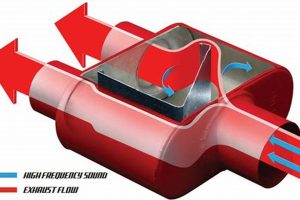
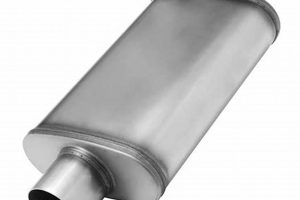
A configuration employing two separate exhaust silencing devices is used in some internal combustion engine systems. This design diverts exhaust gases through parallel pathways, each containing a dedicated noise-reducing component. An automotive application, for instance, might feature one silencer positioned on each side of the vehicle, connected to a common exhaust manifold. This setup differs from a single, larger unit and distributes the exhaust flow.
This dual configuration can offer several advantages. The distribution of exhaust flow can reduce backpressure, potentially improving engine performance and fuel efficiency. Aesthetically, it provides a balanced visual appeal, often preferred in high-performance vehicles. Historically, this type of setup has been favored where space constraints make a single, larger unit impractical, or where a specific exhaust note is desired.
The following sections will delve into specific applications, performance characteristics, and design considerations related to these systems. This includes an examination of their impact on engine output, acoustic properties, and overall vehicle dynamics.
Guidance on Dual Exhaust Silencer Systems
The following provides pertinent information regarding the implementation and maintenance of systems incorporating two separate exhaust silencing devices.
Tip 1: System Compatibility: Ensure the chosen devices are correctly matched to the engine displacement and horsepower rating. Under-sized components may restrict exhaust flow, while oversized units may not provide adequate noise reduction.
Tip 2: Material Selection: Consider material properties when selecting components. Stainless steel offers superior corrosion resistance in environments exposed to road salts and moisture. Aluminized steel presents a more economical alternative, albeit with reduced lifespan in harsh conditions.
Tip 3: Proper Installation: Adhere to specified torque values during installation to prevent leaks at connecting flanges. Employ new gaskets and exhaust hangers to ensure a secure and vibration-dampened assembly.
Tip 4: Acoustic Tuning: The physical characteristics, internal structure, and pipe routing of this type of device influence the exhaust tone. Experiment with variations to achieve the desired auditory profile, balancing loudness and sound quality.
Tip 5: Routine Inspection: Conduct periodic inspections for signs of corrosion, damage, or loose connections. Address issues promptly to maintain optimal performance and prevent potential exhaust leaks.
Tip 6: Backpressure Assessment: Monitor engine performance for indications of excessive backpressure. A dynamometer test or exhaust gas analysis can provide quantitative data to assess system efficiency.
Proper selection, installation, and maintenance of this type of exhaust system can optimize engine performance, enhance acoustic characteristics, and extend component lifespan.
The concluding section will summarize the core principles discussed and offer further avenues for exploration.
1. Reduced backpressure
The installation of an exhaust system that utilizes two mufflers frequently results in decreased backpressure compared to a single-muffler setup. This reduction stems from the increased cross-sectional area available for exhaust gases to flow through. By dividing the exhaust stream, each muffler handles a smaller volume, thereby lowering the resistance to gas flow. Lower backpressure allows the engine to expel exhaust gases more efficiently, potentially leading to increased power output, particularly at higher engine speeds. An illustrative example can be found in many modern sports cars, where this configuration is implemented to optimize engine performance.
The effect of lower backpressure is not universally beneficial and must be considered within the context of the engine’s design parameters. In some low-speed, high-torque applications, a certain level of backpressure can aid in scavenging the cylinders, resulting in improved low-end performance. However, for engines designed to operate at higher revolutions, the benefits of reduced backpressure generally outweigh any potential disadvantages. The selection of the correct muffler size and design within a twin-muffler system is therefore crucial in achieving the desired engine characteristics.
In summary, the correlation between a twin-muffler system and reduced backpressure is based on the increased exhaust flow capacity. Understanding this relationship is essential for optimizing engine performance in specific applications, taking into account engine type and intended use. Challenges remain in precisely quantifying the effect of this configuration on different engines, necessitating careful experimentation and data analysis.
2. Enhanced aesthetics
The utilization of two exhaust silencing devices often contributes to an enhanced aesthetic appeal, particularly in automotive design. This aesthetic improvement arises from the visual symmetry and balanced proportions achieved through the dual outlet configuration. Instead of a single, often asymmetrically positioned exhaust tip, a dual system presents a balanced appearance, influencing the perceived sportiness and high-performance nature of the vehicle. The strategic placement of two exhaust outlets can complement the vehicle’s rear fascia design, integrating seamlessly with other styling elements such as diffusers and bumper contours.
Examples of this enhanced aesthetic are prevalent in various vehicle segments. High-performance sports cars frequently employ this system to underscore their performance capabilities. Luxury vehicles may use it to convey a sense of sophistication and attention to detail. Even some mainstream vehicles adopt dual outlet systems to enhance their perceived value and appeal to consumers. The specific design of the exhaust tips themselves, including their shape, finish, and material, further contributes to the overall aesthetic impact. Round tips, square tips, and even integrated designs are all employed to achieve specific visual objectives, working in concert with the vehicle’s broader design language.
In conclusion, the aesthetic benefits derived from employing this dual-silencer configuration are significant and contribute to a vehicle’s overall appeal. The symmetrical layout and potential for customized tip designs allow manufacturers to enhance the perceived value and performance of their vehicles. Though subjective, the aesthetic impact is a crucial factor influencing consumer preferences and purchasing decisions. Manufacturers who understand and leverage the potential of the setup can effectively differentiate their products in a competitive market.
3. Balanced Exhaust Flow

Balanced exhaust flow, achieved through the use of two mufflers, is a critical consideration in optimizing engine performance and exhaust system efficiency. The distribution of exhaust gases across two pathways influences several factors, directly impacting the engine’s operating characteristics.
- Reduced Flow Restriction
A dual-muffler system divides the total exhaust volume, decreasing the flow rate through each individual muffler. This reduced flow restriction translates to lower backpressure within the exhaust system. The decreased pressure enhances the engine’s ability to expel exhaust gases, potentially increasing horsepower and improving fuel economy. Consider a V6 engine where each bank of cylinders feeds a separate muffler; this evenly distributes the exhaust load.
- Minimized Engine Strain
Uneven exhaust flow can create stress on specific cylinders within the engine. A balanced system ensures that each cylinder operates under similar exhaust backpressure conditions, which reduces strain and promotes more uniform wear across the engine. Engines with uneven cylinder firing orders or asymmetrical exhaust manifold designs benefit significantly from this balancing effect, as seen in some inline engines.
- Improved Exhaust Scavenging
Uniform exhaust scavenging refers to the efficient removal of exhaust gases from the cylinders during the exhaust stroke. A balanced system contributes to more consistent scavenging across all cylinders, improving the engine’s volumetric efficiency and combustion process. This can be particularly advantageous in turbocharged engines, where effective scavenging is crucial for maintaining turbocharger response.
- Optimized Catalyst Performance
Catalytic converters rely on consistent exhaust gas composition and temperature to function effectively. Uneven flow distribution can lead to temperature variations and localized enrichment or lean conditions, reducing catalyst efficiency. A balanced system ensures a more homogenous exhaust stream, promoting optimal catalyst performance and emissions control. This is relevant in achieving regulatory compliance for modern vehicles.
Therefore, the implementation of a two-muffler system is not merely an aesthetic choice but a functional one that actively influences engine performance and longevity through balanced exhaust flow. While specific gains depend on the engine architecture and exhaust system design, the principles of reduced restriction, minimized strain, improved scavenging, and optimized catalyst performance remain constant across various applications.
4. Acoustic customization
Acoustic customization, in the context of systems employing two silencers, relates to the ability to manipulate the exhaust sound characteristics to achieve a desired auditory profile. This manipulation extends beyond simple noise reduction to encompass adjustments in tone, volume, and overall sound quality. The dual-muffler configuration provides opportunities for acoustic tuning not readily available in single-muffler systems.
- Muffler Volume and Design
The physical dimensions and internal architecture of each silencer significantly influence the resulting sound. Larger volume mufflers generally produce lower frequency sounds, while smaller units tend to attenuate higher frequencies. Baffled designs, chambered designs, and absorption-type designs each impart distinct acoustic characteristics. By varying the muffler types within the twin-muffler system, the overall sound can be tailored to a specific preference. An example includes using a chambered muffler on one side to emphasize lower tones and an absorption muffler on the other for overall sound level reduction.
- Pipe Diameter and Length
The diameter and length of the exhaust piping connecting the engine to the mufflers, and the mufflers to the exhaust outlets, affect the resonant frequencies within the system. Longer pipes tend to emphasize lower frequencies, while shorter pipes favor higher frequencies. Adjustments to pipe diameter influence the velocity of exhaust gases and, consequently, the sound produced. An example is varying pipe lengths between the two mufflers to create subtle differences in sound arrival times at the exhaust outlets, producing a unique acoustic signature.
- Resonator Integration
Resonators, which are specifically tuned acoustic chambers, can be integrated into the exhaust system to target and attenuate specific frequencies. A twin-muffler system allows for the strategic placement of resonators in either or both exhaust pathways. The targeted frequency cancellation effectively reduces unwanted droning or harshness, improving the overall sound quality. An example is adding a Helmholtz resonator to one side of the system to eliminate a specific frequency known to cause cabin resonance.
- X-Pipe or H-Pipe Implementation
An X-pipe or H-pipe, which connects the two exhaust pathways, can significantly alter the sound characteristics. These devices promote exhaust gas scavenging and create a more balanced pressure distribution, often resulting in a smoother and more refined exhaust note. The specific placement and design of the X-pipe or H-pipe influence the degree of acoustic change. An example is using an X-pipe to create a higher-pitched, more aggressive exhaust note compared to a system with no interconnecting pipe.
These various methods of acoustic customization, when applied to a twin-muffler configuration, provide a nuanced level of control over the exhaust sound. The ability to independently adjust muffler characteristics, pipe dimensions, resonator integration, and interconnecting pipe design allows for a wide range of acoustic possibilities, tailored to specific vehicle applications and individual preferences. While achieving a precise auditory profile requires careful experimentation and acoustic analysis, the design offers significant advantages in shaping the exhaust sound characteristics.
5. Space optimization

The strategic arrangement of vehicle components is a critical aspect of automotive design. In exhaust systems, particularly, spatial constraints often necessitate innovative solutions. A configuration utilizing two mufflers frequently arises as a viable method for achieving efficient noise reduction without compromising available volume.
- Distributed Volume
Employing two smaller units offers increased flexibility in accommodating the exhaust system within the undercarriage. This distributed volume approach is beneficial in vehicles with limited longitudinal space or those incorporating complex suspension systems that encroach upon the exhaust routing. A single, large muffler might prove infeasible in such scenarios, while two smaller units can be positioned more strategically within the available area. An example includes certain sports cars where the transmission tunnel and rear suspension components necessitate a split exhaust design.
- Weight Distribution Considerations
The placement of components influences the overall vehicle balance. Dividing the silencing function across two units allows for a more symmetrical weight distribution compared to a single, heavier component located on one side. This balanced arrangement contributes to improved handling characteristics and reduced yaw inertia. Some all-wheel-drive vehicles utilize twin mufflers to maintain a balanced weight distribution along the vehicle’s longitudinal axis.
- Adaptability to Chassis Configuration
Different chassis designs present unique challenges for exhaust system integration. Ladder frame constructions, commonly found in trucks and SUVs, often require exhaust systems to navigate around frame rails and suspension mounting points. In these cases, two smaller components can be more easily routed to avoid interference. A compact car with a rear-mounted fuel tank may also benefit from a twin-muffler system to create space for the exhaust path.
- Modular Design Integration
A dual configuration enables modular design approaches, where pre-fabricated components are integrated into the overall exhaust system. This modularity simplifies the manufacturing process and allows for greater customization options. Individual manufacturers can adapt the mufflers’ specifications to align with particular performance needs or sound characteristics without requiring complete system redesigns. This approach promotes manufacturing efficiencies and reduces production costs.
The benefits of distributing exhaust silencing duties between two components extend beyond mere packaging convenience. Improved weight distribution, adaptability to different chassis designs, and facilitation of modular design practices all contribute to the overall effectiveness of a system using dual mufflers. The advantages become particularly pronounced in applications where spatial constraints and vehicle dynamics are paramount considerations.
Frequently Asked Questions Regarding Twin Muffler Systems
The following addresses common inquiries and clarifies misconceptions surrounding the design and application of exhaust systems utilizing two separate mufflers.
Question 1: Does a dual-muffler configuration invariably increase horsepower?
A twin-muffler setup can increase horsepower, but it is not guaranteed. The primary factor is reduced backpressure, which eases the engine’s exhaust expulsion. However, the degree of improvement depends on the engine’s characteristics and the design of the entire exhaust system. If the original system already provides adequate flow, the gains may be minimal.
Question 2: Are these systems louder than single-muffler systems?
Not necessarily. While a higher flow rate can lead to increased volume, the mufflers themselves determine the final sound level. It is possible to design a twin-muffler setup that is quieter than a single, less efficient unit. The specific internal architecture and materials used in the mufflers are crucial to sound attenuation.
Question 3: Do vehicles with systems employing two silencers require specialized maintenance?
The maintenance requirements are generally similar to those of single-muffler systems. Routine inspections for corrosion, leaks, and damaged hangers are essential. The presence of two mufflers does not inherently introduce new or unique maintenance procedures. However, if one muffler fails, both should be inspected to ensure balanced performance after replacement.
Question 4: Is a twin-muffler system compatible with any vehicle?
While technically feasible to install on many vehicles, the practicality depends on available space and chassis configuration. Vehicles designed with a single exhaust outlet might require modifications to the undercarriage and bumper to accommodate the second outlet. Careful consideration should be given to exhaust routing and potential interference with other components.
Question 5: Does the installation of a two-muffler system void a vehicle’s warranty?
The impact on warranty coverage depends on the specific terms of the warranty and the nature of the modification. If the twin-muffler installation is performed improperly or causes damage to other vehicle components, the warranty could be voided for those affected parts. Consult the vehicle’s warranty documentation and consider professional installation to minimize potential issues.
Question 6: Are all twin-muffler systems created equal in terms of performance and sound?
No. Significant variations exist in performance, sound characteristics, and build quality between different brands and designs. Factors such as muffler volume, internal construction, pipe diameter, and material selection all contribute to these differences. Research and comparison of specifications and user reviews are crucial in selecting a system that meets specific needs and expectations.
In conclusion, while they can offer performance and aesthetic benefits, a careful selection and installation approach is necessary. Proper considerations for vehicle compatibility, warranty implications, and potential sound or performance deviations from the original exhaust system are essential.
The next segment will explore case studies where this specific configuration has demonstrably impacted vehicle dynamics.
Conclusion
This exploration has detailed the multifaceted nature of the twin muffler system. From its potential to reduce backpressure and enhance engine performance to its contribution to vehicle aesthetics and acoustic customization, the advantages are considerable. The spatial optimization afforded by a dual configuration is also a significant factor in certain vehicle designs. Understanding these benefits allows for informed decisions regarding exhaust system selection and modification.
The twin muffler configuration represents a balance of performance, aesthetics, and engineering considerations. Further research and development in exhaust system design may yield even more refined solutions, optimizing both vehicle performance and environmental impact. Continued investigation into the acoustic properties of these systems will also contribute to a greater understanding of noise reduction and sound shaping in automotive engineering.