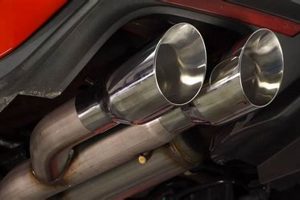
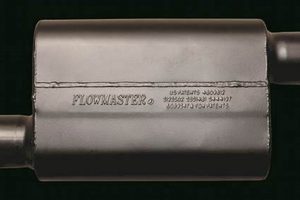
The component under consideration is a vehicle exhaust system element engineered to produce the lowest frequency and most resonant tone possible. These parts are designed with specific internal structures that manipulate sound waves, diminishing higher frequencies and emphasizing lower ones. An example would be a chambered or baffled unit constructed to amplify bass tones while suppressing higher-pitched noises.
The significance of this type of equipment lies in its ability to alter the auditory experience of a vehicle’s operation. The deeper, more powerful sound can be perceived as an enhancement of the vehicle’s performance and aesthetics. Historically, such modifications have been popular among enthusiasts seeking to personalize their vehicles and express their individual style. The benefit is primarily aesthetic, contributing to a perceived increase in the vehicle’s character.
The following sections will explore various designs, materials, and considerations involved in achieving the desired low-frequency exhaust note, as well as examining the legal and environmental ramifications of modifying vehicle exhaust systems.
Achieving a Resonant Exhaust Tone
Optimizing a vehicle’s exhaust system for a deep, resonant sound requires careful consideration of several factors. This section provides guidance on achieving the desired auditory profile while maintaining regulatory compliance and vehicle performance.
Tip 1: Material Selection: Choose heavier gauge steel, such as stainless steel, for its inherent damping characteristics. Thicker materials tend to absorb higher frequencies, contributing to a lower, more profound tone. The density of the metal directly impacts sound wave propagation.
Tip 2: Chamber Design: Opt for a multi-chamber design featuring strategically placed baffles. These chambers promote sound wave cancellation at higher frequencies while amplifying lower frequencies. The internal geometry is crucial in shaping the exhaust note.
Tip 3: Exhaust Pipe Diameter: A slightly larger diameter exhaust pipe can contribute to a deeper sound. However, excessive diameter can reduce backpressure, negatively affecting engine performance, particularly in naturally aspirated vehicles. A balanced approach is necessary.
Tip 4: Resonator Placement: Consider incorporating a resonator further upstream in the exhaust system. Resonators are designed to target and eliminate specific frequencies, allowing for fine-tuning of the overall exhaust note and mitigating unwanted drone.
Tip 5: Pipe Routing and Length: The length and bends in the exhaust piping influence the sound characteristics. Longer exhaust systems generally produce deeper tones due to increased sound wave attenuation. Avoid sharp bends, as they can disrupt exhaust flow and alter the sound.
Tip 6: Catalytic Converter Impact: Be aware that catalytic converters significantly affect sound. High-flow catalytic converters will reduce backpressure and slightly change the exhaust note. It’s essential to consider this when selecting the exhaust system components.
Achieving a specific exhaust sound is a process of balancing various factors to get the tone you desired, while also considering regulatory compliance and performance is crucial for your vehicle.
The subsequent section will discuss the legal and environmental aspects related to exhaust system modifications.
1. Internal Volume

Internal volume within an exhaust component plays a critical role in shaping the resultant sound profile, particularly when the objective is to achieve a low-frequency, resonant tone. The physical space available within the component influences the behavior of sound waves, with direct implications for the depth and quality of the exhaust note.
- Sound Wave Amplitude Enhancement
A larger internal volume allows for greater sound wave expansion, resulting in increased amplitude at lower frequencies. This expansion provides space for sound waves to resonate and amplify, directly contributing to a deeper, more pronounced bass response. Example: A larger muffler body will typically produce a deeper sound than a smaller one, all other design parameters being equal.
- Low-Frequency Resonance Promotion
The internal dimensions can be tuned to promote resonance at specific low frequencies. This involves carefully calculating the volume and shape to align with the target frequency range. A resonant frequency corresponds to the system’s natural tendency to oscillate with greater amplitude at one frequency than others when the system is driven. When the system is driven the system will vibrate at that frequency. Example: Tuning the internal chamber to match the engine’s firing frequency at idle can amplify the idle rumble.
- Damping and Noise Cancellation Reduction
While internal volume facilitates sound wave amplification, it also affects damping and noise cancellation characteristics. Larger volumes may require careful design considerations to prevent unwanted high-frequency noise from also being amplified. Example: Damping materials may be strategically placed to absorb higher frequencies while allowing lower frequencies to pass through.
- Exhaust Gas Flow Impact
The volume is directly related to the pressure and velocity of gas flowing, which impacts the generated sounds. Larger exhaust flow will in most cases create louder and deeper exhaust notes. The size of the internal flow must be adjusted to fit the volume. Example: Tuning the exhaust system to maximize gas velocity can contribute to a more aggressive and powerful exhaust sound.
The interaction between internal volume and these multifaceted elements defines the capability of an exhaust component to generate a deep, resonant sound. Balancing the trade-offs between amplification, damping, and resonant frequency is crucial for achieving the desired low-frequency exhaust note, ultimately contributing to the vehicle’s overall auditory experience.
2. Baffle Configuration

Baffle configuration within an exhaust system component significantly influences the production of a low-frequency, resonant exhaust note. The arrangement of bafflesinternal partitions or deflectorsdirectly governs how sound waves propagate through the component, selectively filtering and amplifying specific frequencies. A carefully designed baffle configuration is essential for achieving a “deepest sounding muffler” by manipulating sound waves to emphasize lower frequencies while suppressing higher ones. For example, a series of strategically placed baffles can create resonance chambers tuned to amplify bass frequencies, while simultaneously diffusing high-pitched noises that contribute to a harsh or raspy sound. The specific geometry, spacing, and orientation of these baffles are crucial parameters in defining the resultant sound signature.
The effectiveness of baffle configuration can be observed in various exhaust designs. A chambered muffler, for instance, employs multiple chambers separated by baffles. Each chamber is designed to reflect and interfere with sound waves, selectively attenuating certain frequencies while amplifying others. The number and size of these chambers, as well as the presence of perforations within the baffles, determine the muffler’s overall acoustic characteristics. An example illustrating this principle is a muffler that employs a Helmholtz resonatora chamber tuned to cancel a specific frequencyto eliminate unwanted drone. The configuration of baffles surrounding the Helmholtz resonator is critical for its proper function. Different muffler types will have vastly different baffle configurations resulting in significantly different sounds.
In conclusion, baffle configuration represents a critical design element in creating an exhaust component characterized by a deep, resonant sound. The arrangement of baffles directly influences sound wave propagation, selectively attenuating and amplifying frequencies to achieve a desired sound profile. While material choice and internal volume also contribute, it is the precise manipulation of sound waves through strategic baffle configuration that truly defines the depth and quality of the exhaust note. This understanding is essential for engineers and enthusiasts seeking to optimize the auditory experience of a vehicle’s exhaust system.
3. Material Density

Material density exhibits a direct correlation with the acoustic properties of an exhaust component, notably affecting its capacity to produce a low-frequency, resonant sound. Higher density materials, such as thick-gauge steel or cast iron, inherently possess greater mass, influencing sound wave propagation and damping characteristics. This increased mass acts as a more effective barrier to high-frequency vibrations, preferentially allowing lower frequencies to resonate and propagate, thus contributing to a deeper exhaust note. The cause is the inertial properties of denser materials that are less prone to vibrating at higher frequencies, filtering out the high pitched sounds. For instance, mufflers constructed from heavy-gauge stainless steel often exhibit a deeper tone compared to those made from thinner, less dense materials. The selection of dense materials is therefore a crucial element in the design of a component intended to deliver a low, resonant sound.
The importance of material density can be illustrated by considering the physical principles governing sound wave transmission. Denser materials exhibit higher acoustic impedance, resulting in increased reflection of sound waves. This reflection, when coupled with appropriately designed internal chambers, facilitates the amplification of specific low-frequency sounds while suppressing higher frequencies. An example of this principle in practice is the use of weighted damping materials applied to the exterior of a muffler casing. These materials, often composed of dense rubber or polymer compounds, further dampen high-frequency vibrations, enhancing the perceived depth of the exhaust note. The practical significance of understanding material density lies in its ability to predictably control the sonic output of the exhaust system. The component sounds will be deep because the high pitch vibration is being filtered.
In summary, material density plays a pivotal role in achieving a low-frequency, resonant exhaust sound. Denser materials attenuate high-frequency vibrations, amplifying lower frequencies and contributing to a deeper exhaust note. While challenges exist in balancing material density with weight considerations and manufacturing costs, the understanding of this relationship is paramount for designing components with a targeted acoustic profile. The strategic utilization of material density, in conjunction with other design parameters, enables the creation of exhaust systems that deliver a desired sound, effectively and reliably.
4. Exhaust Pulse Shaping
Exhaust pulse shaping, the precise manipulation of pressure waves generated by engine combustion, is fundamentally linked to the production of a low-frequency, resonant exhaust note. The objective is to control the intensity, duration, and timing of individual exhaust pulses to optimize their interaction within the exhaust system. This optimization directly influences the frequencies amplified and attenuated, which determines the overall sound characteristics. An engine with irregular combustion events produces a raspy tone, whereas a carefully shaped pulse creates a clean, deep rumble. The importance of pulse shaping as a component lies in its ability to convert the chaotic output of an engine into a more organized, sonically pleasing auditory experience.
Exhaust pulse shaping is achieved through various design elements, including header design, exhaust manifold geometry, and even the firing order of the engine. Optimizing these elements minimizes pulse collisions and maximizes the energy contained within each pulse, this increases overall performance. An example of real-world application can be seen in high-performance exhaust systems designed for V8 engines. By carefully tuning the header length and diameter, engineers can create a scavenging effect, drawing exhaust gases out of the cylinders more efficiently. This not only improves engine performance but also shapes the exhaust pulses into a more coherent, low-frequency wave. In racing applications, exhaust systems are tailored to provide a specific exhaust note at certain engine RPMs by controlling exhaust pulse interactions.
In summary, exhaust pulse shaping is a fundamental aspect of achieving a low-frequency, resonant exhaust sound. The manipulation of pressure waves within the exhaust system, through carefully designed header geometry and firing order optimization, enables the creation of a coherent, sonically pleasing exhaust note. By carefully considering design, a exhaust sound, whether deep or more aggressive, can be created. The understanding of pulse shaping is essential for designing exhaust systems that provide both performance benefits and the desired acoustic qualities.
5. Resonance Chamber Tuning

Resonance chamber tuning represents a critical factor in the design and optimization of an exhaust system component intended to produce a low-frequency, resonant sound. The precise manipulation of internal chamber dimensions and geometries facilitates the selective amplification of targeted frequencies, directly influencing the depth and tonal characteristics of the exhaust note. This process involves a careful calibration of the resonance chamber to align with the desired frequency range, effectively maximizing the output of lower frequencies while minimizing unwanted higher-frequency components.
- Helmholtz Resonance Optimization
Helmholtz resonators, specifically tuned chambers connected to the main exhaust flow, are frequently employed to target and attenuate specific frequencies, typically drone or unwanted high-pitched noises. Optimizing the volume and neck dimensions of the Helmholtz resonator enables precise control over the frequency it cancels. For example, a Helmholtz resonator can be tuned to eliminate the 120Hz drone common in many four-cylinder engines, resulting in a cleaner, deeper exhaust note. The success of the Helmholtz resonator is linked to the specific needs of the user.
- Quarter-Wave Resonator Application
Quarter-wave resonators, utilizing the principle of destructive interference, can be integrated into the exhaust design to attenuate certain frequencies and enhance others. The length of the resonator is calculated to be one-quarter of the wavelength of the target frequency, causing reflected sound waves to cancel out the original wave. For example, a quarter-wave resonator can be used to reduce raspiness in the mid-range frequencies, resulting in a smoother, more refined low-frequency exhaust note. Depending on the pipe length different sounds are made.
- Multi-Chamber Tuning
Employing multiple interconnected chambers, each tuned to resonate at slightly different frequencies, allows for a broader range of frequency control and shaping. This approach enables the creation of a more complex and nuanced exhaust note. By strategically placing and tuning multiple chambers, engineers can create an exhaust system that provides both a deep, resonant sound at low RPMs and a powerful, aggressive sound at higher RPMs. A multi-chamber design can also mitigate specific frequency peaks, resulting in a more balanced and aesthetically pleasing exhaust note.
- Acoustic Damping Material Integration
While resonance chamber tuning focuses on frequency amplification, the strategic placement of acoustic damping materials within or adjacent to the resonance chambers can further refine the sound profile. These materials absorb unwanted high-frequency components, further emphasizing the lower frequencies and contributing to a deeper exhaust note. For example, wrapping the exterior of a Helmholtz resonator with sound-absorbing material can prevent the Helmholtz resonator from leaking sounds. This results in a purer, more focused low-frequency tone, without the interference of unwanted high-frequency noise.
The interplay between these facets of resonance chamber tuning underscores its pivotal role in achieving a targeted low-frequency exhaust sound. Through precise manipulation of chamber dimensions, and strategic integration of damping materials, engineers can create exhaust systems that deliver the desired auditory profile.
Frequently Asked Questions
This section addresses common inquiries regarding components designed to produce a vehicle’s lowest frequency exhaust tone. Understanding these aspects can inform purchasing decisions and ensure satisfactory results.
Question 1: What factors contribute to a component producing a low-frequency sound?
Several factors influence the sound characteristics of these components, including internal volume, baffle configuration, material density, exhaust pulse shaping, and resonance chamber tuning. A larger internal volume allows for greater sound wave expansion. Baffle configuration influences frequency filtering. Material density contributes to sound absorption. Exhaust pulse shaping affects the character of the sound. Resonance chamber tuning offers customized frequency manipulation.
Question 2: Does a larger exhaust pipe automatically result in a deeper sound?
Not necessarily. While a slightly larger diameter exhaust pipe can contribute to a deeper sound, excessive diameter can reduce backpressure, negatively affecting engine performance. A balanced approach is necessary.
Question 3: How does material selection impact the sound produced?
Heavier gauge steel, such as stainless steel, exhibits inherent damping characteristics. Thicker materials tend to absorb higher frequencies, contributing to a lower, more profound tone. The density of the metal directly impacts sound wave propagation.
Question 4: Are there legal restrictions regarding modification of vehicle exhaust systems?
Yes, many jurisdictions have regulations regarding permissible noise levels for vehicles. It is crucial to understand and adhere to local laws when modifying an exhaust system. Excessive noise can result in fines or vehicle impoundment.
Question 5: How do catalytic converters influence the sound of the exhaust?
Catalytic converters significantly affect sound. High-flow catalytic converters will reduce backpressure and slightly change the exhaust note. It’s essential to consider this when selecting exhaust system components.
Question 6: Can a “deepest sounding muffler” negatively affect vehicle performance?
Potentially. Improperly designed systems can reduce backpressure to levels detrimental to engine performance, particularly in naturally aspirated vehicles. It is advisable to select components designed to maintain optimal engine operation.
A carefully planned and executed exhaust modification, mindful of these factors, can enhance the vehicle’s auditory experience without compromising performance or violating legal regulations.
The next section will address the installation process and maintenance considerations for exhaust system components.
Deepest Sounding Muffler
The preceding exploration underscores the multifaceted considerations involved in selecting or designing a vehicle exhaust component to produce the lowest frequency acoustic output. Critical parameters, including internal volume, baffle configuration, material density, exhaust pulse shaping, and resonance chamber tuning, collectively determine the resultant sound profile. Optimal system design necessitates a thorough understanding of these interdependencies to achieve the desired acoustic characteristics without compromising vehicle performance or regulatory compliance.
The pursuit of a distinctive auditory signature through exhaust system modification necessitates a commitment to informed decision-making. Prudence and careful consideration of acoustic principles, regulatory requirements, and potential performance implications are essential to realize a successful and satisfying outcome. Further research and consultation with qualified professionals are encouraged to ensure optimal results.