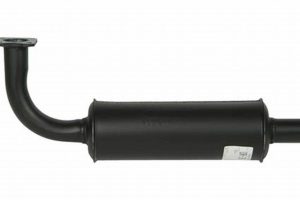
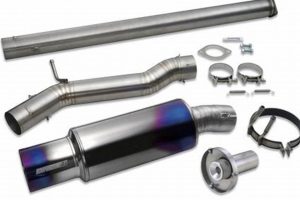
Engine rotational speed significantly impacts exhaust sound levels. An exhaust component designed to mitigate noise produced within specific operational ranges, particularly at elevated engine speeds, plays a critical role in vehicle acoustics. For example, a component engineered to reduce noise between 2000 and 3000 revolutions per minute (RPM) contributes to a more refined auditory experience for the driver and surrounding environment.
Effective management of exhaust noise provides numerous benefits, including compliance with regulatory noise standards and enhanced driver comfort. Historically, these components have evolved from simple baffles to sophisticated systems incorporating resonators and sound-absorbing materials. This evolution reflects increasing demands for quieter vehicles and advancements in acoustic engineering.
The following sections will delve into the principles governing the operation of these noise-reduction systems, explore various design considerations, and examine the materials utilized in their construction.
Maximizing Performance and Minimizing Noise
Optimizing the function of an exhaust noise reduction system requires careful consideration of several factors. The following tips outline essential elements for achieving both performance and acoustic objectives.
Tip 1: Accurate Measurement is Crucial. Precise evaluation of existing noise levels at various engine speeds is essential. Data logging equipment or calibrated sound level meters should be used to obtain reliable readings.
Tip 2: Select Appropriate Materials. The material used in the construction of the noise reduction system should be resistant to heat, corrosion, and vibration. Stainless steel or aluminized steel are common choices.
Tip 3: Optimize Resonance Chamber Design. Resonance chambers can effectively cancel out specific frequencies. Accurate calculation of chamber dimensions based on target frequencies is vital.
Tip 4: Consider Backpressure Effects. While reducing noise, it’s crucial to minimize backpressure. Excessive backpressure can negatively impact engine performance and fuel efficiency.
Tip 5: Regular Inspection and Maintenance. Periodic visual inspection for damage, corrosion, or loose connections is necessary. Promptly address any identified issues to maintain optimal performance.
Tip 6: Professional Installation Recommended. For complex systems, professional installation ensures proper fitment and function, minimizing potential performance drawbacks.
These tips emphasize the importance of data-driven design, material selection, and ongoing maintenance in achieving effective noise reduction without compromising vehicle performance.
The subsequent section will explore case studies illustrating the application of these principles in real-world scenarios.
1. Frequency cancellation

Frequency cancellation represents a core principle underlying the design and function of an effective exhaust silencing component. The objective is to counteract or neutralize specific sound frequencies generated within the engine’s operational range, particularly at defined revolutions per minute (RPM). When applied within an “RPM muffler,” this involves strategically engineering internal chambers and pathways to produce sound waves that are 180 degrees out of phase with the primary exhaust noise. These opposing waves interfere destructively, diminishing the overall sound level. For instance, if an engine produces a prominent drone at 2500 RPM, the muffler might be designed to generate a counter-frequency that attenuates this specific noise, resulting in a quieter driving experience.
The importance of frequency cancellation stems from its ability to target and minimize the most objectionable frequencies emanating from the engine. Without effective frequency cancellation, a muffler would primarily rely on sound absorption materials, which are less effective at low frequencies and can also increase backpressure. A well-designed system employing frequency cancellation not only reduces noise but can also be tuned to alter the exhaust note, achieving a desired sound profile without significantly impeding engine performance. Many aftermarket performance mufflers, for example, utilize Helmholtz resonators (a type of frequency cancellation device) to eliminate unwanted frequencies while allowing a more aggressive exhaust tone to pass through. The effectiveness relies heavily on accurate calculation and precise construction, as even small deviations in chamber dimensions can drastically alter the targeted frequencies and diminish the cancellation effect.
In summary, frequency cancellation is a critical aspect of RPM muffler design, enabling targeted noise reduction at specific engine speeds. Its successful implementation leads to a more refined and pleasant driving experience, regulatory compliance, and the potential for performance enhancement through careful tuning. The challenge lies in accurately predicting and counteracting complex sound frequencies across a wide range of RPMs, often requiring sophisticated modeling and testing. Understanding the principles of frequency cancellation is vital for both engineers designing these systems and consumers seeking to optimize their vehicle’s exhaust sound and performance.
2. Material Durability
Material durability is a paramount consideration in the design and longevity of an “RPM muffler.” The exhaust system, and specifically the muffler, endures extreme operating conditions, including high temperatures, corrosive gases, and mechanical vibrations. Selecting materials with inherent resistance to these factors is crucial for ensuring reliable performance and extended service life.
- Resistance to Thermal Degradation
Exhaust gases can reach temperatures exceeding 1000 degrees Fahrenheit, leading to material oxidation, warping, and fatigue. Stainless steel alloys, such as 304 or 409, are commonly employed due to their high-temperature strength and resistance to scaling. The specific alloy grade is chosen based on the anticipated operating temperature range. Insufficient heat resistance can lead to premature failure and a degradation of the muffler’s acoustic properties.
- Corrosion Resistance
Exhaust gases contain corrosive compounds such as sulfur dioxide and water vapor, which can attack the muffler’s internal surfaces. Aluminized steel provides a cost-effective solution for moderate corrosion resistance, while stainless steel offers superior protection. The presence of surface coatings, such as ceramic-based paints, can further enhance corrosion resistance, particularly in environments with high levels of road salt exposure.
- Vibration Fatigue
Engine vibrations transmitted through the exhaust system can induce cyclic stress on the muffler’s welds and structural components. Material selection must account for fatigue strength and damping characteristics. Using thicker gauge metal and implementing reinforced welds can mitigate the risk of vibration-induced failures. Internal baffling systems should also be designed to minimize resonant frequencies that could amplify vibration stresses.
- Acoustic Degradation Over Time
The sound-absorbing materials within the muffler, such as fiberglass packing or woven fabrics, can degrade over time due to heat, moisture, and vibration. This degradation reduces their sound-absorbing effectiveness, leading to increased noise levels. Selecting materials with high thermal stability and resistance to chemical breakdown ensures consistent acoustic performance throughout the muffler’s lifespan. Regularly replacing or repacking the muffler can restore its original sound-dampening capabilities.
The material durability directly impacts the long-term performance and acoustic characteristics of the “RPM muffler.” A comprehensive understanding of the operating environment and careful selection of materials are essential for designing systems that withstand the rigors of daily use and maintain their noise-reduction effectiveness. The choice of materials represents a crucial compromise between cost, performance, and longevity. The long term cost will be more if a low quality material are used.
3. Backpressure mitigation

Backpressure mitigation represents a critical design consideration in the context of an “rpm muffler,” as excessive exhaust restriction can negatively impact engine performance, particularly at higher engine speeds. Maintaining an optimal balance between noise reduction and exhaust flow is essential for maximizing both power output and fuel efficiency.
- Core Diameter Optimization
The internal core diameter of the “rpm muffler” directly influences exhaust flow. A smaller diameter increases backpressure, while a larger diameter reduces it. Engineering a specific diameter tailored to the engine’s displacement and power output characteristics is vital. For instance, a high-performance engine operating at elevated RPMs requires a larger diameter core to minimize flow restriction, whereas a smaller engine may tolerate a slightly reduced diameter for enhanced sound attenuation without significant performance loss. Incorrect diameter selection can result in either power loss due to excessive backpressure or insufficient noise reduction.
- Perforation Pattern Design
The perforated core design impacts exhaust flow and sound wave propagation. The size, density, and arrangement of the perforations determine the resistance to exhaust gas flow. A high perforation density reduces backpressure but can also diminish sound attenuation. Conversely, a low perforation density increases backpressure while enhancing noise reduction. Careful consideration must be given to the perforation pattern to achieve the desired balance between performance and sound levels. Advanced designs may incorporate variable perforation patterns, with larger holes strategically placed to optimize flow and smaller holes used for targeted noise cancellation.
- Internal Chamber Configuration
The internal chamber configuration within the “rpm muffler” significantly affects exhaust flow characteristics. Straight-through designs minimize backpressure but offer less sound attenuation compared to baffled designs. Baffled designs introduce flow restrictions, increasing backpressure while enhancing noise reduction. Hybrid designs, incorporating both straight-through sections and strategically placed baffles, represent a compromise between performance and sound levels. The design should consider resonance effects within the chambers. Well-tuned resonant chambers can selectively cancel specific frequencies while minimizing overall flow restriction.
- Surface Finish and Coating
The internal surface finish of the muffler affects exhaust flow. Rough surfaces increase friction and turbulence, contributing to backpressure. Polished or coated surfaces reduce friction and improve flow efficiency. Ceramic coatings, for example, provide a smooth, heat-resistant surface that minimizes flow restriction. The coating selection also takes into consideration chemical inertness to the by-products of the combustion process, extending longevity.
These facets highlight the intricate relationship between backpressure mitigation and the “rpm muffler’s” design. Achieving optimal performance necessitates a holistic approach, considering all factors that influence exhaust flow and sound attenuation. Properly addressing each aspect leads to a system that maximizes engine power while maintaining acceptable noise levels.
4. Resonance tuning

Resonance tuning constitutes a critical element in the design of an “rpm muffler,” influencing its ability to attenuate specific frequencies associated with engine operation at targeted revolutions per minute. The phenomenon of resonance occurs when the natural frequency of an object or system aligns with an external driving frequency, leading to amplified oscillations. In the context of an “rpm muffler,” carefully designed chambers and passages are employed to create acoustic resonators that counteract problematic engine noise frequencies. This is achieved by ensuring that the resonators’ dimensions produce resonant frequencies that are out of phase with the targeted engine noise, resulting in destructive interference and noise reduction. A practical example is the use of Helmholtz resonators within an “rpm muffler” to cancel out low-frequency drone often experienced at cruising speeds. The dimensions of the Helmholtz resonator’s cavity and neck are calculated to resonate at the specific drone frequency, thereby mitigating its impact.
The effectiveness of resonance tuning in an “rpm muffler” hinges on precise calculation and execution. Deviations from the intended resonant frequencies can lead to ineffective noise cancellation or even the amplification of undesirable frequencies. Furthermore, the operating characteristics of an engine are not static; as engine speed and load change, the dominant noise frequencies can also shift. Therefore, advanced “rpm muffler” designs may incorporate multiple resonators tuned to different frequencies or utilize variable geometry resonators that can adapt to changing engine conditions. Consider, for example, a vehicle used for both city driving and highway cruising. A fixed-frequency resonator might effectively cancel noise at highway speeds but be ineffective or even detrimental at lower city speeds. A variable resonator, however, could adjust its resonant frequency to provide optimal noise cancellation across a wider range of operating conditions. These techniques highlight the intricacies involved in practical design.
In summary, resonance tuning is an indispensable aspect of “rpm muffler” design, enabling targeted noise reduction at specific engine speeds. Accurate prediction and manipulation of resonant frequencies are essential for achieving effective and desirable acoustic characteristics. While the underlying principles are relatively straightforward, their application in real-world “rpm muffler” design necessitates sophisticated modeling, testing, and optimization to account for the complex and dynamic nature of engine noise. Overcoming the challenges of precise frequency targeting and adaptation to changing operating conditions are key to developing high-performance noise reduction systems that enhance the driving experience.
5. Acoustic absorption

Acoustic absorption plays a significant role in the functionality of an “rpm muffler” by reducing noise levels through the conversion of sound energy into heat. The effectiveness of an “rpm muffler” is directly influenced by the materials and design employed to maximize acoustic absorption.
- Fiberglass Packing Efficiency
Fiberglass packing, a common component in “rpm muffler” designs, functions by creating friction as sound waves pass through its porous structure. This friction converts the sound energy into thermal energy, diminishing the amplitude of the sound waves. The density and thickness of the fiberglass packing influence its absorptive capacity; denser packing generally absorbs higher frequencies more effectively, while thicker layers provide greater overall sound reduction. However, over-packing can increase backpressure, negatively impacting engine performance. Deterioration of fiberglass packing over time due to heat and moisture reduces its effectiveness, necessitating periodic replacement. The packing configuration, whether layered or uniformly distributed, also affects performance and longevity. Manufacturers often use specialized weaves of fiberglass to improve packing life and resistance to settling within the muffler.
- Acoustic Wool Applications
Acoustic wool, often made from basalt or mineral fibers, represents an alternative to fiberglass packing in “rpm muffler” designs. It offers superior thermal resistance and can withstand higher exhaust gas temperatures, extending its lifespan. Like fiberglass, acoustic wool absorbs sound energy through friction, converting it into heat. Different grades of acoustic wool vary in density and fiber diameter, influencing their frequency-specific absorption characteristics. Some “rpm muffler” designs incorporate multiple layers of acoustic wool with varying densities to achieve broadband noise reduction. Acoustic wool is more resistant to degradation from moisture and chemical exposure compared to fiberglass, making it suitable for demanding environments.
- Resonance Chamber Integration
While primarily functioning through frequency cancellation, resonance chambers within an “rpm muffler” can also contribute to acoustic absorption. The internal surfaces of these chambers are often lined with sound-absorbing materials to dampen reflected sound waves, reducing the overall noise level. The shape and dimensions of the resonance chambers influence the frequencies at which absorption is most effective. In designs utilizing Helmholtz resonators, for example, the chamber walls may be coated with a thin layer of acoustic foam to reduce the amplitude of standing waves within the resonator, enhancing its noise-canceling effect. The combination of frequency cancellation and acoustic absorption provides a synergistic approach to noise reduction in “rpm muffler” systems.
- Multi-Layered Absorption Techniques
Advanced “rpm muffler” designs often employ multi-layered absorption techniques to achieve broad-spectrum noise reduction. These designs incorporate multiple layers of different materials with varying densities and acoustic properties. For instance, an “rpm muffler” might feature an inner layer of high-density acoustic wool for absorbing low-frequency sounds, followed by a layer of fiberglass packing for attenuating mid-range frequencies, and an outer layer of perforated metal to diffuse high-frequency noise. This multi-layered approach optimizes noise reduction across a wide range of engine speeds and operating conditions. The specific combination of materials and layer thicknesses is carefully engineered to achieve the desired acoustic characteristics while minimizing backpressure and maximizing durability. Composite structures of metal and sound deadening polymer layers are also used in some designs.
The implementation of acoustic absorption within an “rpm muffler” requires careful consideration of material properties, design configurations, and operating conditions. Effective acoustic absorption minimizes noise levels, contributing to a more refined driving experience and compliance with noise regulations. The selection and arrangement of sound-absorbing materials represent a crucial aspect of “rpm muffler” design, balancing acoustic performance with durability and backpressure considerations.
6. Performance Optimization
Performance optimization, when considered in the context of an “rpm muffler,” represents a multifaceted engineering challenge that seeks to reconcile noise reduction with the preservation, or even enhancement, of engine power and efficiency. The fundamental trade-off lies in the inherent resistance to exhaust flow introduced by any muffler design. As the “rpm muffler” functions to attenuate sound waves, it inevitably presents an obstacle to the free flow of exhaust gases. The key is to minimize this restriction, ensuring that the engine can effectively expel combustion byproducts without undue impedance. An improperly designed “rpm muffler” can create excessive backpressure, leading to reduced volumetric efficiency, diminished power output, and increased fuel consumption. Consequently, performance optimization demands a meticulous balancing act, leveraging advanced acoustic principles and fluid dynamics to mitigate noise while preserving or improving engine performance across its operational RPM range.
A practical illustration of this optimization can be seen in the design of aftermarket performance “rpm mufflers.” These systems often incorporate straight-through designs, featuring a perforated core surrounded by sound-absorbing materials. This configuration minimizes flow restriction compared to baffled mufflers, allowing for higher exhaust gas velocities and reduced backpressure. Simultaneously, strategically placed resonators and carefully selected absorption materials target specific noise frequencies, achieving a balance between performance and noise control. For example, some manufacturers utilize computational fluid dynamics (CFD) simulations to model exhaust gas flow through the muffler, identifying areas of turbulence and pressure drop. These simulations guide design modifications aimed at streamlining the flow path and reducing backpressure. Real-world testing on dynamometers then validates the effectiveness of these modifications, quantifying any gains in power or torque.
In conclusion, performance optimization is not merely an ancillary consideration but an integral component of “rpm muffler” design. A well-optimized “rpm muffler” enhances the driving experience by reducing unwanted noise without compromising engine performance. It necessitates a comprehensive understanding of acoustics, fluid dynamics, and engine operation, coupled with rigorous testing and validation. The ongoing pursuit of performance optimization drives innovation in “rpm muffler” technology, leading to more efficient and effective noise reduction systems that cater to the diverse needs of vehicle manufacturers and consumers alike. The integration of electric exhaust valves in newer models further allow for the active management of exhaust flow and noise levels, representing a new era in performance and sound optimization.
Frequently Asked Questions About RPM Mufflers
The following questions and answers address common inquiries regarding the function, application, and maintenance of “rpm muffler” systems.
Question 1: What is the primary function of an RPM muffler?
An RPM muffler is designed to attenuate exhaust noise generated by an internal combustion engine, particularly within specific engine speed ranges. It achieves this through a combination of sound absorption, frequency cancellation, and baffling techniques, balancing noise reduction with minimal exhaust flow restriction.
Question 2: How does backpressure affect engine performance when using an RPM muffler?
Excessive backpressure created by a poorly designed RPM muffler can impede exhaust gas flow, reducing engine volumetric efficiency and power output, especially at higher RPMs. Optimized designs prioritize minimizing backpressure while maintaining effective noise reduction.
Question 3: What materials are commonly used in RPM muffler construction and why?
Stainless steel and aluminized steel are common materials due to their high-temperature resistance, corrosion resistance, and durability. Stainless steel offers superior longevity, while aluminized steel provides a more cost-effective alternative with adequate protection in many applications.
Question 4: How often should an RPM muffler be inspected and maintained?
Regular inspections are recommended at least every 6 months or 12,000 miles, whichever comes first. Maintenance should include visual checks for corrosion, damage, and loose connections. Replacement of internal packing material may be necessary to maintain optimal acoustic performance.
Question 5: Can an RPM muffler improve fuel efficiency?
While primarily focused on noise reduction, a well-designed RPM muffler that minimizes backpressure can contribute to improved fuel efficiency compared to a severely restrictive system. The degree of improvement depends on the engine’s specific characteristics and the original exhaust system’s performance.
Question 6: Are there any specific regulations governing RPM muffler noise levels?
Yes, noise regulations vary by jurisdiction. Many regions have established maximum permissible noise levels for vehicles, and RPM mufflers must comply with these standards. Aftermarket installations should be checked for compliance with local laws to avoid penalties.
Understanding the function, maintenance, and regulatory aspects of RPM mufflers is crucial for optimizing vehicle performance and ensuring compliance with legal requirements.
The following section will provide a comparative analysis of different RPM muffler types available in the market.
Conclusion
The preceding analysis elucidates the multifaceted nature of the “rpm muffler,” underscoring its significance in balancing engine performance and noise attenuation. From material selection and resonance tuning to backpressure mitigation and acoustic absorption, each element contributes to the overall effectiveness of the system. The integration of these engineering principles yields a component capable of meeting both regulatory standards and consumer expectations for a refined driving experience. The “rpm muffler” represents a critical intersection of mechanical engineering and acoustic design, demanding a meticulous approach to achieve optimal results.
As automotive technology continues to evolve, further advancements in “rpm muffler” design are anticipated. Research into novel materials, adaptive noise cancellation techniques, and integrated electronic control systems promises to enhance performance and reduce environmental impact. Continued attention to these areas is vital for ensuring that “rpm muffler” technology remains a cornerstone of vehicle design and regulatory compliance in the years to come. The ongoing pursuit of innovation in this field will undoubtedly shape the future of automotive acoustics and performance.