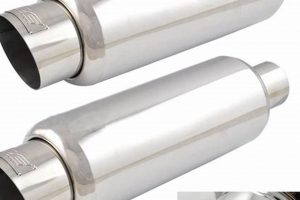
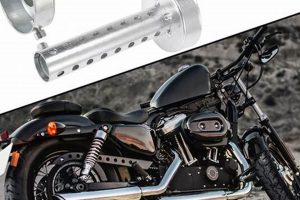
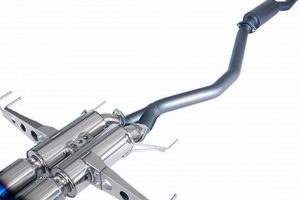
The components in a vehicle’s exhaust system play critical roles in managing engine noise and emissions. Two such elements are designed to attenuate sound, each utilizing different mechanisms to achieve this goal. One is typically a cylindrical chamber designed to reduce specific sound frequencies that create unwanted droning or humming. The other is a larger component that deals with a broader spectrum of frequencies, aiming for overall noise reduction. One is usually installed upstream of the other within the exhaust pathway.
The functionality of these parts contribute significantly to the driving experience and adherence to noise regulations. Their selection and integration within an exhaust system are crucial aspects of vehicle design. Historically, advancements in acoustic engineering have led to progressively more sophisticated designs, allowing for improved performance while minimizing noise pollution. The development of quieter vehicles contributes to increased comfort for both the driver and surrounding communities.
The following sections will delve into a comparison of these two components, examining their operational principles, structural differences, impact on vehicle performance, and factors to consider when choosing or replacing them.
Understanding the distinctions and applications of key exhaust system components is crucial for informed maintenance and performance optimization.
Tip 1: Prioritize Sound Frequency Reduction: When addressing specific droning or humming noises, consider the installation or replacement of the component designed to target particular frequencies. This can often be more effective than solely relying on general noise reduction measures.
Tip 2: Assess Overall Noise Reduction Needs: If the goal is to reduce the overall exhaust noise level, focus on the component designed for broad-spectrum sound attenuation. Consider options with varying levels of sound dampening based on desired sound characteristics.
Tip 3: Consider Engine Performance Impact: Be aware that alterations to the exhaust system can potentially affect engine performance. Ensure that replacements or modifications are compatible with the vehicle’s specifications and do not introduce excessive backpressure.
Tip 4: Inspect for Damage Regularly: Routine inspection for corrosion, leaks, or physical damage is essential for maintaining optimal exhaust system function and preventing costly repairs. Pay close attention to the welds and mounting points of each component.
Tip 5: Evaluate Material Quality: When selecting replacements, opt for components constructed from durable materials such as stainless steel. Higher-quality materials offer improved resistance to corrosion and prolonged lifespan.
Tip 6: Consult a Qualified Technician: For complex exhaust system issues or modifications, seek the expertise of a qualified automotive technician. Incorrect installation or mismatched components can lead to performance problems or regulatory violations.
Maintaining awareness of component-specific functionalities enables vehicle owners to make informed decisions regarding exhaust system maintenance and upgrades, leading to improved vehicle performance and noise management.
The subsequent section will present a comparative analysis of these components, outlining key considerations for selection and replacement.
1. Frequency Tuning
Frequency tuning represents a critical element in the design and functionality of both exhaust resonators and mufflers, albeit with differing application. The resonator is specifically engineered to target and mitigate particular sound frequencies that produce unwanted resonance or droning within the exhaust system. This is achieved through a carefully calibrated chamber that creates destructive interference, effectively canceling out the targeted frequencies. The size and shape of the resonator’s chamber are precisely determined to match the wavelength of the undesirable sound, ensuring optimal noise reduction at that specific frequency. A typical example involves the elimination of low-frequency drone commonly experienced at certain engine speeds. Incorrect tuning can render the resonator ineffective or even amplify unwanted frequencies.
In contrast, mufflers, while also influencing sound frequencies, primarily focus on broad-spectrum noise reduction. The design of the muffler may incorporate multiple chambers, baffles, or sound-absorbing materials to attenuate a wide range of frequencies. While frequency tuning principles apply in the design of specific muffler components, the primary objective is to diminish the overall noise level rather than eliminate specific resonant frequencies. For example, a chambered muffler is designed to reflect and redirect sound waves, resulting in a reduction across a broad frequency range. The precise impact on each frequency is less precisely controlled than in a resonator application.
The distinction in frequency tuning highlights the complementary roles of resonators and mufflers within an exhaust system. Resonators address specific, problematic frequencies, while mufflers provide overall noise suppression. An understanding of frequency tuning principles is essential for effectively diagnosing and resolving exhaust noise issues, as well as for optimizing the performance and sound characteristics of a vehicle’s exhaust system. This involves considering the engine’s operating characteristics, the vehicle’s intended use, and regulatory noise requirements.
2. Broadband Attenuation
Broadband attenuation, in the context of exhaust systems, refers to the reduction of noise across a wide spectrum of sound frequencies. The muffler is designed primarily for broadband attenuation. Its internal structure, often incorporating baffles, chambers, and sound-absorbing materials, disrupts sound waves across a range of frequencies. This approach contrasts with the targeted frequency cancellation employed by a resonator. An example of the importance of broadband attenuation is evident in vehicles subject to strict noise regulations. A muffler effectively reduces the overall exhaust volume to comply with legal limits, preventing excessive noise pollution. Failure to achieve adequate broadband attenuation can result in a vehicle exceeding permissible noise levels, leading to fines or restrictions.
The effectiveness of broadband attenuation in a muffler depends on several factors, including the design of the internal components, the type and amount of sound-absorbing material used, and the flow characteristics of the exhaust gas. Certain muffler designs prioritize low-frequency attenuation, while others focus on higher frequencies. Manufacturers often fine-tune these aspects to achieve a balance between noise reduction and exhaust flow. The choice of materials also plays a critical role. Dense, porous materials, such as fiberglass or steel wool, are commonly used to absorb sound energy and convert it into heat. Corrosion-resistant materials are essential to maintain performance over time, especially in harsh environmental conditions.
In summary, broadband attenuation is a crucial function performed by mufflers within exhaust systems. It addresses overall noise levels by attenuating a wide spectrum of sound frequencies, contributing to compliance with noise regulations and improved driving comfort. While resonators target specific frequencies, mufflers provide comprehensive noise reduction. The design, materials, and maintenance of mufflers directly impact their ability to provide effective broadband attenuation, influencing both the vehicle’s sound characteristics and its adherence to environmental standards.
3. Sound Wave Cancellation
Sound wave cancellation is a fundamental principle underpinning the operation of exhaust resonators. This process involves the deliberate generation of a sound wave that is equal in amplitude but opposite in phase to an undesirable sound wave. When these two waves combine, they destructively interfere, resulting in a reduction or elimination of the original sound. Resonators are designed to exploit this phenomenon to attenuate specific frequencies that contribute to unwanted exhaust noise, such as droning or humming. For instance, at a particular engine speed, a specific frequency may resonate within the exhaust system. A properly designed resonator will generate an opposing wave to neutralize this resonance. Failure to achieve precise sound wave cancellation renders the resonator ineffective, potentially exacerbating the targeted noise.
While mufflers also aim to reduce noise, they primarily rely on sound absorption and redirection rather than precise sound wave cancellation. Mufflers typically employ baffles, chambers, and sound-absorbing materials to dampen sound waves across a broad spectrum of frequencies. Although some degree of interference may occur within a muffler’s complex internal structure, it is not the primary mechanism for noise reduction. An example of this difference lies in the application: a resonator addresses a narrow band of frequencies causing a specific noise issue, whereas a muffler provides a general reduction in exhaust noise levels across the frequency range. Understanding this distinction is crucial when diagnosing exhaust noise problems and selecting the appropriate component for remediation.
In summary, sound wave cancellation is a core principle governing the functionality of exhaust resonators, enabling the targeted attenuation of specific sound frequencies. While mufflers reduce noise through broader means, the resonator relies on the precise generation and interference of sound waves. The effective implementation of sound wave cancellation within a resonator necessitates precise design and tuning to match the characteristics of the undesirable frequencies. A lack of understanding of the principle of destructive interference will leads to selection of wrong components.
4. Flow Restriction
Flow restriction represents a critical consideration in the design and selection of exhaust system components. Both resonators and mufflers, by their nature, introduce some degree of flow impedance. The extent of this impedance influences engine performance and exhaust sound characteristics. Minimizing flow restriction while achieving the desired noise attenuation is a key engineering challenge.
- Design and Internal Structure
The internal design of both components directly dictates the level of flow restriction. Resonators, typically employing a straight-through design with a perforated core surrounded by a resonating chamber, generally offer lower flow restriction compared to many muffler designs. Mufflers, often utilizing baffles and complex internal pathways to attenuate sound, inherently introduce greater flow impedance. The specific configuration of these internal elements, such as the size and number of baffles, significantly affects exhaust gas flow. A poorly designed muffler can create excessive backpressure, hindering engine performance.
- Impact on Engine Performance
Excessive flow restriction within the exhaust system increases backpressure on the engine. This backpressure reduces the engine’s ability to expel exhaust gases efficiently, leading to decreased horsepower and torque, particularly at higher engine speeds. Furthermore, increased backpressure can negatively impact fuel economy and increase engine operating temperatures. Therefore, selecting a resonator and muffler combination that minimizes flow restriction while achieving the desired sound characteristics is crucial for maintaining optimal engine performance. Aftermarket performance systems often prioritize reduced flow restriction, sometimes at the expense of increased noise levels.
- Material and Diameter Considerations
The material and diameter of the exhaust piping, as well as the resonator and muffler, influence flow restriction. Smaller diameter piping inherently creates greater resistance to flow. Smooth, mandrel-bent tubing minimizes turbulence and reduces flow restriction compared to crush-bent tubing. Similarly, the internal diameter of the resonator and muffler should be appropriately sized for the engine’s displacement and power output. Upgrading to larger diameter exhaust components can improve exhaust flow and reduce backpressure, particularly in performance applications. However, excessively large diameter piping can decrease exhaust gas velocity, potentially reducing low-end torque.
- Maintenance and Blockages
Over time, exhaust components can become clogged with carbon deposits and debris, increasing flow restriction. This is particularly relevant in older vehicles or those subjected to frequent short trips. Regular inspection and maintenance of the exhaust system, including the resonator and muffler, can help prevent excessive buildup and maintain optimal flow. Damaged or corroded components can also impede exhaust flow, necessitating replacement. Addressing exhaust leaks promptly is essential to prevent exhaust gas recirculation and maintain proper system pressure.
In conclusion, flow restriction is a critical factor to consider when evaluating resonators and mufflers. The design, materials, diameter, and maintenance of these components directly impact exhaust flow and, consequently, engine performance. Balancing noise attenuation with minimal flow restriction is a primary objective in exhaust system design. Informed selection and proper maintenance of these components are essential for optimizing both engine performance and sound characteristics.
5. Physical Size
The physical size of exhaust components directly influences their performance characteristics and installation constraints within a vehicle. The dimensions of both resonators and mufflers are dictated by their internal design, noise reduction goals, and the available space under the vehicle. Size considerations impact not only noise attenuation but also exhaust flow and overall vehicle packaging.
- Volume and Noise Reduction
Generally, a larger volume allows for greater noise attenuation. Within a muffler, larger chambers and increased surface area for sound absorption facilitate the reduction of a broader range of frequencies. A larger resonator can be tuned to cancel lower frequencies, often responsible for undesirable droning. However, physical size constraints under the vehicle often limit the maximum volume achievable for these components. In compact vehicles, smaller, more efficient designs are necessary to achieve acceptable noise levels without compromising ground clearance or other vehicle systems. This necessitates a trade-off between size and acoustic performance.
- Flow Restriction Considerations
While a larger volume can improve noise reduction, it can also lead to increased flow restriction if not properly designed. Internal baffles and convoluted pathways, often found in smaller mufflers attempting to maximize noise attenuation in a limited space, can significantly impede exhaust gas flow. This restriction can negatively impact engine performance by increasing backpressure. Conversely, a straight-through design in a resonator minimizes flow restriction, but it may require a larger physical size to achieve the desired level of noise cancellation. The diameter of the inlet and outlet pipes also influences flow, with smaller diameters inherently restricting exhaust gas movement.
- Installation and Vehicle Packaging
The available space under a vehicle dictates the maximum physical size of the exhaust components that can be installed. This is particularly relevant when retrofitting or upgrading exhaust systems. Larger mufflers or resonators may require modifications to the vehicle’s undercarriage or exhaust hangers to accommodate their dimensions. Ground clearance is also a critical consideration, as oversized components can reduce the vehicle’s ability to navigate uneven terrain. Therefore, careful measurement and consideration of the vehicle’s packaging constraints are essential before selecting or installing exhaust components.
- Material Weight and Durability
The physical size of an exhaust component is directly related to the amount of material used in its construction. Larger mufflers and resonators inherently weigh more, potentially adding to the vehicle’s overall weight. This increased weight can slightly impact fuel economy and handling. The material used also affects durability, with thicker gauge steel or stainless steel offering greater resistance to corrosion and physical damage. Larger components, particularly those constructed from heavier materials, require robust mounting to prevent vibration and premature failure. Therefore, size considerations also influence the long-term reliability and maintenance requirements of the exhaust system.
The interplay between physical size and performance characteristics is a defining aspect of exhaust resonator and muffler design. Balancing noise attenuation, flow restriction, installation constraints, and material considerations requires careful engineering. The selection of appropriate components necessitates a comprehensive understanding of these trade-offs to optimize both vehicle sound and overall performance.
6. Placement
The placement of components within an exhaust system significantly affects their functional effectiveness, particularly when considering resonators and mufflers. The positioning of each component is deliberately chosen to optimize its specific noise reduction capabilities. Resonators, designed to target specific frequencies, are often placed upstream of the muffler. This strategic placement allows the resonator to address resonant frequencies before the exhaust gases reach the muffler, which is responsible for broader noise attenuation. A typical configuration involves the resonator positioned closer to the engine to intercept and cancel out drone frequencies generated by the engine’s combustion process and exhaust pulses. The distance from the engine and the location relative to other exhaust components can significantly influence the resonator’s effectiveness. In certain vehicle designs, a resonator might be located further downstream due to space constraints or specific acoustic tuning requirements.
Mufflers, intended for broadband noise attenuation, are typically placed at the terminal end of the exhaust system. This downstream placement enables the muffler to address the remaining noise components after the resonator has mitigated specific frequencies. The muffler’s position also maximizes its impact on overall exhaust volume before the gases are released into the atmosphere. The proximity of the muffler to the tailpipe directly influences the perceived sound level outside the vehicle. Variations in muffler placement may occur based on vehicle architecture, exhaust routing, and aesthetic considerations, such as tailpipe design. However, the fundamental principle of downstream placement for final noise reduction remains consistent.
In summary, the placement of resonators and mufflers within an exhaust system is a critical factor in achieving optimal noise reduction and managing exhaust flow. Resonators, positioned upstream, target specific frequencies, while mufflers, located downstream, provide broadband attenuation. Understanding the rationale behind these placement strategies is essential for diagnosing exhaust noise issues, selecting appropriate replacement components, and optimizing exhaust system performance. Incorrect placement can negate the benefits of each component, leading to ineffective noise reduction and potentially impacting engine performance.
Frequently Asked Questions
The following questions address common inquiries regarding the function, selection, and maintenance of exhaust resonators and mufflers. The information provided is intended to clarify the roles of these components within a vehicle’s exhaust system.
Question 1: What is the primary difference between an exhaust resonator and a muffler?
An exhaust resonator primarily targets and attenuates specific sound frequencies, often those causing droning or humming noises. A muffler, conversely, reduces overall exhaust noise across a broader frequency range.
Question 2: Where are resonators and mufflers typically located within the exhaust system?
Resonators are generally positioned upstream of mufflers, closer to the engine, to address specific frequency issues early in the exhaust pathway. Mufflers are typically located at the end of the exhaust system to reduce overall noise levels before the gases exit the vehicle.
Question 3: How does the size of a resonator or muffler affect its performance?
Generally, a larger volume allows for greater noise attenuation. However, physical size constraints under the vehicle often limit the maximum volume achievable. Additionally, larger components can increase flow restriction if not properly designed.
Question 4: Can replacing a muffler or resonator affect engine performance?
Yes, both components introduce some level of flow restriction. Excessive restriction can increase backpressure, potentially reducing engine horsepower and torque. Selecting components with optimized flow characteristics is crucial.
Question 5: What materials are commonly used in the construction of resonators and mufflers?
Common materials include aluminized steel, stainless steel, and titanium. Stainless steel offers superior corrosion resistance and extended lifespan compared to aluminized steel.
Question 6: How can a vehicle owner determine if a resonator or muffler needs replacement?
Common indicators include excessive exhaust noise, the presence of rust or physical damage, and a noticeable decrease in engine performance. A thorough inspection by a qualified technician is recommended.
Understanding these key distinctions allows for informed decisions regarding exhaust system maintenance and modifications. Proper selection and upkeep of resonators and mufflers are essential for optimizing both vehicle sound and performance.
The subsequent section will provide a summary of the key takeaways from this discussion, reinforcing the critical differences and applications of exhaust resonators and mufflers.
Exhaust Resonator vs. Muffler
This exploration has delineated the distinct roles of the exhaust resonator and the muffler within a vehicle’s exhaust system. While both components contribute to noise reduction, they operate through fundamentally different mechanisms. The exhaust resonator targets specific sound frequencies, employing sound wave cancellation to mitigate undesirable resonance. The muffler, conversely, attenuates a broader spectrum of frequencies, reducing overall exhaust noise through absorption and redirection. Understanding these operational differences, their respective placement within the system, and their potential impact on exhaust flow is crucial for effective noise management and maintaining optimal engine performance.
The informed selection and maintenance of these components directly affect vehicle sound characteristics and adherence to regulatory noise standards. Continued advancements in acoustic engineering promise further refinement of exhaust system technologies. Therefore, a commitment to understanding and applying these principles will remain essential for automotive engineers, technicians, and vehicle owners seeking to optimize both the performance and environmental impact of their vehicles.