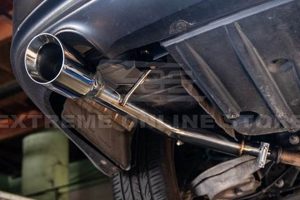
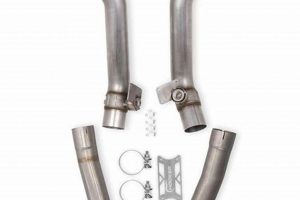
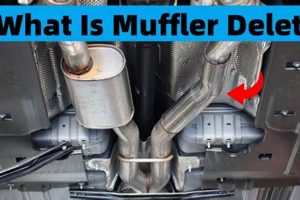
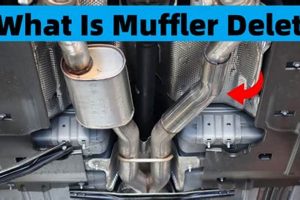
A component modification for the fifth generation (Mk5) Volkswagen GTI, this aftermarket part replaces the factory-installed muffler located on the turbocharger’s compressor outlet. The original equipment manufacturer (OEM) part is designed to reduce noise; its replacement aims to improve airflow. Examples of brands manufacturing these replacements include APR, CTS Turbo, and Integrated Engineering.
The perceived benefits center around enhanced throttle response and a slight increase in horsepower due to the reduction of backpressure. The OEM muffler is often seen as a restriction in the exhaust system. The aftermarket replacement provides a more direct path for the compressed air exiting the turbocharger. Early versions were simple cylindrical pipes; modern iterations often incorporate diverter valve recirculation ports to maintain proper function of the diverter valve, preventing compressor surge.
The subsequent discussion will cover installation considerations, potential drawbacks, impact on vehicle sound, and performance expectations when integrating this component into a Mk5 GTI. This analysis seeks to provide a balanced perspective on its suitability for various driving styles and performance goals.
Installation & Considerations
The following considerations are crucial when contemplating the integration of this component into a Mk5 GTI.
Tip 1: Research Compatibility: Verify the specific component’s compatibility with the Mk5 GTI’s engine code (e.g., BPY, CCTA). Not all aftermarket parts are universally compatible, even within the same vehicle generation.
Tip 2: Proper Installation: Ensure correct installation. This often involves removing the existing OEM part and securely attaching the replacement using appropriate clamps or hardware. Improper sealing can lead to boost leaks.
Tip 3: Diverter Valve Compatibility: If the replacement incorporates a diverter valve relocation port, ensure the diverter valve is properly reconnected and functioning as intended. Incorrect diverter valve operation can lead to performance issues or damage.
Tip 4: Boost Leak Testing: After installation, conduct a boost leak test to confirm that the system is properly sealed and there are no pressure leaks. This can be achieved using a pressure tester connected to the intake system.
Tip 5: Sound Considerations: Be aware that replacing the OEM muffler may alter the vehicle’s exhaust note. This change in sound can range from a subtle increase in turbocharger noise to a more pronounced whooshing sound upon throttle lift.
Tip 6: ECU Tuning: While not always necessary, optimizing engine control unit (ECU) parameters may unlock further performance gains. A professional tuner can adjust fuel and timing maps to complement the increased airflow.
Tip 7: Material Quality: Select a replacement manufactured from durable materials such as aluminum or stainless steel to resist corrosion and withstand high temperatures.
Careful consideration of these points will help ensure a successful installation and prevent potential issues related to performance or reliability.
The subsequent section will delve into the potential drawbacks associated with this modification.
1. Improved airflow

The primary rationale for replacing the factory turbocharger muffler with a delete kit on a Mk5 GTI centers on enhancing airflow. The OEM muffler is designed to reduce turbocharger noise, which inherently introduces restrictions in the air pathway. This restriction can impede the free flow of compressed air from the turbocharger, potentially limiting the engine’s ability to generate power efficiently. By removing the OEM muffler and installing a straight-through design, the resistance to airflow is reduced, leading to a more direct and less turbulent path for the compressed air. For example, dyno tests performed by aftermarket parts manufacturers often demonstrate a small but measurable increase in horsepower and torque, directly attributed to this improved airflow.
The increased airflow achieved through this modification has a direct impact on the engine’s volumetric efficiency. Volumetric efficiency refers to the engine’s ability to fill its cylinders with air during each intake stroke. When airflow is less restricted, the cylinders can fill more completely, leading to a more efficient combustion process. This improved combustion results in increased power output and potentially improved fuel economy, provided the engine management system is optimized to take advantage of the increased airflow. Examples of tuning modifications can lead to fuel adjustments, where a fuel is added or reduced based on the airflow entering the engine. The goal of tuning is to create the optimal air to fuel ratio needed for combustion to maximize the potential for this modification.
In conclusion, the enhancement of airflow is a foundational aspect of the modification. Removing the OEM turbocharger muffler provides a less restrictive air path, leading to increased engine performance and efficiency. While the gains may be subtle, the enhanced airflow creates a basis for further performance modifications and unlocks the full potential of the engine. The practical significance lies in optimizing the engine’s breathing capability, leading to improved overall performance characteristics.
2. Throttle response

Throttle response, representing the immediacy of engine reaction to accelerator pedal input, constitutes a frequently cited benefit of modifying the turbocharger muffler on a Mk5 GTI. The factory muffler, designed to attenuate turbocharger noise, inherently introduces a level of flow restriction. Eliminating this restriction is anticipated to enhance the engine’s responsiveness.
- Reduced Backpressure
The OEM muffler creates backpressure in the turbocharger system. This backpressure hinders the immediate outflow of compressed air. Removing this impediment facilitates a quicker pressure build-up in the intake manifold when the throttle is opened. The result is a faster engine response to driver input, minimizing lag.
- Minimized Turbulence
The internal design of the stock muffler can induce turbulence in the airflow. This turbulence disrupts the laminar flow of air, slowing its transit to the intake manifold. The modified component streamlines the airflow, allowing for a more direct and less turbulent path, thereby improving throttle response.
- Turbocharger Spool-Up
A decrease in backpressure caused by the replaced component can positively influence turbocharger spool-up time. By allowing exhaust gases to flow more freely, the turbine spins up more quickly, generating boost pressure earlier in the RPM range. This translates to improved low-end torque and enhanced throttle responsiveness, especially at lower engine speeds.
- Subjective Perception vs. Measurable Data
While some improvement may be measurable using specialized equipment, the enhanced throttle response often presents as a perceived improvement. The altered engine sound and faster boost response can lead to a more engaging driving experience. However, measurable gains may be marginal, emphasizing the subjective element of driver perception.
The combined effect of reduced backpressure, minimized turbulence, and improved turbocharger spool-up contributes to the perception and potential reality of enhanced throttle response on a Mk5 GTI. While measurable performance gains may vary, the altered driving experience often justifies the modification for enthusiasts seeking a more responsive vehicle.
3. Turbo noise
The alteration of turbocharger noise is a direct consequence of removing the OEM turbocharger muffler and replacing it with a delete kit on a Mk5 GTI. The factory-installed muffler is specifically designed to dampen and reduce the high-frequency sounds produced by the turbocharger’s compressor wheel. Its absence allows for a more audible manifestation of these noises. Examples include a more pronounced “whoosh” or “flutter” sound during throttle lift-off, and a generally increased presence of turbocharger whine under acceleration. This auditory change is often considered a desirable attribute by performance enthusiasts, signaling the enhanced functionality of the turbocharger system.
The increase in turbocharger noise is not merely an aesthetic preference; it provides auditory feedback that can aid in monitoring the turbocharger’s performance. Experienced drivers may use the distinct sounds to gauge boost levels, detect potential boost leaks, or assess the overall health of the turbocharger. However, it is important to acknowledge that excessively loud or unusual turbocharger noises can also indicate underlying mechanical issues, necessitating a thorough diagnostic evaluation. For instance, a high-pitched whistling sound could signify a boost leak, while a grinding noise might indicate bearing failure within the turbocharger itself. Therefore, a balanced understanding of the expected sounds versus atypical noises is crucial. A good benchmark is to understand the sounds before the delete and then listen to any change after the installation.
In summary, the amplified turbocharger noise resulting from the delete is an integral aspect of the modification. It represents a trade-off between sound reduction and enhanced auditory feedback, appealing to drivers seeking a more engaging driving experience. However, responsible implementation involves a clear understanding of normal turbocharger sounds and the ability to differentiate them from sounds indicative of potential mechanical problems. The increased noise then is just one aspect of the overall change and a good indicator if the modification was a success.
4. Installation complexity

The installation complexity associated with a component modification for the fifth-generation GTI varies according to mechanical aptitude and available resources. While conceptually straightforward, the process demands careful attention to detail. Novice individuals without prior experience in automotive repair might encounter difficulties, potentially leading to improper installation and subsequent performance issues. Access to appropriate tools, such as socket sets, wrenches, and potentially a vehicle lift or ramps, is essential for completing the task safely and efficiently. Furthermore, pre-existing corrosion or damaged fasteners can complicate the removal of the OEM part, requiring additional effort and specialized tools like penetrating oil or bolt extractors. For instance, a seized bolt on the OEM turbocharger muffler can extend the installation time significantly and increase the risk of damaging surrounding components.
Several factors contribute to the overall installation complexity. These include the accessibility of the turbocharger assembly within the engine bay, the specific design of the aftermarket replacement (some designs require more intricate mounting procedures), and the need to properly reconnect or relocate the diverter valve. Incorrect diverter valve connection can result in compressor surge or reduced boost pressure. A practical example involves installations where the replacement features a smaller diameter outlet than the OEM part, necessitating the use of adapter sleeves or shims to ensure a secure and leak-free connection. This illustrates the importance of verifying component compatibility prior to commencing the installation. Detailed step-by-step instructions, often available from the component manufacturer or online forums, can mitigate the difficulties encountered during the installation process.
In conclusion, the installation complexity of the modification for the fifth-generation GTI necessitates careful evaluation. While the modification can be undertaken by individuals with moderate mechanical skills, a thorough understanding of the procedure and access to the correct tools are crucial. Potential challenges, such as corroded fasteners or incompatible component designs, should be anticipated and addressed proactively. Ultimately, a cautious and methodical approach will contribute to a successful installation and optimal performance of the aftermarket part.
5. ECU Tuning
Electronic Control Unit (ECU) tuning represents a critical aspect of optimizing performance after the installation of a turbocharger muffler delete on a Mk5 GTI. The ECU governs various engine parameters, and modifying the exhaust system can necessitate adjustments to maintain optimal operation and realize the full potential of the aftermarket part.
- Air-Fuel Ratio Optimization
The factory ECU settings may not adequately compensate for the increased airflow resulting from the modification. Specifically, adjustments to the fuel maps are often required to maintain the ideal air-fuel ratio (AFR). Failure to do so can lead to a lean condition, potentially causing engine damage, or a rich condition, resulting in reduced fuel economy and performance. For example, a professional tuner can use a wideband oxygen sensor to measure AFR under various driving conditions and adjust the fuel delivery accordingly.
- Boost Pressure Calibration
The ECU controls boost pressure, and the alteration of exhaust flow dynamics introduced by the turbocharger muffler delete can influence the turbocharger’s boost characteristics. Optimizing the boost control parameters within the ECU can maximize the performance gains achieved by the modification. This often involves adjusting wastegate duty cycles to maintain stable boost levels across the RPM range, preventing overboost or underboost situations.
- Timing Advance Adjustments
Ignition timing plays a crucial role in engine performance and is directly affected by changes in airflow and boost pressure. Optimizing timing advance through ECU tuning can unlock additional horsepower and torque. However, it’s essential to exercise caution, as excessive timing advance can lead to engine knock or detonation, potentially causing severe engine damage. Experienced tuners utilize knock detection equipment to fine-tune timing settings safely.
- Fault Code Management
In some instances, the aftermarket replacement can trigger fault codes related to exhaust system performance or airflow readings. ECU tuning allows for the suppression or modification of these fault codes, preventing nuisance engine check lights and ensuring proper diagnostic functionality. The process involves remapping the values within the ECU to adjust for the increased airflow.
These facets highlight the necessity of considering ECU tuning as an integral component of enhancing performance of the GTI. Altering airflow dynamics via a modification necessitates corresponding adjustments to fuel delivery, boost pressure, ignition timing, and fault code parameters. Through careful optimization, a tuner can maximize the performance gains of the aftermarket part while maintaining engine reliability and drivability.
Frequently Asked Questions
This section addresses common inquiries concerning the modification, providing factual information and clarifying potential misconceptions.
Question 1: Does the installation of a turbo muffler delete void the vehicle’s warranty?
The impact on the vehicle’s warranty depends on the specific warranty terms and applicable laws. A modification can potentially void warranty coverage if it is determined that the modification directly caused a component failure. Consult the warranty documentation and applicable legislation for clarification.
Question 2: What is the expected horsepower gain from a turbo muffler delete on a Mk5 GTI?
The specific horsepower gain varies based on supporting modifications and tuning. Independent dyno tests often reveal marginal gains, typically in the range of 5-10 horsepower. The primary benefit is often perceived as improved throttle response rather than significant power increase.
Question 3: Will a turbo muffler delete cause compressor surge?
When correctly installed, a replacement incorporating a diverter valve relocation port should not induce compressor surge. Compressor surge occurs when the diverter valve is improperly connected or malfunctioning, creating a backflow of pressure onto the turbocharger’s compressor wheel. Proper diverter valve operation is essential.
Question 4: Is ECU tuning necessary after installing the delete?
While the vehicle will generally operate without ECU tuning, optimizing the engine control unit (ECU) can unlock further performance gains. A professional tuner can adjust fuel and timing maps to complement the increased airflow, maximizing power output and efficiency. Tuning is recommended for optimal results.
Question 5: How does the replacement impact the vehicle’s exhaust emissions?
In most regions, a turbo muffler delete does not directly impact emissions testing, as it does not alter the catalytic converter or other primary emissions control devices. However, consult local regulations to ensure compliance with emissions standards.
Question 6: What materials are commonly used in the construction of aftermarket turbo muffler deletes?
Aftermarket replacements are typically manufactured from durable materials such as aluminum or stainless steel. These materials resist corrosion and withstand the high temperatures encountered in the engine bay. Select a replacement constructed from a reputable material to ensure longevity.
In conclusion, the discussed aspects are designed to help navigate this modification.
Next, we explore potential drawbacks.
Conclusion
The preceding analysis has explored the component for the fifth-generation GTI, examining its purpose, installation considerations, benefits, and potential drawbacks. This modification, intended to enhance throttle response and airflow, necessitates a comprehensive understanding of its implications. From material selection to ECU tuning considerations, a successful implementation requires careful planning and execution.
Ultimately, the decision to proceed with the component for the fifth-generation GTI rests on individual priorities and technical competency. Prior to undertaking this modification, evaluate performance goals, mechanical aptitude, and potential consequences. The pursuit of increased performance should be balanced against the need for responsible vehicle modification and adherence to applicable regulations.