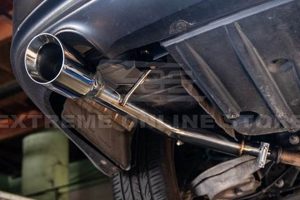
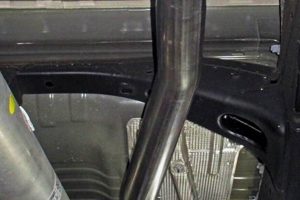
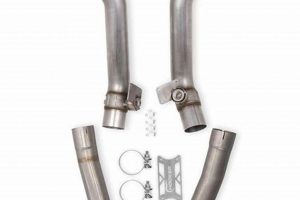
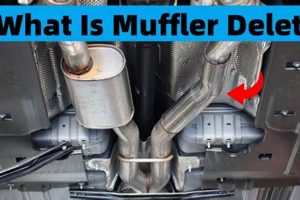
The removal of the factory-installed sound-dampening device from a Ram truck’s exhaust system, specifically to increase exhaust flow and alter the vehicle’s sound profile, is a modification frequently discussed within automotive circles. This process involves replacing the original component with a straight pipe or similar aftermarket alternative. For example, a Ram 1500 owner might elect to remove the component to achieve a more aggressive exhaust note.
Altering the exhaust system’s configuration provides a range of potential outcomes. Performance enhancements, such as improved horsepower and torque, are often cited. The amplified auditory experience is another significant draw for enthusiasts. Historically, modifications to exhaust systems have been a popular method for vehicle personalization and enhancing perceived performance.
The subsequent sections will delve into the potential performance implications, sound characteristics, legality, and installation considerations associated with this modification. Specific attention will be paid to the impact on fuel efficiency, potential drone issues, and relevant regulatory compliance factors.
Guidance Regarding Exhaust System Modification
The following points offer important considerations for individuals contemplating alterations to their Ram truck’s exhaust system. Careful evaluation of these factors is crucial before proceeding with any modifications.
Tip 1: Regulatory Compliance: Prior to any modifications, thoroughly research and understand local, state, and federal regulations pertaining to vehicle exhaust systems. Non-compliance can result in fines and mandatory vehicle inspections.
Tip 2: Performance Expectations: While some individuals report performance improvements, the actual gains may be minimal or even negligible on a stock engine. Consider dyno testing to accurately measure any changes.
Tip 3: Sound Characteristics: Altering the exhaust system will dramatically change the vehicle’s sound. Listen to sound clips of similar modifications to gauge whether the new sound profile aligns with preferences. Be mindful of potential noise ordinances in residential areas.
Tip 4: Potential for Drone: Certain modifications can induce an unpleasant resonance, known as “drone,” inside the vehicle’s cabin, especially at highway speeds. Research methods to mitigate drone, such as resonators or specific muffler designs.
Tip 5: Installation Considerations: The modification can be performed by a professional mechanic or by an experienced individual with the appropriate tools and knowledge. Incorrect installation can lead to leaks, decreased performance, or damage to other components.
Tip 6: Warranty Implications: Modifying the exhaust system may void the vehicle’s warranty, particularly for components directly affected by the change. Consult the warranty documentation and the dealership before proceeding.
Tip 7: Fuel Efficiency: Changes in exhaust flow dynamics can potentially influence fuel economy. Monitor fuel consumption patterns after the modification to assess any impact.
Thorough assessment of these factors is essential to make an informed decision regarding modifying a Ram truck’s exhaust system. Balancing performance, sound, legality, and practical considerations will lead to a satisfactory outcome.
The subsequent sections will explore the specific technical aspects of performing this modification, including tools, safety precautions, and troubleshooting techniques.
1. Aggressive Sound Profile
The pursuit of an aggressive sound profile is a primary motivator for many individuals contemplating alterations to a Ram truck’s exhaust system. The modification is often pursued to elicit a louder, more assertive exhaust note that deviates significantly from the factory-produced sound.
- Increased Volume
Removal of the sound-dampening component invariably results in a substantial increase in exhaust volume. The vehicle emits a louder roar, particularly during acceleration. This elevated noise level is a direct consequence of the unrestricted exhaust flow and the absence of a device designed to mitigate sound propagation. Examples include the shift from a subtle rumble to a prominent bellow when accelerating or idling, drastically changing the acoustic signature of the vehicle.
- Change in Tone
The modification alters the tonal characteristics of the exhaust. The engine’s inherent sound, typically muted by the OEM component, becomes more pronounced. This shift can manifest as a deeper, more resonant sound, often described as “throatier” or more “aggressive.” An example is a change from a relatively smooth sound at 2000 RPM to a deeper, rumbling sound at the same engine speed after modification.
- Perception of Performance
The intensified sound can create a subjective perception of increased engine performance. While the actual horsepower gains may be minimal, the auditory feedback can lead drivers to believe the vehicle is more powerful. This effect is purely psychological, but it represents a tangible benefit for some enthusiasts. An example is the increased confidence and perceived acceleration during highway merges or passing maneuvers.
- Potential Drawbacks
While the modification creates an aggressive sound profile, potential drawbacks exist. Increased volume may violate local noise ordinances, resulting in fines. The altered sound may also become tiresome on long drives. Furthermore, the amplified sound may attract unwanted attention from law enforcement. A real-world example is receiving noise violation warnings in residential areas or triggering vehicle inspections due to excessive sound levels.
In summation, the connection between achieving an aggressive sound profile and altering the factory exhaust system is direct. While the amplified and modified sound is desirable for some, careful consideration of the potential legal and practical consequences is essential.
2. Exhaust Flow Dynamics
The fundamental principle of exhaust flow dynamics directly influences the operational characteristics of an internal combustion engine. Removing the factory-installed muffler, a key component of the exhaust system, fundamentally alters the flow of gases exiting the engine. This change subsequently impacts engine performance and efficiency.
- Reduced Backpressure
The factory muffler, by design, introduces a degree of backpressure into the exhaust system. This backpressure is intended to optimize engine performance and emissions control. The removal of the muffler reduces backpressure, allowing exhaust gases to exit the engine more freely. This can potentially increase horsepower, especially at higher engine speeds. However, excessively low backpressure can also negatively impact low-end torque and scavenging efficiency. For instance, a Ram 1500 with a 5.7L Hemi engine might experience increased top-end power at the expense of low-speed responsiveness.
- Scavenging Efficiency
Scavenging refers to the process of removing exhaust gases from the cylinders during the overlap period when both intake and exhaust valves are partially open. Optimizing exhaust flow can enhance scavenging efficiency, leading to improved cylinder filling with fresh air and fuel mixture. Modifying the exhaust system, including the removal of the muffler, affects scavenging dynamics. Improper modifications can disrupt the balanced interaction between exhaust and intake cycles, thereby hindering overall performance. An example is a poorly designed exhaust system leading to incomplete combustion, reducing fuel efficiency and increasing emissions.
- Exhaust Gas Velocity
The velocity of exhaust gases significantly influences the overall performance of the exhaust system. Removing the muffler increases exhaust gas velocity due to the reduced flow restriction. While this can potentially improve engine performance, it is crucial to consider the overall design of the exhaust system. Optimal exhaust gas velocity maintains a balance between maximizing gas flow and minimizing turbulence. An unbalanced system might create areas of high and low pressure, adversely affecting engine efficiency. For example, an overly large exhaust pipe coupled with a muffler increases gas volume and decreases the gas velocity.
- Resonance and Wave Propagation
Exhaust systems are designed to manage sound waves and resonance. The muffler plays a critical role in damping sound waves and reducing noise levels. Removing it eliminates this damping effect, resulting in a louder exhaust note. However, this modification also affects the propagation of pressure waves within the exhaust system. These pressure waves can influence cylinder filling and scavenging. Poorly managed resonance can lead to performance issues and drone. A Ram 2500 with a Cummins diesel engine may experience significant drone at specific engine speeds after the removal of the muffler.
In conclusion, the removal has a cascading effect on exhaust flow dynamics. While there may be potential benefits such as increased horsepower, careful consideration must be given to the potential drawbacks, including reduced low-end torque, compromised scavenging efficiency, and increased noise levels. Optimizing exhaust flow requires a balanced approach, considering all the variables to achieve the desired outcome.
3. Potential Drone Issues
The removal of the factory-installed sound-dampening device from a Ram truck’s exhaust system frequently introduces an undesirable resonance known as “drone.” This phenomenon manifests as a low-frequency humming or booming sound within the vehicle’s cabin, particularly noticeable at cruising speeds. Drone arises from the amplification of specific exhaust frequencies when the muffler, designed to attenuate these frequencies, is absent. For instance, a Ram 1500 operating at 1800-2200 RPM might exhibit pronounced drone after this modification, negatively impacting the driving experience. The intensity of the drone varies depending on factors such as exhaust system design, vehicle configuration, and engine characteristics. The presence of drone directly diminishes the perceived quality and comfort of the vehicle, rendering it a significant concern for many vehicle owners considering this type of exhaust modification.
Mitigating drone often necessitates the installation of additional components, such as resonators, which are designed to cancel out specific sound frequencies. Careful selection of aftermarket exhaust components, including those advertised as “drone-free” or “drone-reducing,” is crucial. Online forums and user reviews can provide valuable insights into the real-world experiences of other vehicle owners who have performed similar modifications. Some individuals may find that the increased exhaust volume and altered tone outweigh the inconvenience of drone, while others prioritize minimizing in-cabin noise. Exhaust system design fundamentally shapes the overall outcome. Systems with larger diameter piping or different routing configurations can further exacerbate or reduce the prevalence of drone. A Ram 2500, for instance, may require a different resonator configuration than a Ram 1500 to effectively manage drone due to differing engine sizes and exhaust characteristics.
The existence and severity of drone serve as a critical consideration when evaluating the viability of removing the factory muffler. Understanding the potential for drone and proactively implementing mitigation strategies is essential for achieving a satisfactory outcome. Failure to address this issue can lead to driver dissatisfaction and a compromised driving experience, thereby negating many of the perceived benefits associated with the modification. Balancing the desired exhaust tone with the necessity of maintaining a comfortable cabin environment remains a central challenge in the modification process.
4. Legality and Compliance
Adherence to legal and regulatory standards is a paramount concern when considering modifications to a vehicle’s exhaust system. The removal of the factory-installed muffler from a Ram truck, while potentially appealing for its sound and performance enhancements, is subject to a complex web of federal, state, and local regulations. Failure to comply with these regulations can result in fines, failed vehicle inspections, and legal repercussions. Therefore, a thorough understanding of applicable laws is crucial before undertaking such a modification.
- Federal Noise Regulations
The U.S. Environmental Protection Agency (EPA) establishes baseline noise emission standards for motor vehicles. While the EPA primarily focuses on the manufacturers of new vehicles, these standards indirectly influence state and local regulations. The EPA requires vehicles to be equipped with functioning noise control devices, and tampering with these devices is generally prohibited. Although federal enforcement of individual vehicle modifications is rare, states often adopt similar regulations, making violations more likely. Removing a muffler could potentially be interpreted as tampering with a noise control device, thus violating federal guidelines.
- State and Local Noise Ordinances
State and local governments enact specific noise ordinances that regulate permissible noise levels within their jurisdictions. These ordinances often set decibel limits for vehicle exhaust systems, and enforcement typically falls to local law enforcement agencies. Many jurisdictions employ sound level meters to measure vehicle exhaust noise. Violations can result in fines, mandatory repairs to bring the vehicle into compliance, or even impoundment. For instance, some cities have strict noise limits during nighttime hours, making a modified exhaust system particularly problematic for residents in urban areas. Its important to consult state vehicle codes as well.
- Vehicle Inspection Requirements
Many states mandate periodic vehicle inspections to ensure compliance with safety and emissions standards. These inspections often include a visual inspection of the exhaust system to verify the presence and functionality of required components, including mufflers and catalytic converters. The absence of a muffler, or evidence of tampering with the exhaust system, can result in a failed inspection. A failed inspection can prevent vehicle registration renewal, effectively rendering the vehicle illegal to operate on public roads. Some inspection stations may use sound level meters to measure exhaust noise during the inspection process.
- Aftermarket Parts Certification
Some aftermarket exhaust components are designed to be compliant with noise regulations. These components often carry certifications indicating that they meet specific noise level standards. Installing a certified aftermarket part can provide a degree of legal protection. However, it is crucial to verify that the part is certified for use on the specific vehicle model and in the relevant jurisdiction. Simply installing a part labeled as “street legal” does not guarantee compliance. Thorough research and documentation are necessary to demonstrate compliance if challenged by law enforcement or during a vehicle inspection.
The intersection of legality and compliance with the modification highlights a delicate balance between personal preferences and societal responsibilities. It is important to realize that local and state laws can change overtime. While achieving a desired exhaust note and potentially improving performance may be attractive, the potential legal consequences and associated costs should not be overlooked. Prior to any exhaust modification, consulting with legal professionals and thoroughly researching applicable regulations is strongly advised.
5. Installation Complexity
The process of removing the factory-installed muffler from a Ram truck and replacing it with a straight pipe or aftermarket alternative involves a spectrum of technical considerations that define its installation complexity. The difficulty of this task varies depending on factors such as the installer’s experience, available tools, and the specific design of the vehicle and chosen replacement.
- Required Tools and Equipment
Successful completion necessitates access to a range of specialized tools. These typically include a socket set, wrenches (including potentially metric sizes), a cutting tool (such as a reciprocating saw or pipe cutter), and a welding apparatus if the replacement requires welding. Furthermore, safety equipment, including eye protection and gloves, is essential. The absence of appropriate tools can significantly increase the difficulty and risk of damage to the vehicle or injury to the installer. Example: attempting to cut the exhaust pipe with an inadequate tool can result in a jagged cut, making proper alignment and sealing problematic.
- Accessibility and Vehicle Configuration
The physical accessibility of the exhaust system components varies depending on the Ram truck model and year. Limited space, corroded fasteners, and the presence of heat shields can complicate the removal process. Some configurations may require the removal of additional components to gain adequate access. Example: on certain Ram models, the fuel tank proximity to the exhaust system necessitates careful heat management during cutting or welding to prevent fuel ignition.
- Cutting and Welding Requirements
The installation often involves cutting the existing exhaust pipe to remove the factory muffler. This process requires precision and skill to ensure a clean, square cut. Depending on the replacement component, welding may be necessary to secure the new pipe or connector. Welding requires specialized skills and equipment to create a strong, leak-free joint. Inexperienced individuals may struggle to achieve a proper weld, leading to exhaust leaks and compromised performance. Example: an improperly welded joint may crack over time due to stress and vibration, necessitating costly repairs.
- Alignment and Sealing
Proper alignment of the exhaust components is crucial to prevent leaks and ensure optimal performance. The replacement pipe must align correctly with the existing exhaust system to create a tight seal. Gaskets or exhaust clamps are typically used to create this seal. Improper alignment or inadequate sealing can result in exhaust leaks, reduced performance, and increased noise levels. Example: a misaligned connection can cause an audible hissing sound and a noticeable drop in engine power.
The multifaceted nature of the installation highlights the importance of careful planning and preparation. While some individuals may possess the skills and resources to perform this modification successfully, others may benefit from seeking professional assistance. The potential for complications and the need for specialized tools underscore the significance of accurately assessing the installation complexity before proceeding with the modification.
Frequently Asked Questions
This section addresses common inquiries and misconceptions surrounding the removal of the factory muffler from Ram trucks. The information presented aims to provide factual insights and informed perspectives on this modification.
Question 1: Is the modification legal for on-road use?
The legality of deleting the muffler varies depending on state and local regulations. Many jurisdictions have noise ordinances that the modification may violate. Always consult local laws before proceeding.
Question 2: Will removing the muffler increase engine horsepower?
While some perceive a performance gain, the actual horsepower increase is often minimal, especially on a stock engine. Any power gains are typically realized at higher RPMs and may not be noticeable in everyday driving conditions.
Question 3: What is the potential for exhaust drone after the modification?
Drone, a low-frequency resonance inside the cabin, is a common side effect. The severity of drone varies depending on exhaust system design and vehicle configuration. Resonators or specific muffler designs may mitigate this issue.
Question 4: Does the modification void the vehicle’s warranty?
The modification may void the vehicle’s warranty, particularly for components directly affected by the exhaust system. Consult the warranty documentation and the dealership before proceeding.
Question 5: Is specialized equipment required for installation?
The installation typically requires specialized tools, including cutting equipment and welding apparatus, depending on the replacement component. Improper installation can lead to leaks and performance issues.
Question 6: Will removing the muffler affect fuel efficiency?
The impact on fuel efficiency varies. Some report a minor decrease in fuel economy, while others experience no noticeable change. Monitor fuel consumption patterns after the modification to assess any impact.
The key takeaway is that while the modification can offer an enhanced exhaust note, potential drawbacks and legal considerations must be thoroughly evaluated. Informed decision-making is crucial for a satisfactory outcome.
The subsequent sections will delve into specific case studies and examples of Ram trucks with modified exhaust systems, providing practical insights into real-world performance and owner experiences.
Conclusion
This exploration of the term has detailed the multifaceted implications of this exhaust modification. Key areas examined include the potential for enhanced sound profiles, alterations to exhaust flow dynamics, the pervasive issue of drone, adherence to stringent legal and regulatory frameworks, and the technical complexities inherent in the installation process. Each aspect presents a critical decision point for vehicle owners considering this alteration.
Given the intricacies involved, responsible assessment and meticulous planning are paramount. Prospective modifiers must weigh the potential benefits against the drawbacks and ensure full compliance with applicable laws. The decision to implement this exhaust modification should be informed by thorough research, expert consultation when needed, and a clear understanding of the potential ramifications for both vehicle performance and legal standing. Proceed with caution and awareness.